AgricultureReport ID: MR-376Feb 2024415 PagesGlobal
Verified by the Meticulous Standard·Last verified: May 2026 by Prashant Bombe

Seed Treatment Market by Type (Chemical {Insecticides}, Biological), Form (Liquid, Dry), Function (Seed Protection, Seed Enhancement), Application Technique (Seed Coating, Seed Dressing), Crop Type (Cereals & Grains, Oilseeds) - Global Forecast to 2031

Published Date: Feb 2024
Format: PDF + Excel + Cloud Portal
Pages / Size: 415 Pages
Analyst: Prashant Bombe
Secure checkout · Full methodology disclosure · Underwritten by lead analyst Prashant Bombe
Seed Treatment Market Size
Seed Treatment Market Sizing & Sourcing
Base year: 2025 · CAGR: 7.2%
$5.86B
Market size 2025
$6.42B
Market size 2026
$12.84B
Forecast by 2036
7.2%
CAGR 2026–2036

Market Overview

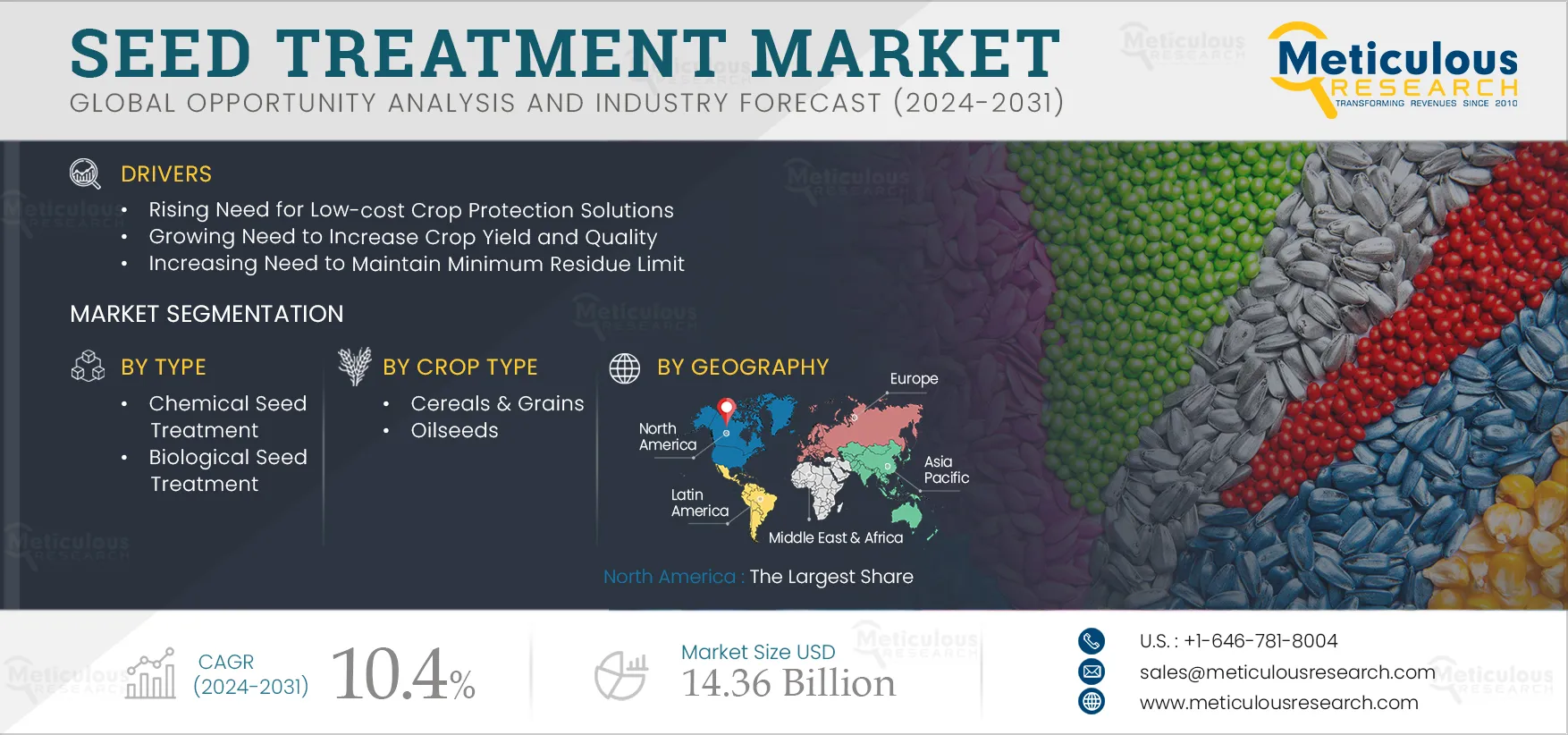
The market's expansion is fueled by the rising need for low-cost crop protection solutions, the growing need to increase crop yield and quality, and the increasing need to maintain minimum residue limit.

The growth of the market is also attributed to the advancements in seed treatment equipment, the rising costs of high-quality seeds (hybrid and GM seeds), the benefits offered by seed treatment, and the declining availability of agricultural land. However, challenges such as stringent and non-standardized regulations, financial hurdles for new entrants, restrictions on the use of neonicotinoids, and limited shelf-life of treated seeds hinder the market's growth to some extent.

The increasing focus on integrated pest management, the growing adoption of biological seed treatment, and the emergence of biodegradable seed coatings are further anticipated to generate opportunities for market growth. Nevertheless, the substantial challenges faced by stakeholders in this market are the complicated process of developing film coating for seed treatment and growing resistance to crop protection products.

Competitive Landscape

The report includes a competitive landscape based on an extensive assessment of the key strategic developments adopted by leading market participants in the industry over the past 3-4 years. The key players profiled in the Seed Treatment Market research report are Bayer AG (Germany), Syngenta AG (Switzerland) (a part of China National Chemical Corporation/ChemChina), BASF SE (Germany), Corteva Inc. (U.S.), UPL Limited (India), Nufarm Limited (Australia), FMC Corporation (U.S.), Tagros Chemicals India Ltd. (India), Germains Seed Technology (U.K.) (Part of Associated British Foods Plc), Verdesian Life Sciences, LLC (U.S.), Novozymes A/S (Denmark), Valent BioSciences LLC (U.S.), Croda International Plc (U.K.), and Precision Laboratories, LLC (U.S.).
Seed Treatment Market

Click here to: Get Free Sample Pages of this Report

Growing Need to Increase Crop Yield and Quality Drive the Growth of the Seed Treatment Market

The world population is growing rapidly. According to the Department of Economic and Social Affairs (UN), the global population is expected to reach 8.6 billion by 2030, 9.8 billion by 2050, and 11.2 billion by 2100. The growing global population places increased pressure on the world's resources to provide not only more but also different types of food. In addition to the increased demand, there has been a growing demand for nutrient-dense and residue-free food products due to rising health awareness, socio-economic changes, increased income, and rapid urbanization.

The agricultural sector plays a vital role in the stability of the global economy. The global demand and consumption of crops for food, feed, and fuel is increasing rapidly, subsequently driving the need to increase crop yield. Since crop yields are becoming increasingly important, the demand for cost-effective strategies to boost crop yields is also rising significantly. Furthermore, the declining availability of agricultural land has driven agricultural producers to become more efficient and productive to meet the global food demand.

According to the FAO, the demand for cereals for human consumption and animal feed is projected to reach 3 billion tonnes by 2050, an increase from 2.1 billion tonnes in 2018. In addition, the rising demand for biofuels will continue to exert upward pressure on commodity prices, affecting food security and poverty levels in developing countries. Thus, modern agricultural practices such as seed treatments with advanced technologies are necessary for breaking yield barriers and enhancing crop productivity to meet the global food demand while ensuring environmental safety.

Seed treatment helps in improving agriculture productivity as it protects the germinating seed and seedlings from seed-borne or soil-borne pathogenic organisms and storage insects. It also enables the uniform growth of crops in adverse conditions. These benefits increase the adoption of seed treatment globally, driving the growth of the global seed treatment market.

Key Findings in the Seed Treatme...

In 2024, the Chemical Seed Treatment Segment is Expected to Dominate the Global Seed Treatment Market by Type

Based on type, the global seed treatment market is segmented into chemical seed treatment and biological seed treatment. In 2024, the chemical seed treatment segment is expected to account for the larger share of the global seed treatment market. The significant market share of this segment is primarily attributed to its increasing use in developing countries, ease of availability, high efficiency, and lower costs compared to biological products.

However, the biological seed treatment segment is expected to register the highest CAGR during the forecast period of 2024–2031 owing to the growing environmental and public health concerns regarding the use of chemical seed treatment, the increasing adoption of organic farming, the high demand for chemical residue-free agricultural products, and the initiatives by governments worldwide to promote the use of biological seed treatment.

In 2024, the Liquid Form Segment is Expected to Dominate the Global Seed Treatment Market by Form

Based on form, the global seed treatment market is segmented into liquid and dry. In 2024, the liquid segment is expected to account for the larger share of the global seed treatment market. The significant market share of this segment is primarily attributed to its high usage by farmers due to ease of handling, better seed coverage, better performance, and higher effective duration (up to 6 months) than dry form (up to 3 months).

However, the dry segment is expected to register the highest CAGR during the forecast period of 2024–2031 owing to the benefits of dry form, such as ease of use and storage and low cost.

In 2024, the Seed Protection Segment is Expected to Dominate the Seed Treatment Market by Function

Based on function, the global seed treatment market is segmented into seed protection and seed enhancement. In 2024, the seed protection segment is expected to account for the larger share of the global seed treatment market. The large market share of this segment is mainly attributed to factors such as low cost, ease of handling, non-injurious to seed under prolonged storage, increasing effectiveness against all diseases, and compatibility with inoculants.

In 2024, the Seed Dressing Segment is Expected to Dominate the Seed Treatment Market by Application Technique

Based on application technique, the global seed treatment market is segmented into seed coating, seed dressing, and seed pelleting. In 2024, the seed coating segment is expected to account for the largest share of the global seed treatment market. The large market share of this segment is mainly attributed to the increasing need to protect seeds from external factors, such as fungi, parasites, pathogens, and extreme temperatures.

However, the seed dressing segment is expected to register the highest CAGR during the forecast period of 2024–2031, owing to the increasing development of seed dressing products and its growing preference in developed countries.

In 2024, the Cereals & Grains Segment is Expected to Dominate the Seed Treatment Market by Crop Type

Based on crop type, the global seed treatment market is segmented into cereals & grains, oilseeds, and other crops. In 2024, the cereals & grains segment is expected to account for the largest share of the global seed treatment market. The large market share of this segment is mainly attributed to the growing need to increase cereal & grain production, minimize cereal & grain loss due to pests and diseases, and their increasing use in animal feed, biofuel, and starch & ethanol production.

North America Dominates the Overall Seed Treatment Market

Based on geography, the global seed treatment market is majorly segmented into North America, Europe, East Asia, South & Southeast Asia, Australasia, Latin America, and the Middle East & Africa. In 2024, North America is expected to account for the largest share of the global seed treatment market. The significant market share in this sector can be attributed to the growing demand for high-yielding and disease-tolerant crops from domestic markets and export destinations. Moreover, factors such as an organized distribution chain for crop protection chemicals, the availability of water and land, entrepreneurial farmers, the growing awareness about sustainable crop production techniques to lessen environmental impact, and the presence of a large number of stakeholders support the growth of this market in the region.

In addition, the enhancing agronomic trends that comprise the development of high-quality seeds through the enhanced potential offered by genetically modified organisms (GMOs), changes in climatic conditions, flexibility in sowing approaches, and greater pressure from regulatory requirements support the growth of this regional market.

Market Research Summary

Particular

Details

Number of Pages

~415

Format

PDF

Forecast Period

2024–2031

Base Year

2023

CAGR (Value)

10.4%

Estimated Market Size (Value)

$14.36 Billion by 2031

Estimated Market Size (Volume)

NA

Segments Covered

By Type

  • Chemical Seed Treatment 
    • Insecticides
    • Fungicides
    • Other Chemical Seed Treatments
  • Biological Seed Treatment 
    • Microbial
      • Microbial-Based Biological Seed Treatment Market, by Microorganism Type
      • Microbial-Based Biological Seed Treatment Market, by Type  
        • Biofertilizers
          • Nitrogen-fixing Bacteria 
            • Rhizobia Bacteria
            • Azospirillum
            • Other Nitrogen-fixing Biofertilizers
          • Other Biofertilizers
        • Biopesticides
          • Bioinsecticides 
            • Bacillus Thuringiensis
            • Beauveria Bassiana
            • Lecanicillium Lecanii/Verticillium Lecanii
            • Metarhizium Anisopliae
            • Baculoviruses
            • Other Bioinsecticides
          • Biofungicides 
            • Trichoderma Viride
            • Pseudomonas
            • Bacillus
            • Streptomyces
            • Trichoderma Harzianum
            • Other Biofungicides
          • Bionematicides
            • Bacillus Firmus
            • Other Bionematicides 
          • Bioherbicides   
        • Biostimulants         
    • Biochemical
    • Other Biological Seed Treatments

By Form

  • Liquid
  • Dry

By Function

  • Seed Protection
  • Seed Enhancement

By Application Technique

  • Seed Coating
  • Seed Dressing
  • Seed Pelleting

By Crop Type

  • Cereals & Grains 
    • Corn
    • Wheat
    • Other Cereals & Grains 
  • Oilseeds 
    • Soybean
    • Cotton
    • Canola 
  • Other Crops

Countries Covered

North America (U.S., Canada), Europe (France, Germany, Italy, Spain, U.K., and Rest of Europe), East Asia (China, Japan, South Korea, and Rest of East Asia), South & Southeast Asia (India, Indonesia, and Rest of South & Southeast Asia), Australasia, Latin America (Brazil, Argentina, Mexico, Chile and Rest of Latin America), and Middle East & Africa

Key Companies

Bayer AG (Germany), Syngenta AG (Switzerland) (a part of China National Chemical Corporation/ChemChina), BASF SE (Germany), Corteva Inc. (U.S.), UPL Limited (India), Nufarm Limited (Australia), FMC Corporation (U.S.), Tagros Chemicals India Ltd. (India), Germains Seed Technology (U.K.) (Part of Associated British Foods Plc), Verdesian Life Sciences, LLC (U.S.), Novozymes A/S (Denmark), Valent BioSciences LLC (U.S.), Croda International Plc (U.K.), and Precision Laboratories, LLC (U.S.)

Frequently Asked Questions

How We Built This Intelligence

Table of Contents

Expand all

Access & Licensing

Choose how you access this intelligence — from a standalone data pack to organization-wide access. Every option is delivered within 24–48 hours and backed by analyst support.

Single User License
Instant access to full PDF report + Excel dataset.
$4,175
1–5 User Access
Full PDF Report + Excel Datasheets
1-Hour Analyst Call included
Free 10% Customization
POPULAR
Multi-User License
Instant access to full PDF report + Excel dataset.
$5,875
1–5 User Access
Full PDF Report + Excel Datasheets
1-Hour Analyst Call included
Free 10% Customization
Enterprise License
Instant access to full PDF report + Excel dataset.
$7,875
1–5 User Access
Full PDF Report + Excel Datasheets
1-Hour Analyst Call included
Free 10% Customization
Flexible Purchase Options
Buy the complete report, individual chapters, or only the data you need. Starting from $1,500.
Analyst-reviewed intelligence
Multi-source validation
Transparent methodology
Citation-ready data
Analyst assistance

Related Statistics & Insights

$6.57B
market value in 2023
$14.36B
projected market value by 2031
Cite this report
Meticulous Research. (2024). Seed Treatment Market - Global Opportunity Analysis and Industry Forecast (2024-2031) (Report No. MR-376). Meticulous Market Research Pvt. Ltd. https://meticulousresearch.com/reports/seed-treatment-market-5075
Custom Research

Need something more specific?

A custom-scoped study can target a single segment, geography, or competitor set — or answer a board-level question this syndicated report doesn't. Tell an analyst what decision you're making and we'll scope it.

Search Market Intelligence

Search across reports, blogs, press releases, and industries