AgricultureReport ID: MR-2163Sep 2026314 PagesGlobal
Verified by the Meticulous Standard·Last verified: May 2026 by Specialist Analyst

Bio-Based Nematicides Market Size, Share & Trends Analysis, by Source (Microbial, Bacterial Based, Fungal Based, Biochemical and Botanical, Neem Based, , Formulation (Liquid, Granular, and Wettable Powder and Dry), Crop Type, and Geography ΓÇö Global Forecast to 2036

Published Date: Sep 2026
Format: PDF + Excel + Cloud Portal
Pages / Size: 314 Pages
Analyst: Specialist Analyst
Secure checkout · Full methodology disclosure · Underwritten by lead analyst Specialist Analyst
Bio-Based Nematicides Market Size
Bio-Based Nematicides Market Sizing & Sourcing
Base year: 2025 · CAGR: 7.2%
$5.86B
Market size 2025
$6.42B
Market size 2026
$12.84B
Forecast by 2036
7.2%
CAGR 2026–2036

Market Overview

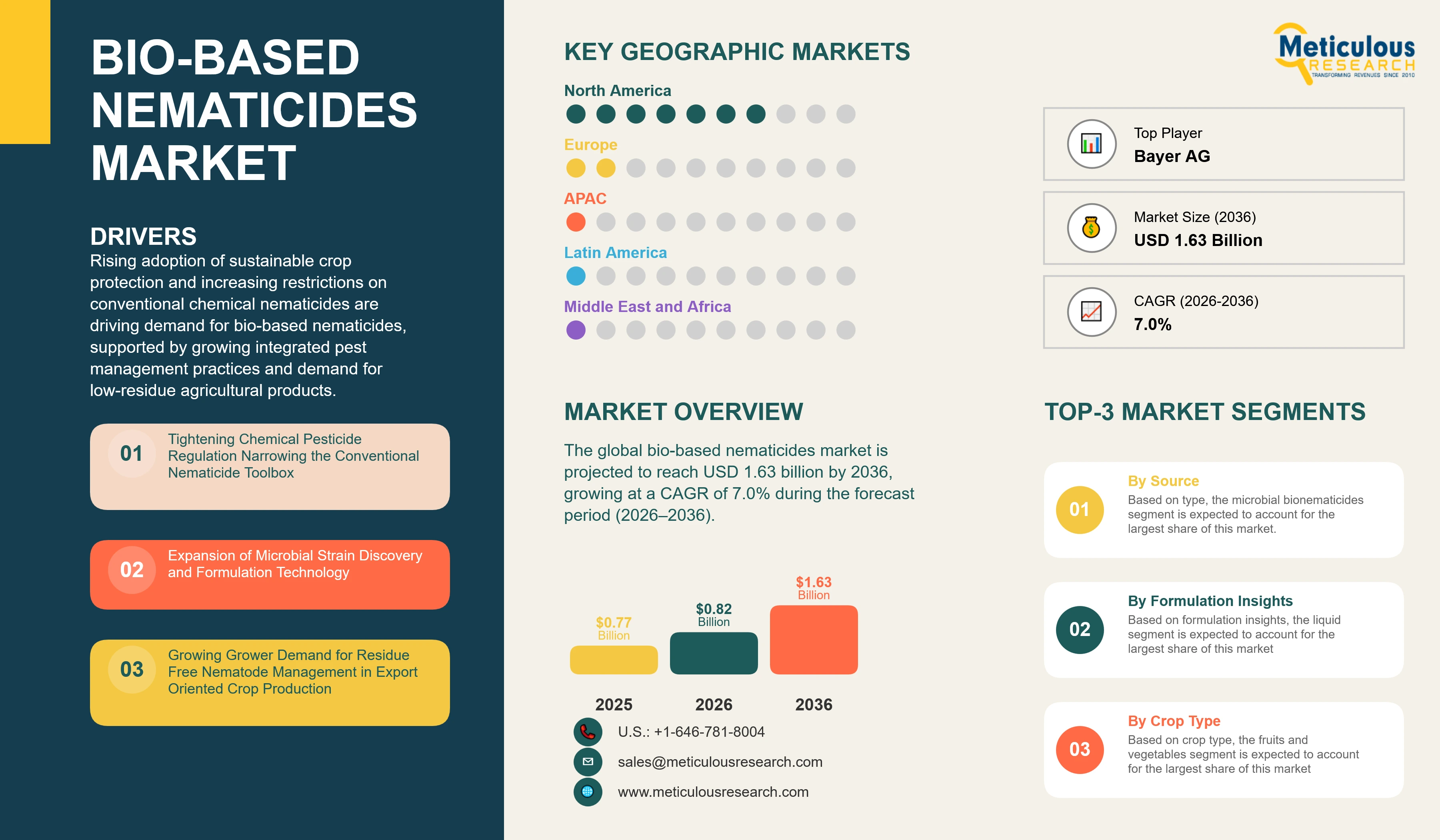
The global bio-based nematicides market was valued at USD 0.77 billion in 2025. The market is projected to reach USD 1.63 billion by 2036, growing from USD 0.82 billion in 2026 at a CAGR of 7.0% during the forecast period (2026–2036).

Key Highlights

  • The global bio-based nematicides market is projected to reach USD 1.63 billion by 2036.
  • The market is expected to grow at a CAGR of 7.0% during the forecast period 2026–2036.
  • The total bio-based nematicides market was valued at USD 0.77 billion in 2025 and is estimated to reach USD 0.82 billion in 2026.
  • North America is expected to dominate this market with the largest revenue share in 2026, supported by a large soybean, cotton, and specialty crop base affected by cyst and root knot nematode pressure, an established biological crop protection registration pathway through the U.S. Environmental Protection Agency, and the presence of leading biological input manufacturers with domestic fermentation and formulation capacity.
  • Asia Pacific is projected to witness the fastest revenue growth during the forecast period, driven by the large area under nematode susceptible crops such as rice, vegetables, and plantation crops across India, China, and Southeast Asia, government backed promotion of biological crop protection under national integrated pest management programs, and rising restrictions on older fumigant and organophosphate nematicide chemistries.
  • By source, the microbial bionematicides segment is expected to hold the largest share of the market in 2026, supported by the wide commercial availability of Bacillus firmus, Bacillus subtilis, and Purpureocillium lilacinum based products across row crop and horticultural applications.
  • By source, the biochemical and botanical bionematicides segment is projected to register the highest growth during the forecast period, driven by expanding use of neem based and other plant extract formulations in fruit, vegetable, and plantation crop nematode management programs.
  • By formulation, the liquid segment is expected to account for the largest share of the market in 2026, reflecting its compatibility with drip irrigation, chemigation, and in furrow application equipment already used for conventional crop protection products.
  • By formulation, the granular segment is projected to register the highest growth during the forecast period, supported by its ease of handling in seed treatment and soil applied programs for row crops.
  • By crop type, the fruits and vegetables segment is expected to account for the largest share in 2026, while the cereals and grains segment is projected to register the highest CAGR during the forecast period.
  • By geography, North America is expected to dominate the market in 2026, while Asia Pacific is expected to witness the fastest growth during the forecast period.

Executive Summary

Click here to: Get Free Sample Pages

The global bio-based nematicides market comprises biological crop protection products derived from microorganisms and plant-based compounds used to manage plant-parasitic nematodes in field, horticultural, and plantation crops. The market includes microbial bionematicides based on bacteria such as Bacillus firmus, Bacillus subtilis, and Pasteuria species; beneficial and nematode-antagonistic fungi such as Purpureocillium lilacinum and Trichoderma species; and biochemical or botanical products derived from neem and other plant extracts. These products are used across fruits and vegetables, cereals and grains, oilseeds and pulses, plantation and commercial crops, and turf and ornamentals.

Bio-based nematicides are applied as alternatives or complements to conventional chemical nematicides and can suppress nematodes through mechanisms such as root-zone colonization, parasitism of nematode eggs and juveniles, and disruption of nematode development. Plant-parasitic nematodes cause substantial economic losses, estimated at approximately USD 10 billion annually in the U.S. and more than USD 100 billion globally.

Market growth is supported by increasing restrictions on conventional pesticides, greater adoption of integrated pest management, and rising demand for lower-residue crop protection solutions. In the European Union, the Farm to Fork strategy established a policy target of reducing the use and risk of chemical pesticides by 50% by 2030. In the U.S., the Environmental Protection Agency regulates microbial and biochemical pesticides through its biopesticide framework and maintains a comprehensive database of registered active ingredients.

However, adoption remains constrained by variable field performance, slower activity compared with some conventional products, sensitivity of live microbial formulations to storage and handling conditions, and the need for greater grower awareness and technical guidance.

Market Growth Drivers

Tightening Chemical Pesticide Regulation Narrowing the Conventional Nematicide Toolbox and Accelerating Biological Substitution

The progressive restriction of conventional fumigant, organophosphate, and carbamate nematicides across major agricultural regulatory regimes represents one of the most significant structural drivers of the global bio-based nematicides market, shifting nematode management spending toward biological alternatives with fewer use restrictions and residue concerns. The European Union's Farm to Fork Strategy has set a binding direction toward reduced chemical pesticide use and expanded organic farmed area by 2030, placing sustained pressure on growers across European fruit, vegetable, and arable crop production to adopt biological nematode management tools ahead of further tightening of conventional active substance approvals.

In the United States, the Environmental Protection Agency's streamlined registration pathway for biochemical and microbial pesticides under its Biopesticides and Pollution Prevention Division continues to bring new nematode active biological products to market at a pace that outstrips new conventional nematicide registrations, reflecting both lower data generation burdens for naturally derived actives and sustained regulatory encouragement of biological pest management as a component of integrated pest management. This registration environment is expanding the commercial pipeline of bionematicide active ingredients available to growers across major row crop and specialty crop production regions.

Expansion of Microbial Strain Discovery and Formulation Technology Broadening the Commercial Bionematicide Product Base

Advances in microbial strain screening and fermentation technology are steadily expanding the range of bacterial and fungal species being commercialized for nematode management, moving the market beyond first generation Bacillus firmus and Purpureocillium lilacinum based products toward a broader portfolio that includes additional Bacillus species, Pasteuria based products, and Trichoderma based formulations with combined nematicidal and plant growth promoting activity. Leading biological crop protection manufacturers continue to expand fermentation capacity and combine microbial actives with proprietary metabolites to improve field consistency and extend the crop and geography coverage of their bionematicide portfolios.

In parallel, growing commercial interest in botanical and biochemical nematicides derived from neem and other plant extracts is broadening grower choice for residue sensitive fruit, vegetable, and export crop production, where biochemical actives offer a complementary mode of action to live microbial products and typically face a shorter regulatory review pathway in many jurisdictions.

Integration of Bionematicides into Seed Treatment and Digital Agronomy Programs Improving Grower Adoption

The incorporation of bionematicide actives directly into seed treatment platforms, alongside fungicide and insecticide seed treatment components, is improving grower convenience and adoption by embedding nematode protection into existing seed purchase and planting workflows rather than requiring a separate in season application decision. Leading agricultural input companies continue to expand Bacillus based biological seed treatment offerings for corn, cotton, soybean, and other row crops, positioning early season nematode and root protection as a standard component of integrated seed treatment packages.

Digital agronomy and precision application platforms are further supporting bionematicide adoption by helping growers identify field zones with elevated nematode pressure through soil sampling and yield mapping data, allowing more targeted and cost effective deployment of biological nematode management products relative to blanket field applications.

Segment Analysis

By Source: In 2026, the Microbial Bionematicides Segment to Dominate the Global Bio-Based Nematicides Market

Based on source, the bio-based nematicides market is segmented into microbial bionematicides and biochemical and botanical bionematicides. The microbial bionematicides segment is further categorized into bacterial based bionematicides, including products based on Bacillus firmus, Bacillus subtilis, and Pasteuria species, and fungal based bionematicides, including products based on Purpureocillium lilacinum and Trichoderma species. In 2026, the microbial bionematicides segment is expected to account for the largest share of this market. The leading position of this segment is attributed to the established commercial track record of Bacillus firmus and Purpureocillium lilacinum based products across major row crop and horticultural applications, the broad crop label coverage secured by leading manufacturers for these actives, and the compatibility of microbial bionematicides with existing soil applied and seed treatment application methods used by growers.

However, the biochemical and botanical bionematicides segment is projected to register the highest growth during the forecast period. The high growth of this segment is driven by expanding use of neem based and other plant extract formulations in residue sensitive fruit, vegetable, and export oriented plantation crop production, the generally simpler regulatory data requirements associated with biochemical actives in several jurisdictions, and growing grower interest in combining biochemical nematicides with microbial products as part of integrated nematode management programs.

By Formulation: In 2026, the Liquid Segment to Hold the Largest Share

Based on formulation, the bio-based nematicides market is segmented into liquid, granular, and wettable powder and dry formulations. In 2026, the liquid segment is expected to account for the largest share of this market. The growth of this segment is driven by the compatibility of liquid bionematicide formulations with drip irrigation, chemigation, and in furrow liquid application equipment that growers already use for conventional crop protection and fertigation programs, allowing straightforward integration of biological nematode management into existing farm operations without additional application equipment investment.

However, the granular segment is projected to register the highest growth during the forecast period. The high growth of this segment is driven by the increasing use of granular bionematicide formulations in seed furrow and soil incorporated applications for row crops such as corn, soybean, and cotton, where granular products offer easier handling, longer shelf stability for certain microbial actives, and simpler integration into planting time application programs relative to liquid alternatives.

By Crop Type: In 2026, the Fruits and Vegetables Segment to Hold the Largest Share

Based on crop type, the bio-based nematicides market is segmented into fruits and vegetables, cereals and grains, oilseeds and pulses, plantation and commercial crops, turf and ornamentals, and other crop types. In 2026, the fruits and vegetables segment is expected to account for the largest share of this market, reflecting the high value nature of horticultural production, the intensive and often continuous cropping patterns that elevate nematode pressure in vegetable and fruit systems, and the strong preference among fruit and vegetable growers for residue free and export compliant nematode management solutions.

However, the cereals and grains segment is projected to register the highest growth during the forecast period. The high growth of this segment is driven by the large cultivated area under nematode susceptible cereal and grain crops such as rice, wheat, and maize across Asia Pacific and parts of Africa, rising integration of bionematicide seed treatments into row crop planting programs in North America, and expanding government supported promotion of biological crop protection inputs in cereal producing economies.

Geographical Analysis

Based on geography, the overall bio-based nematicides market is segmented into North America, Europe, Asia Pacific, Latin America, and the Middle East and Africa. In 2026, North America is expected to account for the largest share of this market. This growth is driven by the extensive soybean, cotton, and specialty crop area across the United States that is exposed to significant nematode pressure, including from the soybean cyst nematode, an established and predictable biological pesticide registration pathway administered by the United States Environmental Protection Agency, and the presence of leading biological crop protection manufacturers with domestic fermentation, formulation, and distribution infrastructure.

However, the Asia Pacific bio-based nematicides market is expected to grow at the fastest rate from 2026 to 2036. The rapid growth of this market is driven by the large area under nematode susceptible rice, vegetable, and plantation crops across India, China, and Southeast Asia, government backed promotion of biological crop protection under national integrated pest management and organic farming programs, and tightening restrictions on older fumigant and organophosphate nematicide chemistries across several Asia Pacific markets. India's expanding biological crop protection manufacturing base, supported by domestic producers with established distribution networks across South Asia, is further broadening the region's addressable market for bionematicide products.

Europe represents a well-established and regulation led market for bio-based nematicides, supported by the Farm to Fork Strategy's chemical pesticide reduction target and organic farming expansion goal for 2030, alongside the region's broader plant protection product authorization framework. European specialty crop and organic vegetable growers continue to represent a significant and structurally growing addressable base for bionematicide adoption as chemical nematicide options narrow.

The Middle East and Africa region represents a growing market for bio-based nematicides, supported by expanding protected cultivation and export oriented fruit and vegetable production in Gulf Cooperation Council countries and parts of North and East Africa. The Latin America market is supported primarily by soybean, fruit, and vegetable production in Brazil, Mexico, and Argentina, where growing biological crop protection manufacturing presence is expanding local availability of bionematicide products.

Key Companies

The global bio-based nematicides market is moderately fragmented, with competition driven by strain and active ingredient portfolio breadth, fermentation and formulation capability, regulatory registration coverage across crops and geographies, and the strength of grower facing agronomy and distribution networks. Large diversified crop protection companies including Bayer AG, BASF SE, Corteva, Inc., Syngenta Crop Protection AG, FMC Corporation, and UPL Limited compete through combined conventional and biological nematicide portfolios, extensive global registration coverage, and integrated seed treatment and crop protection distribution networks. Specialist biological crop protection manufacturers including Certis Biologicals, Bioceres Crop Solutions Corp., Valent BioSciences LLC, Koppert B.V., Andermatt Group AG, and Novonesis A/S compete through focused microbial strain development, dedicated fermentation infrastructure, and deep agronomic application expertise. American Vanguard Corporation and Biobest Group NV maintain competitive positions through established biological input portfolios and grower distribution relationships in North America and Europe respectively, while T. Stanes and Company Limited, Biotech International Limited, and Isagro S.p.A. maintain strong regional positions in South Asian and European specialty crop markets through localized manufacturing and formulation capabilities.

The report provides a comprehensive competitive analysis based on an assessment of key players' product portfolios, geographic presence, and strategic initiatives undertaken over the past few years.

Some of the key players operating in the global bio-based nematicides market include Bayer AG (Germany), BASF SE (Germany), Corteva, Inc. (U.S.), Syngenta Crop Protection AG (Switzerland), FMC Corporation (U.S.), UPL Limited (India), Certis Biologicals (U.S.), Bioceres Crop Solutions Corp. (Argentina), Valent BioSciences LLC (U.S.), Koppert B.V. (Netherlands), Andermatt Group AG (Switzerland), Novonesis A/S (Denmark), American Vanguard Corporation (U.S.), T. Stanes and Company Limited (India), Nufarm Limited (Australia), and Sumitomo Chemical Co., Ltd. (Japan), among others.

Market Research Summary

Parameters

Details

Market Size by 2036

USD 1.63 Billion

Market Size in 2026

USD 0.82 Billion

Market Size in 2025

USD 0.77 Billion

Revenue Growth Rate (2026–2036)

CAGR of 7.0%

Dominating Source

Microbial Bionematicides

Fastest Growing Source

Biochemical and Botanical Bionematicides

Dominating Formulation

Liquid

Fastest Growing Formulation

Granular

Dominating Crop Type

Fruits and Vegetables

Fastest Growing Crop Type

Cereals and Grains

Dominating Geography

North America

Fastest Growing Geography

Asia Pacific

Base Year

2025

Forecast Period

2026 to 2036

Frequently Asked Questions

How We Built This Intelligence

Table of Contents

Expand all

Access & Licensing

Choose how you access this intelligence — from a standalone data pack to organization-wide access. Every option is delivered within 24–48 hours and backed by analyst support.

Single User License
Instant access to full PDF report + Excel dataset.
$4,175
1–5 User Access
Full PDF Report + Excel Datasheets
1-Hour Analyst Call included
Free 10% Customization
POPULAR
Multi-User License
Instant access to full PDF report + Excel dataset.
$5,875
1–5 User Access
Full PDF Report + Excel Datasheets
1-Hour Analyst Call included
Free 10% Customization
Enterprise License
Instant access to full PDF report + Excel dataset.
$7,875
1–5 User Access
Full PDF Report + Excel Datasheets
1-Hour Analyst Call included
Free 10% Customization
Flexible Purchase Options
Buy the complete report, individual chapters, or only the data you need. Starting from $1,500.
Analyst-reviewed intelligence
Multi-source validation
Transparent methodology
Citation-ready data
Analyst assistance

Related Statistics & Insights

$0.77B
market value in 2025
$1.63B
projected market value by 2036
7.0%
compound annual growth rate
$10billion
annually in the U.S
Cite this report
Meticulous Research. (2026). Bio-Based Nematicides Market - Global Opportunity Analysis and Industry Forecast (2026-2036) (Report No. MR-2163). Meticulous Market Research Pvt. Ltd. https://meticulousresearch.com/reports/bio-based-nematicides-market-6846
Custom Research

Need something more specific?

A custom-scoped study can target a single segment, geography, or competitor set — or answer a board-level question this syndicated report doesn't. Tell an analyst what decision you're making and we'll scope it.

Search Market Intelligence

Search across reports, blogs, press releases, and industries