- Home
- Reports
- Agriculture
- Gene-Edited Seeds Market
Gene-Edited Seeds Market Size, Share, Trends & Forecast Analysis by Editing Technology (CRISPR-Cas9, CRISPR-Cas12a, Base Editing, Prime Editing, Oligonucleotide-Directed Mutagenesis, TALEN), Trait (Herbicide Tolerance, Disease & Pest Resistance, Yield & Compositional Improvement, Abiotic Stress Tolerance), Crop Type, Regulatory Category, End User, and Geography ΓÇö Global Forecast to 2036
Market Overview
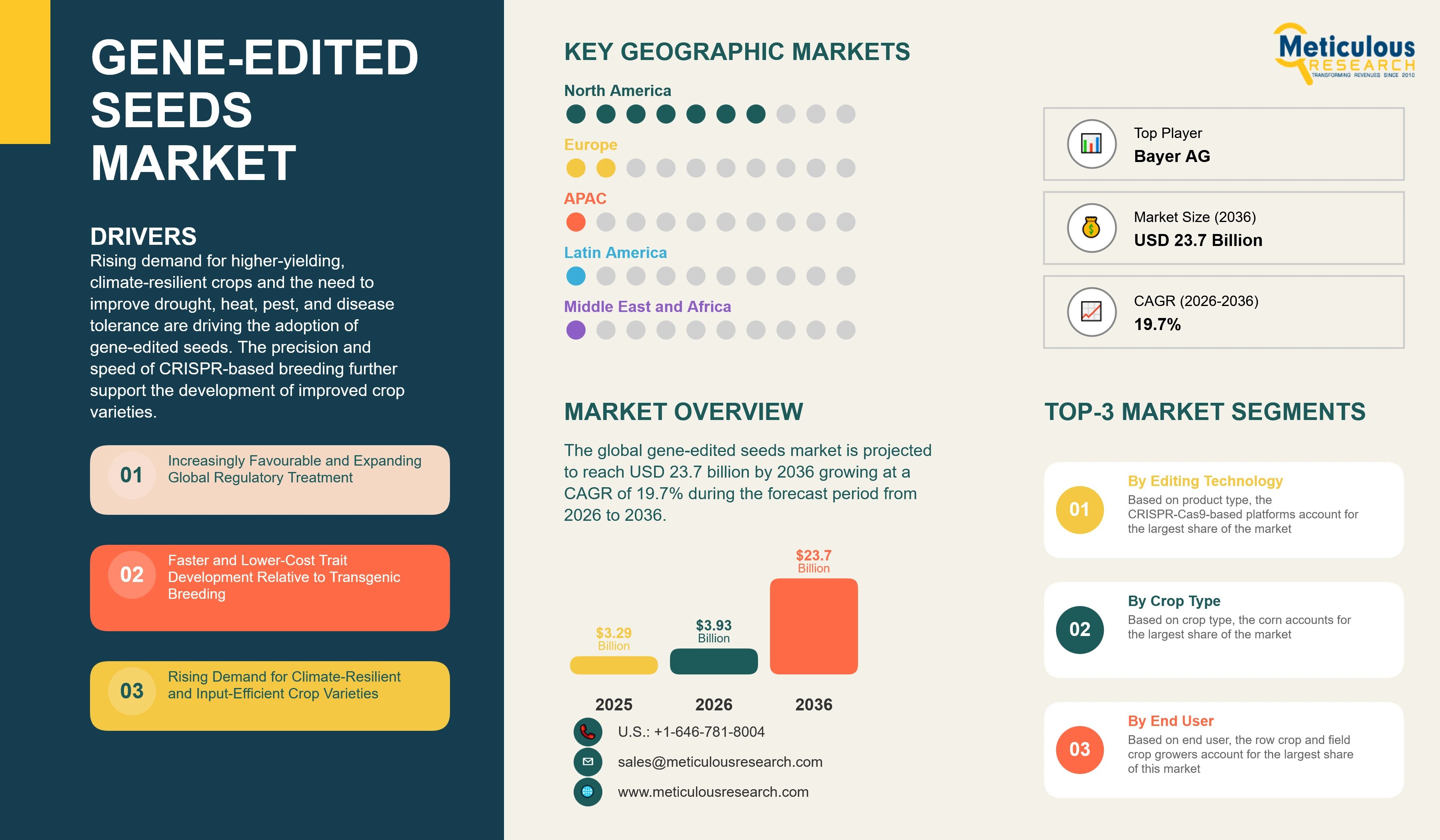
The global gene-edited seeds market is projected to reach USD 23.7 billion by 2036 from an estimated USD 3.93 billion in 2026, at a CAGR of 19.7% during the forecast period from 2026 to 2036. Row crop applications in corn, soybean and wheat account for the largest share of market value through most of the forecast period, reflecting the scale of acreage already served by Corteva, Bayer, BASF and Syngenta's gene editing pipelines, while specialty and horticultural crops developed through licensed trait platforms represent the fastest growing category as companies such as Pairwise, Tropic Biosciences and Cibus extend gene editing beyond staple row crops.
Key Highlights
- The global gene-edited seeds market is projected to reach USD 23.7 billion by 2036 from an estimated USD 3.93 billion in 2026, at a CAGR of 19.7% during the forecast period from 2026 to 2036, driven by faster trait development timelines relative to conventional breeding, an expanding and increasingly supportive regulatory landscape, and rising demand for climate-resilient, input-efficient crop varieties.
- On December 2, 2024, the U.S. District Court for the Northern District of California vacated USDA APHIS's May 2020 biotechnology rule. APHIS subsequently reinstated the pre-2020 regulatory framework, restarting the permitting and "Am I Regulated?" processes in January 2025, notifications in February 2025, and petitions in March 2025. Regulatory Status Review responses, Confirmation Request responses, and active permits issued before December 2, 2024, remain valid.
- On June 17, 2026, the European Parliament gave final approval to new rules governing plants obtained through certain new genomic techniques (NGTs). The framework establishes two categories: NGT-1 plants with genetic changes comparable to those achievable through conventional breeding, which receive a lighter regulatory treatment, and NGT-2 plants, which remain subject to the EU's GMO framework and risk assessment requirements. The regulation will apply two years after its entry into force.
- The UK's Genetic Technology (Precision Breeding) Regulations 2025 took effect on November 13, 2025, operationalising the Genetic Technology (Precision Breeding) Act 2023 and establishing a two-tier Defra and Food Standards Agency authorisation pathway that makes England the first major European economy with a dedicated regulatory framework for gene-edited plants.
- In India, SDN-1 and SDN-2 genome editing that does not introduce foreign DNA has been exempted from the applicable provisions of the country's GMO regulatory framework. This pathway has supported the development of India's first genome-edited rice varieties, DRR Rice 100 (Kamala) and Pusa DST Rice 1, developed by ICAR using CRISPR-Cas technology.
- In China, the Ministry of Agriculture and Rural Affairs issued new guidelines for the safety evaluation of gene-edited plants in 2022. In December 2024, MARA issued five new biosafety certificates for gene-edited events for domestic cultivation and processing, including the country's first gene-edited rice event.
- Corteva's CRISPR-edited Waxy Corn, which modifies the plant's own DNA without introducing foreign DNA, has received a USDA determination that it is not regulated under USDA Biotechnology Regulatory Services, supporting its commercialization pathway in the U.S. The company is also advancing gene-editing applications for traits including disease resistance.
- Corteva announced in April 2026 the executive leadership team for its future advanced seed and genetics company, previously referred to as "SpinCo." In May 2026, Corteva announced that the business would operate under the name Vylor, Inc. following its planned separation in the fourth quarter of 2026. Vylor's innovation portfolio includes gene editing, advanced germplasm, multi-disease-resistant corn, and other next-generation agricultural technologies.
- Cibus, formed through the 2023 merger of Calyxt and Cibus, is commercialising herbicide-tolerant rice traits in Latin America through a January 2026 letter of intent with Interoc, followed by an import permit in March 2026 and the transfer of gene-edited trait material into Interoc's rice seed lines in May 2026.
Executive Summary

Click here to: Get Free Sample Pages
A gene-edited seed is a seed developed using precision genome-editing technologies, such as CRISPR-Cas9, CRISPR-Cas12a, base editing, prime editing, TALENs, or oligonucleotide-directed mutagenesis, to make targeted changes to a plant's genome. Unlike conventional transgenic approaches, many gene-editing applications modify the plant's existing DNA without introducing foreign genetic material, although certain editing approaches can involve targeted DNA insertion or replacement. This distinction has contributed to differentiated regulatory treatment for certain gene-edited crops in a growing number of jurisdictions, although the specific requirements vary by country. The category spans staple row crops such as corn, soybean, wheat, rice, and canola, where large diversified seed companies play a major role in commercialization, as well as specialty and horticultural crops such as bananas, tomatoes, berries, and mushrooms, where technology-focused developers increasingly work with established seed, agricultural, and food-industry partners.
The competitive landscape reflects two broad business models. Diversified agricultural companies, including Corteva, Bayer, BASF, Syngenta, KWS SAAT, and Groupe Limagrain, integrate gene editing into their existing germplasm, breeding, and trait-development pipelines, alongside conventional breeding and, in some markets, transgenic products. A second group comprises specialized gene-editing and plant-biotechnology companies, including Cibus, Pairwise, Inari Agriculture, Tropic Biosciences, KeyGene, and Qi Biodesign. These companies use different commercial models, ranging from developing and commercializing their own edited seed products to licensing gene-editing technologies and traits or collaborating with established seed companies. Inari, for example, combines AI-powered predictive design with multiplex gene editing to develop commercial seed solutions, while KeyGene provides gene-editing and other plant-breeding technologies through licensing arrangements. Corteva's September 2024 $25 million investment in Pairwise and the formation of a joint venture illustrate the increasing collaboration between diversified seed companies and specialized gene-editing technology developers.
Regulatory treatment continues to diverge by geography, although several jurisdictions have established pathways that distinguish certain gene-edited plants from conventional transgenic GMOs. In the United States, USDA APHIS's 2020 SECURE rule was vacated by a federal court in December 2024, returning APHIS to its pre-2020 biotechnology regulatory framework while the agency works through the resulting regulatory transition. The European Union adopted a new regulatory framework for plants obtained through certain new genomic techniques in 2026, establishing NGT-1 and NGT-2 categories. NGT-1 covers plants with a limited number and type of genetic changes that could have been achieved through conventional breeding, while NGT-2 covers other NGT plants and retains more extensive regulatory requirements. The United Kingdom has established a separate precision-breeding framework for England, while India provides a regulatory pathway for certain SDN-1 and SDN-2 genome-edited plants that do not contain exogenous DNA. China has also established dedicated safety-evaluation guidelines for gene-edited plants. Consequently, gene-edited seeds do not receive uniform regulatory treatment globally; rather, the regulatory landscape is evolving toward differentiated pathways based on the nature and characteristics of the genetic modification.
Market Growth Drivers
Increasingly Favourable and Expanding Global Regulatory Treatment
Regulatory differentiation between gene-edited and transgenic crops has moved from proposal to practice in several of the world's largest agricultural markets within a short span. India's 2022 exemption enabled the commercial release of the country's first gene-edited rice varieties, China's Ministry of Agriculture and Rural Affairs has issued successive tranches of gene-edited crop safety certificates since 2023, the UK's Precision Breeding Act framework came into force in November 2025, and the European Parliament adopted its New Genomic Techniques regulation in June 2026 after more than two years of negotiation. Each of these developments narrows the regulatory gap between gene-edited seeds and conventionally bred varieties, shortening the time and cost required to bring new traits to market.
Faster and Lower-Cost Trait Development Relative to Transgenic Breeding
Precision editing tools allow developers to make targeted changes to a plant's existing genome without the multi-generation backcrossing and lengthy transgenic event characterisation historically required to bring a genetically modified trait to market. Corteva's Genlytix ecosystem and Pairwise's Fulcrum platform, which combines gene knockout with base editing to fine-tune trait expression rather than simply switching genes on or off, both illustrate how editing tools are compressing development timelines while allowing more complex, multiplexed traits, such as Corteva's four-disease-resistant "Disease Super Locus" corn, to be pursued within commercially realistic windows.
Rising Demand for Climate-Resilient and Input-Efficient Crop Varieties
Growers across major producing regions are contending with more volatile weather, elevated input costs and mounting pressure to reduce reliance on synthetic crop protection and fertiliser. Gene editing is being applied directly to these pressures, from Corteva and CIMMYT's Gates Foundation-backed programme to develop maize lethal necrosis-resistant hybrids for African growers, to disease-resistant corn and wheat traits advancing through Qi Biodesign's SEEDIT platform in China, to drought and salinity-tolerant rice varieties released in India. This alignment between editing capability and grower-facing agronomic need is broadening the addressable trait pipeline beyond the herbicide tolerance and single-gene disease resistance traits that dominated the technology's earliest commercial applications.
Gene-Edited Seeds Market Growth...
Unsettled and Fragmented Regulatory Oversight in Key Markets
The December 2024 vacatur of USDA APHIS's SECURE rule illustrates how quickly regulatory certainty can shift even in a market long viewed as gene editing's most permissive. Following the court's decision, APHIS reverted to its pre-2020 framework and reopened permitting, notification and "Am I Regulated?" processes only in stages between January and March 2025, while a longer-term interim final rule remained under development as of 2026. Developers navigating simultaneous review under the United States' evolving framework, the European Union's newly adopted but not yet fully implemented NGT regulation, and separate national regimes in the UK, India and China face materially different timelines, data requirements and definitions of what qualifies as gene-edited rather than genetically modified, complicating multi-country commercialisation and lengthening time to market for traits intended for global row crop portfolios.
Expansion into Specialty and Horticultural Crops Through Licensed Trait Platforms
Beyond the row crop base of corn, soybean and wheat, gene editing is opening commercial pathways in fruits, vegetables and other specialty crops that transgenic technology rarely reached at scale. Pairwise has licensed its Fulcrum platform to CGIAR research centres, including IITA for tropical crops, CIMMYT for maize and wheat, and IRRI for rice, and has partnered with Sun World on pitted cherries and Enza Zaden on vegetables, while Tropic Biosciences is advancing a Tropical Race 4-resistant Cavendish banana toward commercial cultivation from 2027. This service and licensing model, in which a technology developer partners with an established grower, breeder or seed company rather than building its own commercial and distribution footprint, is extending gene editing's addressable market well beyond the crops that dominated the first wave of commercialisation.
Emerging-Market Commercialisation Through National Genome-Editing Frameworks
India and China are each building structured national pathways for gene-edited crops at a scale few other markets can match. India's gene-edited rice varieties are positioned to replace two widely grown conventional base varieties across south, east and central Indian states, while China's expanding safety certificate approvals, covering soybean, wheat, corn, rice and cotton, and its 2025 planted area of roughly three million hectares of GE corn and soybean, point to a rapidly scaling domestic market tied directly to national food security policy. Companies with locally developed traits, in-country regulatory relationships and domestic seed industry partnerships, such as Qi Biodesign's collaborations with Chinese seed groups and ICAR's public-sector rice programme in India, are best positioned to capture this demand.
Intellectual Property Disputes and Patent Complexity
As gene-edited seed products move from pipeline to market, intellectual property conflicts are emerging as a material commercial risk. Corteva's patent infringement litigation against Inari Agriculture over CRISPR-edited seed technology represents one of the sector's first major disputes centred on commercial products rather than platform technology alone. In parallel, the European Union's NGT trilogue negotiations were themselves complicated by disagreement over patent scope and freedom to operate for traditional breeders, with critics arguing the final text does not adequately protect smaller breeders from patent-holder leverage. As more companies bring overlapping editing platforms and traits to market, resolving freedom-to-operate questions is likely to become a growing cost and timing risk across the industry.
Market Trends
Corporate Realignment Around Gene Editing Platforms and Licensing
Established seed majors are restructuring around gene editing capability rather than treating it as a peripheral research function. Corteva's 2024 equity investment in and joint venture with Pairwise, its planned fourth-quarter 2026 separation into a standalone advanced seed and genetics company built around gene editing and an expanded licensing model, and Bayer's parallel partnerships with Pairwise and G+Flas Life Sciences alongside its acquisition of NIAB in the UK, together signal that gene editing is being positioned as a core strategic asset rather than a supplementary tool. The 2023 merger of Calyxt and Cibus into a single Nasdaq-listed gene editing and trait licensing company reflects a similar consolidation logic among smaller technology-focused developers.
Shift Toward Multiplexed and Fine-Tuned Trait Editing
Early commercial gene-edited products, such as Corteva's waxy corn, typically involved a single gene knockout. The technology is now moving toward more complex interventions: Corteva's Genlytix ecosystem is developing a "Disease Super Locus" corn hybrid combining resistance to four separate diseases within one edited locus, Pairwise's Fulcrum platform combines editing with base editing to "tune" trait expression rather than simply switching a gene on or off, and Qi Biodesign's SEEDIT platform incorporates base editors, prime editors and PrimeRoot editors capable of larger and more precise genomic changes. This shift toward multiplexed, fine-tuned editing is expanding the range of traits gene editing can credibly deliver relative to single-gene knockout or knockin approaches.
Segment Analysis
By Editing Technology: CRISPR-Cas9 Leads in 2026, Base and Prime Editing Grow Fastest
Based on editing technology, the market is segmented into CRISPR-Cas9-based editing, CRISPR-Cas12a (Cpf1)-based editing, base editing, prime editing, oligonucleotide-directed mutagenesis, and TALEN-based editing. In 2026, CRISPR-Cas9-based platforms account for the largest share of the market, reflecting their use across the majority of commercialised and pipeline traits at Corteva, Bayer, Cibus and Qi Biodesign. Base and prime editing are projected to grow fastest, as companies including Pairwise and Qi Biodesign deploy these tools to make more precise, multiplexed edits that go beyond simple gene knockouts.
By Trait: Herbicide Tolerance Leads in 2026, Abiotic Stress Tolerance Grows Fastest
Based on trait, the market is segmented into herbicide tolerance, disease and pest resistance, yield and compositional or quality improvement, abiotic stress tolerance, and other traits, including extended shelf life and non-browning characteristics. In 2026, herbicide tolerance traits, led by Cibus's rice and canola programmes, account for the largest share of the market. Abiotic stress tolerance traits, including drought- and salinity-tolerant rice varieties commercialised in India and heat-resilient traits under development at companies such as Rainbow Crops, are projected to grow fastest as climate variability increases grower demand for input-efficient, resilient varieties.
By Crop Type: Corn Leads in 2026, Rice Grows Fastest
Based on crop type, the market is segmented into corn, soybean, wheat, rice, canola and oilseed rape, cotton, fruits, vegetables and specialty crops, and other crops. In 2026, corn accounts for the largest share of the market, supported by Corteva's commercialised waxy corn and its disease-resistant corn pipeline, alongside China's expanding GE corn planting area. Rice is projected to grow fastest, driven by India's DRR Dhan 100 and Pusa DST Rice-1 varieties, China's gene-edited rice approvals, and Cibus's herbicide-tolerant rice expansion into Latin America.
By Regulatory Category: SDN-1 Leads in 2026, SDN-2 Grows Fastest
Based on regulatory category, the market is segmented into SDN-1 edits, which introduce no template DNA and are broadly treated as equivalent to conventional mutations, SDN-2 edits, which use a short template to direct a precise point change, and SDN-3 or cisgenic edits, which insert a larger DNA segment and in most jurisdictions remain subject to GMO-equivalent review. In 2026, SDN-1 edits account for the largest share of the market, reflecting their exemption from GMO-level review across the United States' pre-2020 framework, India, China and the EU's new NGT-1 category. SDN-2 edits are projected to grow fastest as developers increasingly use template-directed editing to achieve more specific trait outcomes while remaining within lighter-touch regulatory categories such as the EU's NGT-1 and NGT-2 tiers.
By End User: Row Crop & Field Crop Growers Dominate the Market in 2026
Based on end user, the market is segmented into row crop and field crop growers, specialty crop growers, seed companies operating under trait licensing arrangements, and food, feed and ingredient processors. In 2026, row crop and field crop growers account for the largest share of this market, reflecting the concentration of commercialised traits in corn, soybean and wheat. Seed companies operating as trait licensees are projected to register meaningful growth, driven by the licensing-first business model adopted by Pairwise, Cibus and Qi Biodesign.
Geographical Analysis
Based on geography, the global gene-edited seeds market is segmented into North America, Europe, Asia-Pacific, Latin America, and the Middle East & Africa. North America holds a leading share in 2026, anchored by Corteva's commercialised CRISPR waxy corn, its Genlytix-enabled disease-resistant corn pipeline, and a concentration of pure-play technology developers, including Pairwise, Inari Agriculture and Cibus. This position is tempered by regulatory transition following the December 2024 vacatur of USDA APHIS's SECURE rule, which returned the agency to its pre-2020 biotechnology framework while a longer-term rulemaking remains pending.
Europe is entering a new phase of commercial relevance following the European Parliament's June 2026 adoption of the New Genomic Techniques regulation, which differentiates NGT-1 and NGT-2 gene-edited plants from full GMO oversight for the first time since the EU's original 1988 biotechnology proposal. Within Europe, the United Kingdom has moved fastest, with the Genetic Technology (Precision Breeding) Regulations 2025 in force since November 13, 2025 and gene-edited products, including Rothamsted's enhanced camelina and the John Innes Centre and Quadram Institute's provitamin D3 tomato, positioned for potential retail availability by late 2026.
Asia-Pacific is expected to register the fastest CAGR during the forecast period, driven by India's SDN-1 and SDN-2 exemption framework and its first commercial gene-edited rice varieties, and by China's expanding safety certificate approvals and an estimated three million hectares of GE corn and soybean planted in 2025, more than four times the 2024 area, according to industry contacts cited in USDA's FAS GAIN reporting. Latin America, led by Brazil, Argentina and Uruguay, is emerging as a commercialisation destination for both China-developed events, such as Dabeinong's approved soybean traits, and Cibus's herbicide-tolerant rice programme with Interoc. The Middle East & Africa region remains an earlier-stage market, with activity concentrated in donor-funded programmes such as the Corteva-CIMMYT collaboration developing maize lethal necrosis-resistant hybrids for Kenya and other African growing regions.
Key Companies
Major companies in the global gene-edited seeds market have pursued platform development, joint ventures, equity investments, trait licensing partnerships, and geographic regulatory expansion to strengthen their market positions. Diversified seed and agrochemical majors with deep breeding infrastructure and distribution networks compete alongside specialised gene editing technology companies that develop traits and license them to established seed and food industry partners.
Some of the prominent players operating in the global gene-edited seeds market include Corteva, Inc. (U.S.), Bayer AG (Germany), BASF SE (Germany), Syngenta Group (Switzerland), KWS SAAT SE & Co. KGaA (Germany), Groupe Limagrain (France), J.R. Simplot Company (U.S.), Cibus, Inc. (U.S.), Pairwise (U.S.), Inari Agriculture, Inc. (U.S.), Tropic Biosciences UK Limited (U.K.), KeyGene N.V. (Netherlands), Evogene Ltd. (Israel), Beijing Dabeinong Technology Group Co., Ltd. (China), Qi Biodesign (China), and Origin Agritech Limited (China).
- Corteva invested USD 25 million for an equity stake in Pairwise and formed a joint venture in September 2024 to accelerate gene editing solutions across corn, soy, wheat, canola and other crops.
- Corteva announced the executive leadership team of "SpinCo," its planned advanced seed and genetics company, in April 2026, ahead of a fourth-quarter 2026 separation built around elite germplasm, gene editing capability and an expanded trait-licensing model.
- Corteva's Genlytix gene editing ecosystem advanced a "Disease Super Locus" corn hybrid offering resistance to gray leaf spot, northern corn leaf blight, southern rust and anthracnose, which has received USDA regulatory authorisation ahead of an anticipated commercial launch later this decade.
- Cibus advanced its herbicide-tolerant rice traits into Latin America through a January 2026 letter of intent with Interoc, an additional import permit secured in March 2026, and the transfer of gene-edited trait material into Interoc's rice seed lines in May 2026, with discussions ongoing with additional rice seed companies in Brazil and Argentina.
- Bayer expanded its gene editing partnerships with Pairwise and South Korea's G+Flas Life Sciences and acquired NIAB in the UK to strengthen breeding capability in strawberries and other specialty crops.
- Qi Biodesign closed a USD 75 million Series A funding round in December 2024 to advance its SEEDIT gene editing platform, having already secured Chinese biosafety certificates for high-oleic soybean and powdery mildew-resistant wheat and a USDA APHIS exemption for its gene-edited high-oleic soybean.
- China's Ministry of Agriculture and Rural Affairs issued a tranche of gene-edited crop safety certificates effective December 25, 2024, covering two soybean varieties and one each of wheat, corn, rice and cotton, developed by entities including Dabeinong, BASF and Syngenta's China National Seed Group subsidiary.
- India's ICAR released the country's first gene-edited rice varieties, DRR Dhan 100 (Kamala) and Pusa DST Rice-1, following clearance by the Review Committee on Genetic Manipulation in May 2023 under the 2022 SDN-1 and SDN-2 exemption framework.
- The UK's Genetic Technology (Precision Breeding) Regulations 2025 took effect on November 13, 2025, establishing a two-tier Defra and Food Standards Agency authorisation pathway for precision-bred plants in England.
- The European Parliament adopted new rules differentiating NGT-1 and NGT-2 gene-edited plants from GMO oversight on June 17, 2026, following a December 2025 trilogue agreement between the European Commission, Parliament and Council.
- Corteva filed a patent infringement lawsuit against Inari Agriculture over CRISPR-edited seed technology, reported in early 2026, in one of the sector's first major intellectual property disputes centred on commercial products.
Market Research Summary
|
Particulars |
Details |
|
Forecast Period |
2026–2036 |
|
Base Year |
2025 |
|
Estimated Year |
2026 |
|
CAGR (Value) |
19.7% |
|
Market Size (Value) in 2026 |
USD 3.93 Billion |
|
Market Size (Value) in 2036 |
USD 23.7 Billion |
|
Segments Covered |
By Editing Technology: CRISPR-Cas9-based; CRISPR-Cas12a (Cpf1)-based; Base Editing; Prime Editing; Oligonucleotide-Directed Mutagenesis; TALEN-based. By Trait: Herbicide Tolerance; Disease & Pest Resistance; Yield & Compositional/Quality Improvement; Abiotic Stress Tolerance; Other Traits. By Crop Type: Corn; Soybean; Wheat; Rice; Canola & Oilseed Rape; Cotton; Fruits, Vegetables & Specialty Crops; Other Crops. By Regulatory Category: SDN-1; SDN-2; SDN-3/Cisgenic. By End User: Row Crop & Field Crop Growers; Specialty Crop Growers; Seed Companies (Trait Licensing); Food, Feed & Ingredient Processors |
|
Countries Covered |
North America (U.S., Canada), Europe (Germany, U.K., France, Spain, Italy, Netherlands, Nordics, and Rest of Europe), Asia-Pacific (China, India, Japan, South Korea, Australia & New Zealand, and Rest of Asia-Pacific), Latin America (Brazil, Argentina, Mexico, and Rest of Latin America), and the Middle East & Africa (Saudi Arabia, UAE, South Africa, and Rest of Middle East & Africa) |
|
Key Companies |
Corteva, Inc. (U.S.), Bayer AG (Germany), BASF SE (Germany), Syngenta Group (Switzerland), KWS SAAT SE & Co. KGaA (Germany), Groupe Limagrain (France), J.R. Simplot Company (U.S.), Cibus, Inc. (U.S.), Pairwise (U.S.), Inari Agriculture, Inc. (U.S.), Tropic Biosciences UK Limited (U.K.), KeyGene N.V. (Netherlands), Evogene Ltd. (Israel), Beijing Dabeinong Technology Group Co., Ltd. (China), Qi Biodesign (China), Origin Agritech Limited (China) |
|
Primary Reference Sources |
U.S. Department of Agriculture, Animal and Plant Health Inspection Service (biotechnology regulation, SECURE rule vacatur and reversion); USDA Foreign Agricultural Service GAIN reports (China and India biotechnology annuals); European Commission and European Parliament (New Genomic Techniques Regulation); UK Department for Environment, Food and Rural Affairs and Food Standards Agency (Genetic Technology Precision Breeding Regulations 2025); India's Department of Biotechnology, Ministry of Environment, Forest and Climate Change, and Indian Council of Agricultural Research; China's Ministry of Agriculture and Rural Affairs; U.S. Securities and Exchange Commission filings and company press releases from Corteva, Bayer, Cibus and Qi Biodesign; and specialist trade press including Seed World, AgFunderNews, Chemical & Engineering News, and GenomeWeb |
Frequently Asked Questions
Related Tags
How We Built This Intelligence
Table of Contents
Expand allAccess & Licensing
Choose how you access this intelligence — from a standalone data pack to organization-wide access. Every option is delivered within 24–48 hours and backed by analyst support.
Related Statistics & Insights
Need something more specific?
A custom-scoped study can target a single segment, geography, or competitor set — or answer a board-level question this syndicated report doesn't. Tell an analyst what decision you're making and we'll scope it.