- Home
- Reports
- Agriculture
- Hybrid Wheat Market
Hybrid Wheat Market Size, Share, Trends & Forecast Analysis by Wheat Class (Winter Wheat, Spring Wheat, Durum Wheat), Hybridization Technology (Chemical Hybridizing Agent-based, Cytoplasmic Male Sterility-based, Nuclear/Genic Male Sterility-based, Two-Line Photo-Thermo-Sensitive Genic Male Sterility-based), End Use, Distribution Channel, and Geography ΓÇö Global Forecast to 2036
Market Overview
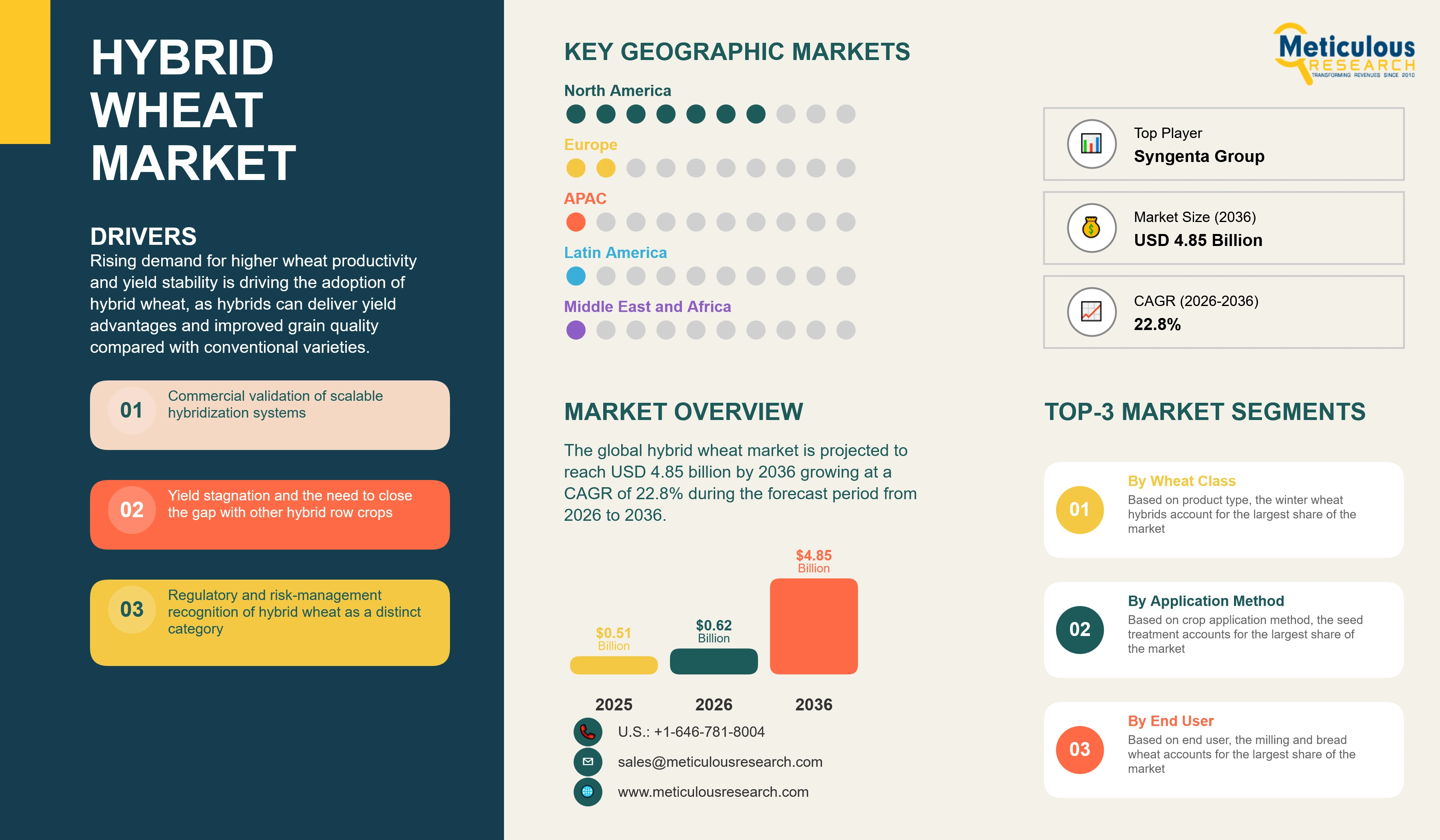
The global hybrid wheat market is projected to reach USD 4.85 billion by 2036 from an estimated USD 0.62 billion in 2026, at a CAGR of 22.8% during the forecast period from 2026 to 2036. Winter wheat hybrids account for the largest share of market value through most of the forecast period, reflecting the crop's dominance in Europe and North America's hard red winter belt, while spring wheat hybrids built on newer nuclear and genomics-guided hybridization systems represent the fastest-growing wheat class as manufacturers extend commercial hybrid platforms beyond their initial winter wheat launches.
Key Highlights
- The global hybrid wheat market is projected to reach USD 4.85 billion by 2036, growing at a CAGR of 22.8% during 2026–2036, driven by the commercial launch of scalable hybridization systems, stagnating conventional wheat yields, and intensifying climate-related yield volatility.
- Wheat accounts for nearly a fifth of global calories, and world wheat production reached an estimated 799.31 million metric tons in 2024/25, rising to a forecast 844.36 million metric tons in 2025/26, according to the USDA Foreign Agricultural Service, underscoring the scale of the crop that hybridization is now targeting.
- Syngenta became the first company to bring a commercially scalable hybrid wheat system to Europe, with its X-Terra platform receiving registration approval in France in February 2026; SY Sphynx and SY Xanthis became the first X-Terra hybrids available for the 2026 sowing season, with more than 20 additional hybrids in registration for the U.K. and Germany.
- Bayer signed an exclusive licensing agreement with RAGT Semences in July 2026 for elite European wheat germplasm, targeting simultaneous hybrid wheat launches in Europe and North America by the early 2030s and a peak annual revenue opportunity of up to €1 billion.
- Corteva, whose seed and genetics business is being spun off as Vylor, has built its hybrid wheat platform around a proprietary nuclear male sterility system and plans to introduce its first hybrid hard red winter wheat product in Kansas in 2027, expanding into soft red winter wheat around 2029 and hard red spring wheat around 2030.
- BASF discontinued its North American hybrid wheat development program in 2023 after 15 years of research but continues to advance hybrid wheat breeding in Europe, where wheat commands higher per-acre value than in the United States.
- China's two-line hybrid wheat system, developed by the Beijing Academy of Agriculture and Forestry Sciences, is already in commercial use; its Jingmai 189 variety produced a demonstration yield of roughly 11.5 tonnes per hectare on saline desert-edge land in Xinjiang in 2026, compared with a national average wheat yield of about 5.99 tonnes per hectare in 2025, and trial cultivation has begun in Pakistan and Uzbekistan.
- Wheat was the lowest-cost major U.S. field crop to produce in 2024 at USD 416 per planted acre, and combined seed, fertilizer, and chemical expenditure represented 28.6% of total U.S. crop farm expenses in 2024, according to USDA's National Agricultural Statistics Service, framing the economic case hybrid wheat must clear against conventional varietal seed.
- The U.S. Federal Crop Insurance Corporation approved a dedicated Hybrid Wheat Seed pilot insurance program effective for the 2026 crop year, covering select counties in Minnesota and North Dakota, signalling growing institutional recognition of hybrid wheat as a distinct production category.
- The European Union's new Regulation on plant reproductive material, published in the Official Journal on June 26, 2026, consolidates the marketing rules that previously governed cereal seed, including Council Directive 66/402/EEC, and is expected to shape the registration pathway for hybrid wheat varieties across member states.
- North America and Europe hold the largest revenue share in 2026, supported by commercial-scale hybrid launches from Syngenta, Bayer, and Corteva, while Asia-Pacific is expected to register the fastest CAGR on the back of China's established two-line hybrid wheat programme and India's rising wheat consumption base.
Executive Summary

Click here to: Get Free Sample Pages
Hybrid wheat is produced by crossing two genetically distinct, inbred parent lines to create a first-generation offspring that combines desirable traits from both parents, delivering the yield stability, stress tolerance, and vigour associated with hybridization in crops such as corn and canola. Unlike those crops, wheat is naturally self-pollinating, and its genome is close to six times the size of the human genome with as many as six copies of many genes, which has made reliable and economical hybrid seed production a persistent scientific and commercial challenge since the 1950s. The market encompasses parent-line seed production, F1 hybrid seed multiplication, and the hybridization systems and crop-management platforms that manufacturers bundle with hybrid seed to help farmers realize its full yield potential.
Several distinct hybridization approaches now compete for commercial relevance. Chemical hybridizing agents, applied to induce male sterility in the female parent line, have historically been the most widely used route and remain central to Europe's hybrid rye and early hybrid wheat efforts. Cytoplasmic male sterility, which relies on sterility genes carried in the cell's cytoplasm, has been used for decades but has struggled with restricted genetic compatibility and unstable restoration in wheat. Newer systems are reshaping the competitive landscape: Corteva's proprietary nuclear male sterility system places the sterility trait in the nucleus rather than the cytoplasm, which the company says works across a broader range of germplasm without requiring separate restorer lines, while Syngenta's X-Terra platform pairs genome-wide screening with precision breeding to identify genes governing viability, yield, and stress tolerance at commercial scale. In China, a two-line, photo-thermo-sensitive genic male sterility system developed by the Beijing Academy of Agriculture and Forestry Sciences has already moved into large-scale farmer adoption.
Demand for hybrid wheat is increasingly being driven by the economics of closing a persistent yield gap rather than novelty alone. While hybrid technology helped lift average corn yields by more than 600% since the 1920s, wheat yield growth has been comparatively flat, and breeders view hybridization as one of the few remaining levers capable of delivering a step change in productivity. Field trials cited by Corteva show hybrid hard red winter wheat yielding up to 20% higher than elite varietal checks under water-stressed conditions, a trait of growing importance as climatic variability intensifies. Regulatory recognition is also catching up with commercial activity: the European Union's newly consolidated plant reproductive material regulation and the United States' new crop insurance pilot for hybrid wheat seed both point to institutions adapting to a category that, until recently, existed mostly in research trials. These factors are expected to support strong growth in the hybrid wheat market through 2036, even as adoption remains at an early, geographically concentrated stage relative to hybrid corn or hybrid rice.
Market Opportunities
- Syngenta received French registration approval for its X-Terra hybrid wheat platform in February 2026, launching SY Sphynx and SY Xanthis for the 2026 sowing season, with U.K. launch targeted for 2027 and Germany for 2029, backed by a pipeline of more than 20 additional hybrids in registration.
- Bayer signed an exclusive licensing agreement with RAGT Semences in July 2026 for elite European wheat germplasm, targeting simultaneous hybrid wheat commercialization in Europe and North America by the early 2030s with a peak sales target of up to €1 billion.
- Corteva announced its proprietary non-GMO nuclear male sterility hybrid wheat technology in November 2024 and confirmed in 2026 that its first hybrid hard red winter wheat product will launch commercially in Kansas in 2027 through its Pioneer sales channel, with expansion into soft red winter wheat around 2029 and hard red spring wheat around 2030.
- Corteva's seed and genetics business, including its hybrid wheat platform, is being spun off as a separate publicly traded company named Vylor, with a board of directors announced in June 2026.
- BASF discontinued its North American hybrid wheat development programme in 2023 after 15 years of research but continues to advance hybrid wheat breeding for the European market.
- KWS SAAT SE & Co. KGaA reported increased research and development investment in the hybridization of wheat and barley within its Cereals segment in its 2025/26 financial results, building on its established leadership in hybrid rye.
- The Beijing Academy of Agriculture and Forestry Sciences' Institute of Hybrid Wheat Research reported a demonstration yield of roughly 11.5 tonnes per hectare for its Jingmai 189 two-line hybrid wheat variety on saline desert-edge land in Xinjiang in 2026, with trial cultivation extending into Pakistan and Uzbekistan.
- The U.S. Federal Crop Insurance Corporation Board of Directors approved a Hybrid Wheat Seed pilot insurance programme in December 2025, effective for the 2026 crop year in select counties of Minnesota and North Dakota.
- The European Union published its consolidated Regulation on the production and marketing of plant reproductive material in the Official Journal on June 26, 2026, replacing the cereal seed marketing directives that previously governed hybrid wheat variety registration in the bloc.
Market Research Summary
|
Particulars |
Details |
|
Forecast Period |
2026–2036 |
|
Base Year |
2025 |
|
Estimated Year |
2026 |
|
CAGR (Value) |
22.8% |
|
Market Size (Value) in 2026 |
USD 0.62 Billion |
|
Market Size (Value) in 2036 |
USD 4.85 Billion |
|
Segments Covered |
By Wheat Class: Winter Wheat (Hard Red Winter, Soft Red Winter, White Winter); Spring Wheat (Hard Red Spring, Other Spring); Durum Wheat. By Hybridization Technology: Chemical Hybridizing Agent-based; Cytoplasmic Male Sterility-based; Nuclear/Genic Male Sterility-based; Two-Line Photo-Thermo-Sensitive Genic Male Sterility-based. By End Use: Milling & Bread Wheat; Feed Wheat; Durum & Pasta Wheat; Specialty Wheat (Noodle & Pastry). By Distribution Channel: Direct & Company-Owned Sales Networks; Retail & Dealer Networks; Cooperative & Government Programs. By Application Method: Seed Treatment; Conventional Drilling; Precision & Variable-Rate Seeding |
|
Countries Covered |
North America (U.S., Canada), Europe (Germany, U.K., France, Spain, Italy, Netherlands, Nordics, and Rest of Europe), Asia-Pacific (China, India, Japan, South Korea, Australia & New Zealand, and Rest of Asia-Pacific), Latin America (Brazil, Argentina, Mexico, and Rest of Latin America), and the Middle East & Africa (Saudi Arabia, UAE, South Africa, and Rest of Middle East & Africa) |
|
Key Companies |
Bayer AG (Germany), Corteva, Inc. / Vylor (U.S.), Syngenta Group (Switzerland), BASF SE (Germany), RAGT Semences (France), KWS SAAT SE & Co. KGaA (Germany), China National Seed Group Corporation (China), Beijing Academy of Agriculture and Forestry Sciences' Institute of Hybrid Wheat Research (China) |
|
Primary Reference Sources |
U.S. Department of Agriculture, Foreign Agricultural Service and Economic Research Service (global wheat production, U.S. wheat acreage and cost of production); U.S. Department of Agriculture, National Agricultural Statistics Service (farm production expenditures); U.S. Department of Agriculture Risk Management Agency (Hybrid Wheat Seed pilot insurance programme); Government of India, Ministry of Agriculture and Farmers' Welfare (wheat production estimates); European Commission (Regulation on plant reproductive material and related legislation); company press releases, product documentation, and investor disclosures from Bayer, Corteva, Syngenta, BASF, and KWS; and specialist and international trade press including World Grain, AgWeb, Business Wire, and Xinhua |
Frequently Asked Questions
Related Tags
How We Built This Intelligence
Table of Contents
Expand allAccess & Licensing
Choose how you access this intelligence — from a standalone data pack to organization-wide access. Every option is delivered within 24–48 hours and backed by analyst support.
Related Statistics & Insights
Need something more specific?
A custom-scoped study can target a single segment, geography, or competitor set — or answer a board-level question this syndicated report doesn't. Tell an analyst what decision you're making and we'll scope it.