Aerospace and DefenseReport ID: MR-2126Aug 2026310 PagesGlobal
Verified by the Meticulous Standard·Last verified: May 2026 by Specialist Analyst

Defense Electronics Market by Product (Communication Systems, Radar Systems, Electronic Warfare Systems), Electronic Component, Platform, Technology, Application, End User, and Geography - Global Forecast to 2036

Published Date: Aug 2026
Format: PDF + Excel + Cloud Portal
Pages / Size: 310 Pages
Analyst: Specialist Analyst
Secure checkout · Full methodology disclosure · Underwritten by lead analyst Specialist Analyst
Defense Electronics Market Size
Defense Electronics Market Sizing & Sourcing
Base year: 2025 · CAGR: 7.2%
$5.86B
Market size 2025
$6.42B
Market size 2026
$12.84B
Forecast by 2036
7.2%
CAGR 2026–2036

Market Overview

Defense Electronics Market Size

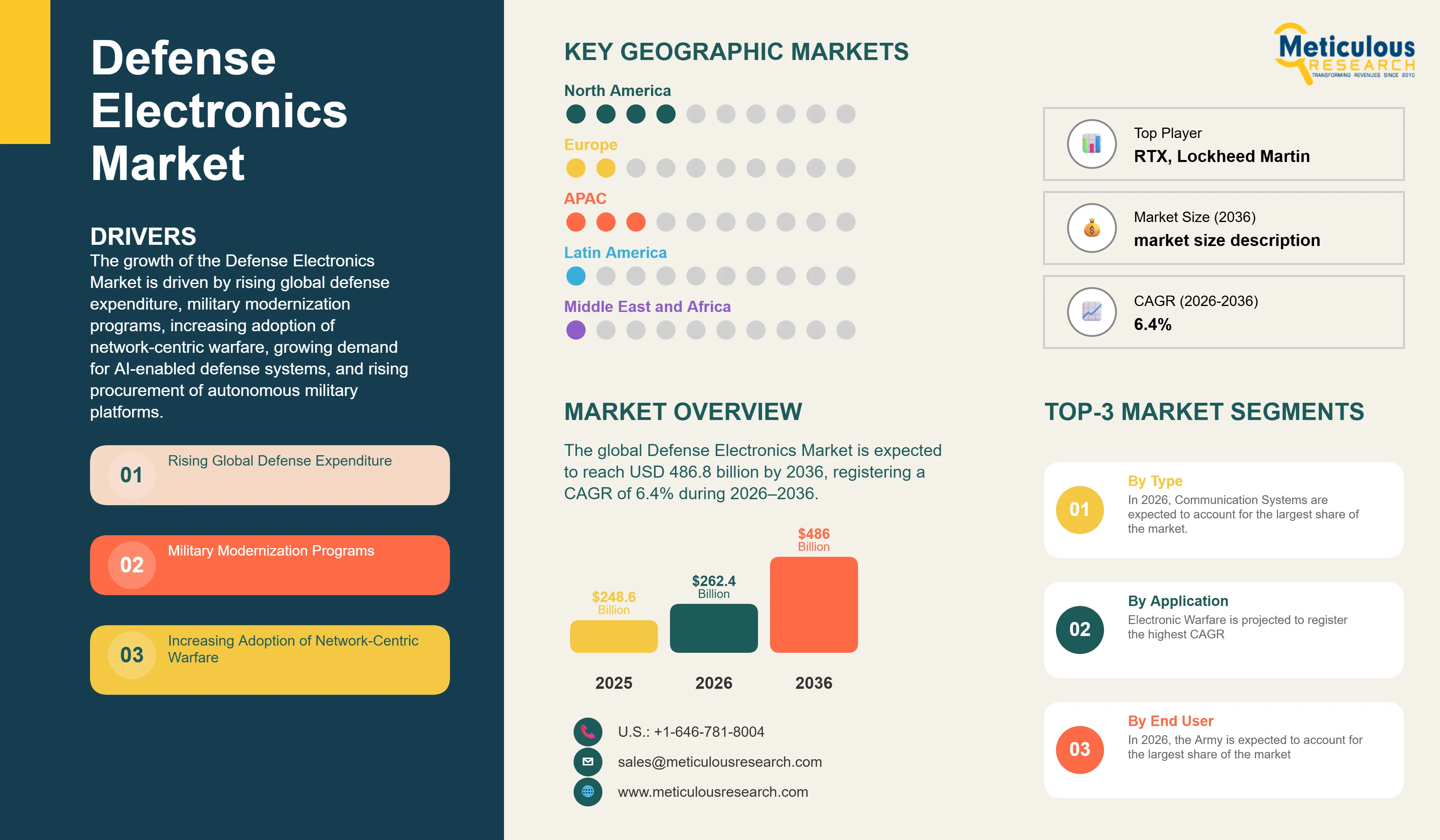
The global Defense Electronics Market is estimated was valued at USD 248.6 billion in 2025 and is projected to reach USD 262.4 billion in 2026. The market is expected to reach USD 486.8 billion by 2036, registering a CAGR of 6.4% during the forecast period (2026–2036).

Key Highlights

  • The global Defense Electronics Market is projected to reach USD 486.8 billion by 2036, driven by rising global defense expenditure, military modernization programs, increasing adoption of AI-enabled defense systems, and growing procurement of autonomous military platforms.
  • North America is expected to account for the largest market share in 2026, while Asia-Pacific is projected to register the fastest growth during the forecast period.
  • By product, Communication Systems are expected to account for the largest market share, whereas Electronic Warfare Systems are projected to witness the fastest growth through 2036.
  • By electronic component, Processing & Computing Modules are expected to dominate the market, while AI & Edge Computing Modules are projected to register the highest CAGR during the forecast period.
  • Growing adoption of AESA radars, software-defined radios (SDRs), Gallium Nitride (GaN) semiconductors, AI-enabled mission systems, and software-defined defense electronics is transforming modern military capabilities.
  • Increasing investments in multi-domain operations, space-based defense systems, next-generation battlefield digitization, and electronic warfare are expected to create significant long-term growth opportunities.

Executive Summary

The Defense Electronics Market comprises electronic systems, subsystems, and components designed for military platforms operating across land, air, naval, and space domains. The market includes communication systems, radar systems, electronic warfare systems, electro-optical and infrared (EO/IR) systems, navigation and positioning systems, mission computers, military power electronics, and identification friend or foe (IFF) systems, along with supporting electronic components such as processors, RF modules, sensors, antennas, connectors, rugged displays, power electronics, and secure data storage devices. These technologies enable intelligence gathering, battlefield communication, surveillance, navigation, targeting, command and control, and electronic protection for modern armed forces.

The market is experiencing strong growth as governments worldwide continue to modernize their armed forces in response to evolving geopolitical threats and technological advancements. According to the Stockholm International Peace Research Institute (SIPRI), global military expenditure reached a record US$2.89 trillion in 2025, marking the 11th consecutive year of growth. Global military spending increased by 41% between 2016 and 2025, while the world's military burden rose to 2.5% of global GDP. In addition, NATO member states agreed in 2025 to increase the Alliance's long-term defence spending target from 2% to 5% of GDP by 2035, reflecting an unprecedented commitment to defence modernization and advanced military capabilities. Increasing investments in advanced fighter aircraft, naval vessels, missile defense systems, unmanned platforms, integrated battlefield communication networks, and space-based defense capabilities are significantly increasing demand for next-generation defense electronics.

Another major growth driver is the transition toward network-centric and multi-domain warfare, where real-time information sharing across air, land, sea, cyber, and space domains has become essential for military effectiveness. Governments are increasingly deploying AI-enabled surveillance systems, software-defined radios, Active Electronically Scanned Array (AESA) radars, edge computing platforms, autonomous military systems, and satellite-enabled command-and-control networks to improve battlefield awareness and decision-making. According to SIPRI, the combined military expenditure of NATO members reached approximately US$1.58 trillion in 2025, accounting for nearly 55% of global military spending, highlighting the scale of ongoing investments in advanced defence technologies. At the same time, the growing use of Gallium Nitride (GaN) semiconductors, open system architectures (MOSA), software-defined electronics, and space-based defense technologies is reshaping the defense electronics ecosystem and creating new opportunities for technology providers.

Market Growth Drivers

Rising Global Defense Expenditure and Military Modernization

The steady increase in global defense spending is one of the primary factors driving the Defense Electronics Market. Governments are investing heavily in modernizing military capabilities by procuring advanced aircraft, naval vessels, armored vehicles, missile defense systems, and integrated battlefield communication platforms. According to SIPRI, global military expenditure reached a record level in 2025, reflecting increasing geopolitical tensions and national security priorities. These investments are driving demand for advanced radar systems, secure communication equipment, mission computers, sensors, electronic warfare systems, and other defense electronics.

Growing Adoption of AI-Enabled Defense Systems and Autonomous Platforms

Artificial intelligence is rapidly transforming military operations by improving target recognition, autonomous navigation, predictive maintenance, battlefield intelligence, and decision support. Defense organizations are increasingly integrating AI into unmanned aerial vehicles (UAVs), autonomous ground vehicles, naval platforms, surveillance systems, and command-and-control networks. At the same time, the growing procurement of autonomous military platforms and AI-enabled electronic warfare systems is increasing demand for high-performance processors, edge computing modules, secure communication systems, and advanced sensors, thereby supporting sustained market growth.

Market Restraints

Lengthy Defense Procurement Cycles

Defense electronics programs typically involve long procurement cycles due to complex evaluation procedures, budget approvals, qualification testing, and regulatory compliance requirements. Large military modernization programs often take several years from program approval to operational deployment. These lengthy procurement timelines can delay revenue realization for manufacturers and slow the adoption of emerging defense technologies.

Export Control Regulations and High Development Costs

Defense electronics are subject to stringent export control regulations, including ITAR, EAR, NATO standards, and military-specific certification requirements. Compliance with these regulations increases product development costs, documentation requirements, and approval timelines. In addition, advanced technologies such as AESA radars, GaN semiconductors, AI-enabled systems, and electronic warfare platforms require substantial research and development investments, creating high barriers to market entry for new participants.

Market Opportunities

Growing Adoption of Open System Architectures (MOSA)

The increasing adoption of Modular Open Systems Approach (MOSA) is creating significant growth opportunities for the Defense Electronics Market. Modern defense programs are increasingly moving away from proprietary architectures toward open, interoperable systems that enable faster technology upgrades, simplified integration, and reduced lifecycle costs. Open standards such as OpenVPX and SOSA (Sensor Open Systems Architecture) are allowing defense organizations to integrate electronic systems from multiple vendors while improving platform flexibility and reducing technology obsolescence. As military modernization programs increasingly emphasize interoperability and rapid capability upgrades, demand for MOSA-compliant defense electronics is expected to grow significantly.

Increasing Integration of AI, Edge Computing, and Space-Based Defense Systems

Artificial intelligence, edge computing, and space-based defense technologies are opening new opportunities across the defense electronics industry. Military organizations are increasingly deploying AI-enabled command-and-control systems, autonomous platforms, intelligent surveillance solutions, and real-time battlefield analytics. At the same time, growing investments in military satellites, space surveillance systems, and resilient space communications are increasing demand for radiation-hardened processors, secure communication electronics, advanced sensors, and high-performance computing modules. These next-generation technologies are expected to create substantial long-term growth opportunities for defense electronics manufacturers.

Market Challenges

Growing Cybersecurity Threats

Cybersecurity remains one of the most significant challenges facing the Defense Electronics Market. Modern defense systems are increasingly connected through digital communication networks, cloud-enabled command centers, and multi-domain battlefield architectures, making them potential targets for cyberattacks. Protecting mission-critical electronics against cyber intrusions, electronic espionage, malware, and data breaches requires continuous investment in secure hardware, encryption technologies, cyber-resilient software, and advanced cybersecurity frameworks.

Electronic Spectrum Congestion and Electromagnetic Interference

The growing number of electronic warfare systems, radar platforms, communication networks, unmanned systems, and satellite communications is increasing congestion across the electromagnetic spectrum. Military forces must ensure reliable operation of multiple electronic systems without signal interference while operating in contested electromagnetic environments. Managing spectrum availability, minimizing electromagnetic interference (EMI), and maintaining communication integrity continue to present significant technical challenges for defense electronics developers.

Market Trends

Increasing Adoption of Gallium Nitride (GaN)-Based Defense Electronics

Gallium Nitride (GaN) technology is becoming one of the most important trends shaping the Defense Electronics Market. GaN semiconductors provide higher power density, greater efficiency, improved thermal performance, and wider operating bandwidth than conventional Gallium Arsenide (GaAs) technologies. These advantages make GaN highly suitable for Active Electronically Scanned Array (AESA) radars, electronic warfare systems, satellite communications, and high-power RF applications. Growing deployment of next-generation radar and electronic warfare platforms is expected to accelerate GaN adoption throughout the forecast period.

Growing Deployment of Software-Defined Defense Electronics

Defense organizations are increasingly adopting software-defined architectures that enable rapid capability upgrades without extensive hardware replacement. Software-defined radios, mission computers, electronic warfare systems, and radar platforms can receive software updates to support new missions, communication protocols, and operational requirements. This approach improves system flexibility, reduces lifecycle costs, and accelerates modernization programs, making software-defined electronics a key trend across modern defense platforms.

Segment Analysis

Market Analysis by Product

Based on product, the global Defense Electronics Market is segmented into Communication Systems, Radar Systems, Electronic Warfare Systems, Electro-Optical & Infrared (EO/IR) Systems, Navigation & Positioning Systems, Mission Computers & Displays, Identification Friend or Foe (IFF) Systems, and Military Power Electronics.

In 2026, the Communication Systems segment is expected to account for the largest share of the global Defense Electronics Market. The large share of this segment is mainly due to increasing deployment of secure battlefield communications, satellite communications, software-defined radios, and network-centric military operations. However, the Electronic Warfare Systems segment is projected to register the fastest growth during the forecast period. The rapid growth of this segment is attributed to rising investments in electronic attack, electronic protection, spectrum dominance, and countermeasure technologies.

Market Analysis by Electronic Component

Based on electronic component, in 2026, Processing & Computing Modules are expected to account for the largest market share because they serve as the core processing platforms for modern military communication, surveillance, and mission systems. However, AI & Edge Computing Modules are projected to register the highest CAGR during the forecast period owing to increasing deployment of autonomous systems, intelligent sensors, and AI-enabled battlefield decision support.

Market Analysis by Platform

Based on platform, the market is segmented into Airborne, Land, Naval, and Space. In 2026, the Airborne segment is expected to account for the largest market share due to increasing procurement of advanced fighter aircraft, military helicopters, airborne surveillance platforms, and UAVs. However, the Space segment is projected to register the highest CAGR during the forecast period owing to increasing investments in military satellites, missile warning systems, secure satellite communications, and space surveillance capabilities.

Market Analysis by Technology

Based on technology, the market is segmented into Analog Electronics, Digital Electronics, RF & Microwave Electronics, Photonics & Electro-Optics, Artificial Intelligence & Edge AI, Software-Defined Electronics, and Quantum Electronics. In 2026, Digital Electronics are expected to account for the largest market share because digital architectures form the foundation of modern military communication, computing, radar, and mission systems.However, Artificial Intelligence & Edge AI is projected to register the highest CAGR during the forecast period due to increasing adoption across autonomous military platforms, intelligence analysis, target recognition, and real-time battlefield decision-making.

Market Analysis by Application

Based on application, in 2026, C4ISR is expected to account for the largest market share owing to increasing investments in integrated battlefield management, secure communication networks, and real-time intelligence sharing. However, Electronic Warfare is projected to register the highest CAGR during the forecast period, driven by increasing emphasis on electromagnetic spectrum superiority, electronic attack capabilities, and countermeasure systems.

Market Analysis by End User

Based on end user, the market is segmented into Army, Navy, Air Force, Space Force, and Homeland Security & Border Protection Agencies. In 2026, the Army segment is expected to account for the largest market share due to extensive procurement of communication systems, surveillance equipment, electronic warfare platforms, and battlefield electronics. However, the Space Force segment is projected to register the highest CAGR during the forecast period because of increasing investments in military satellites, space surveillance, missile tracking, and space-based defense capabilities.
Geographical Analysis

Based on geography, the global Defense Electronics Market is segmented into North America, Europe, Asia-Pacific, Latin America, and the Middle East & Africa.

In 2026, North America is expected to account for the largest share of the global Defense Electronics Market. The region's dominance is supported by the presence of major defense contractors, continuous military modernization programs, and substantial investments in advanced electronic warfare, radar, secure communications, and space-based defense systems. The United States accounts for the largest share of global defense spending and continues to invest heavily in next-generation military technologies. According to the Stockholm International Peace Research Institute (SIPRI), the U.S. remained the world's largest military spender in 2025, accounting for approximately 33% of global military expenditure. Ongoing procurement of advanced fighter aircraft, naval combat systems, missile defense platforms, unmanned systems, and AI-enabled battlefield technologies is driving strong demand for defense electronics across the region.

However, Asia-Pacific is projected to register the highest CAGR during the forecast period. Rising geopolitical tensions, increasing indigenous defense manufacturing, and growing investments in military modernization are accelerating demand for advanced defense electronics across China, India, Japan, South Korea, and Australia. According to the Stockholm International Peace Research Institute (SIPRI), military expenditure in Asia and Oceania increased by 8.1% to approximately US$681 billion in 2025, accounting for nearly one-quarter of global military spending. China remained the region's largest defense spender with an estimated US$336 billion budget, followed by India (US$92.1 billion), Japan (US$62.2 billion), South Korea (US$47.8 billion), and Australia (US$35.3 billion). Governments in the region are expanding investments in integrated air defense systems, secure communication networks, surveillance systems, electronic warfare capabilities, and autonomous military platforms. The rapid modernization of armed forces, coupled with rising defense budgets and increasing domestic procurement of advanced military technologies, is expected to significantly boost demand for defense electronics throughout the forecast period

Competitive Landscape

The global Defense Electronics Market is moderately consolidated, with competition among defense prime contractors, military electronics manufacturers, radar system developers, communication technology providers, and advanced semiconductor companies. Market participants compete primarily on technological innovation, system reliability, cybersecurity capabilities, interoperability, product performance, manufacturing capacity, and long-term defense contracts.

Leading companies are investing in Gallium Nitride (GaN) semiconductors, Active Electronically Scanned Array (AESA) radar systems, artificial intelligence, edge computing, software-defined electronics, and open system architectures (MOSA) to strengthen their market position. Strategic partnerships with defense ministries, military agencies, and system integrators, along with acquisitions, R&D investments, and long-term government procurement contracts, remain the key strategies adopted by major vendors. Companies are also expanding their capabilities in electronic warfare, autonomous military systems, secure battlefield communications, and space-based defense electronics to support evolving multi-domain military operations.

The report provides a comprehensive competitive assessment of the leading companies operating in the global Defense Electronics Market. The key players profiled in the report include RTX Corporation, Lockheed Martin Corporation, Northrop Grumman Corporation, BAE Systems plc, L3Harris Technologies, Inc., Thales S.A., Leonardo S.p.A., Elbit Systems Ltd., Saab AB, HENSOLDT AG, General Dynamics Corporation, Honeywell Aerospace Technologies, Indra Sistemas, S.A., Bharat Electronics Limited (BEL), and Rheinmetall AG.

Market Research Summary

Particulars

Details

Forecast Period

2026–2036

Base Year

2025

Estimated Year

2026

CAGR (Value)

6.4%

Market Size (Value) in 2026

USD 262.4 Billion

Market Size (Value) in 2036

USD 486.8 Billion

Segments Covered

By Product: Communication Systems, Radar Systems, Electronic Warfare Systems, Electro-Optical & Infrared (EO/IR) Systems, Navigation & Positioning Systems, Mission Computers & Displays, Identification Friend or Foe (IFF) Systems, Military Power Electronics.

By Electronic Component: Processing & Computing Modules, RF & Microwave Components, Sensors, Power Electronics, Printed Circuit Boards (PCBs), Connectors & Interconnects, Displays & Human-Machine Interfaces, Antennas, Memory & Data Storage Devices, Electronic Packaging & Thermal Management Components.

By Platform: Airborne, Land, Naval, Space.

By Technology: Analog Electronics, Digital Electronics, RF & Microwave Electronics, Photonics & Electro-Optics, Artificial Intelligence & Edge AI, Software-Defined Electronics, Quantum Electronics.

By Application: Intelligence, Surveillance & Reconnaissance (ISR), Command, Control, Communications, Computers, Intelligence, Surveillance & Reconnaissance (C4ISR), Battlefield Communications, Electronic Warfare, Target Acquisition & Fire Control, Missile Guidance & Control, Border & Homeland Security, Force Protection.

By End User: Army, Navy, Air Force, Space Force, Homeland Security & Border Protection Agencies.

Countries Covered

North America: U.S., Canada.

Europe: U.K., Germany, France, Italy, Poland, Rest of Europe.

Asia-Pacific: China, India, Japan, South Korea, Australia, Singapore, Rest of Asia-Pacific.

Latin America: Brazil, Mexico, Argentina, Rest of Latin America.

Middle East & Africa: Saudi Arabia, UAE, Israel, South Africa, Rest of Middle East & Africa.

Key Companies

RTX Corporation, Lockheed Martin Corporation, Northrop Grumman Corporation, BAE Systems plc, L3Harris Technologies, Inc., Thales S.A., Leonardo S.p.A., Elbit Systems Ltd., Saab AB, HENSOLDT AG, General Dynamics Corporation, Honeywell Aerospace Technologies, Indra Sistemas, S.A., Bharat Electronics Limited (BEL), and Rheinmetall AG.

Key Questions Answered

Frequently Asked Questions

How We Built This Intelligence

Table of Contents

Expand all

Access & Licensing

Choose how you access this intelligence — from a standalone data pack to organization-wide access. Every option is delivered within 24–48 hours and backed by analyst support.

Single User License
Instant access to full PDF report + Excel dataset.
$4,175
1–5 User Access
Full PDF Report + Excel Datasheets
1-Hour Analyst Call included
Free 10% Customization
POPULAR
Multi-User License
Instant access to full PDF report + Excel dataset.
$5,875
1–5 User Access
Full PDF Report + Excel Datasheets
1-Hour Analyst Call included
Free 10% Customization
Enterprise License
Instant access to full PDF report + Excel dataset.
$7,875
1–5 User Access
Full PDF Report + Excel Datasheets
1-Hour Analyst Call included
Free 10% Customization
Flexible Purchase Options
Buy the complete report, individual chapters, or only the data you need. Starting from $1,500.
Analyst-reviewed intelligence
Multi-source validation
Transparent methodology
Citation-ready data
Analyst assistance

Related Statistics & Insights

$248.6B
market value in 2025
$486.8B
projected market value by 2036
6.4%
compound annual growth rate
$2.89trillion
in 2025, marking the 11th consecutive year of growth
Cite this report
Meticulous Research. (2026). Defense Electronics Market - Global Opportunity Analysis and Industry Forecast to 2036 (Report No. MR-2126). Meticulous Market Research Pvt. Ltd. https://meticulousresearch.com/reports/defense-electronics-market-6809
Custom Research

Need something more specific?

A custom-scoped study can target a single segment, geography, or competitor set — or answer a board-level question this syndicated report doesn't. Tell an analyst what decision you're making and we'll scope it.

Search Market Intelligence

Search across reports, blogs, press releases, and industries