Aerospace and DefenseReport ID: MR-2140Aug 2026310 PagesGlobal
Verified by the Meticulous Standard·Last verified: May 2026 by Specialist Analyst

Aerospace Nanomaterials Market by Material Type (Carbon-Based Nanomaterials, Nanoparticles, Nanoceramics, Nanometals), Form, Function, Application, Aircraft & Aerospace Platform, End User, and Geography - Global Forecast to 2036

Published Date: Aug 2026
Format: PDF + Excel + Cloud Portal
Pages / Size: 310 Pages
Analyst: Specialist Analyst
Secure checkout · Full methodology disclosure · Underwritten by lead analyst Specialist Analyst
Aerospace Nanomaterials Market Size
Aerospace Nanomaterials Market Sizing & Sourcing
Base year: 2025 · CAGR: 7.2%
$5.86B
Market size 2025
$6.42B
Market size 2026
$12.84B
Forecast by 2036
7.2%
CAGR 2026–2036

Market Overview

Aerospace Nanomaterials Market Size

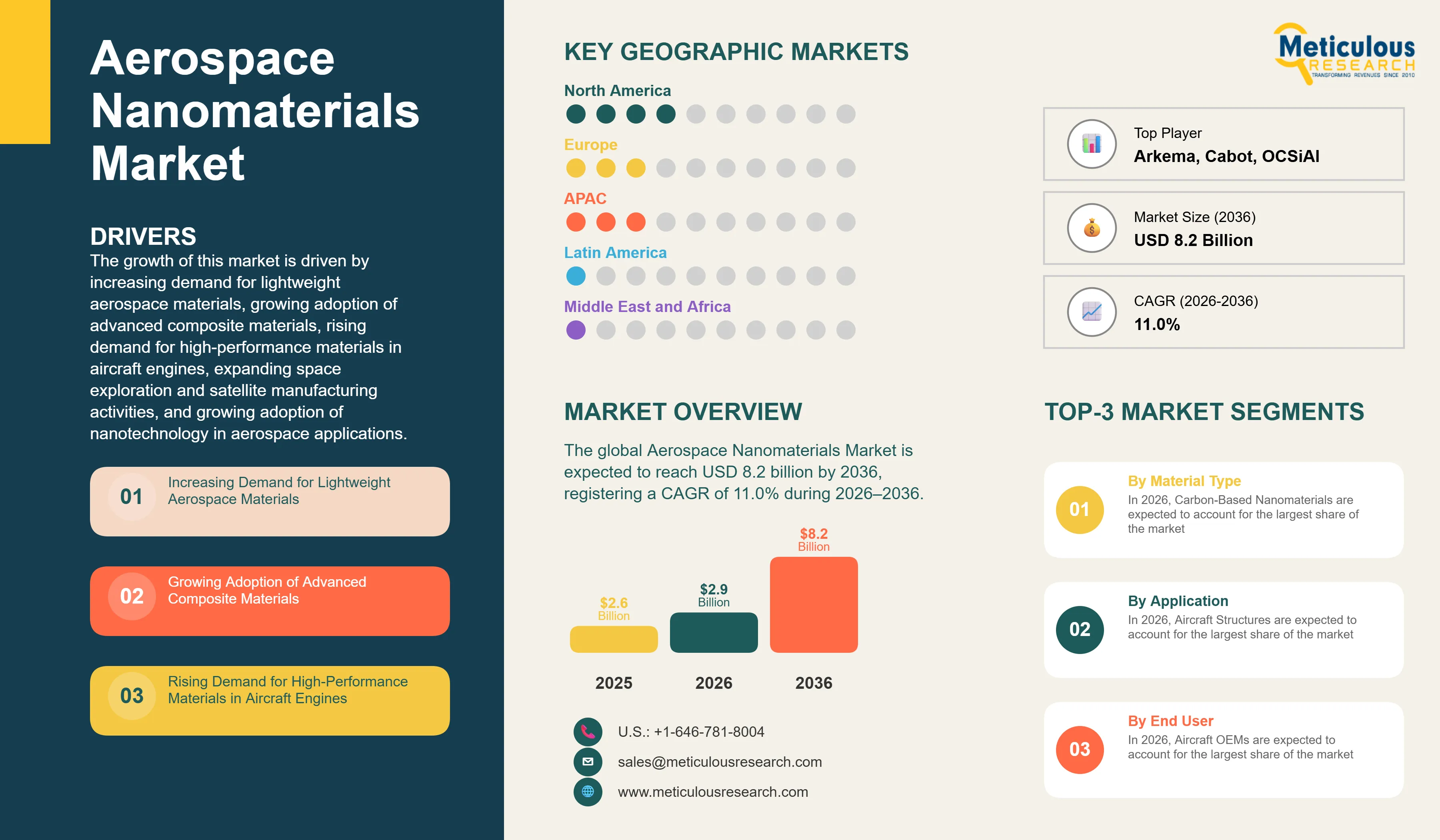
The global Aerospace Nanomaterials Market was valued at USD 2.6 billion in 2025 and is projected to reach USD 2.9 billion in 2026. The market is expected to reach USD 8.2 billion by 2036, registering a CAGR of 11.0% during the forecast period (2026–2036).

Key Highlights

  • The global Aerospace Nanomaterials Market is projected to reach USD 8.2 billion by 2036, driven by increasing demand for lightweight aircraft structures, growing adoption of advanced composite materials, and rising nanomaterial integration in next-generation aircraft engines and spacecraft.
  • North America is expected to account for the largest market share in 2026, while Asia-Pacific is projected to register the fastest growth during the forecast period.
  • By material type, Carbon-Based Nanomaterials are expected to account for the largest market share, whereas Nanocomposites are projected to witness the fastest growth through 2036.
  • By application, Aircraft Structures are expected to dominate the market, while Spacecraft & Satellites are projected to register the highest CAGR during the forecast period.
  • Growing adoption of carbon nanotube-reinforced composites and multifunctional nanocoatings is increasing demand for high-performance nanomaterials across commercial, military, and space platforms.
  • Rising investments in additive manufacturing, advanced air mobility, and satellite constellation deployment are expected to create significant long-term growth opportunities.

Executive Summary

The Aerospace Nanomaterials Market comprises engineered materials with structural features at the nanoscale, including carbon nanotubes, graphene and graphene derivatives, nanoparticles, nanoclays, nanoceramics, nanometals, nanocomposites, and nano-coatings, that are used to enhance the strength-to-weight ratio, thermal stability, electrical conductivity, and durability of aerospace components. These materials are increasingly incorporated into aircraft fuselages, wings, engine components, interiors, spacecraft structures, and launch vehicles in the form of powders, dispersions, films, fibers, resins, and prepregs, enabling lightweighting, EMI shielding, corrosion protection, and thermal management across commercial, military, and space applications.

The market is benefiting from the aerospace industry's sustained shift toward composite-intensive aircraft design. Boeing states that the 787 Dreamliner has an airframe composed of approximately 50% composites by weight, demonstrating the industry's continued reliance on advanced composite materials for lightweighting and performance improvements. Airbus' 2025 Global Market Forecast projects the global in-service commercial aircraft fleet to increase from approximately 24,730 aircraft at the end of 2024 to 49,210 aircraft by 2044, representing an addition of about 24,480 aircraft. Airbus also forecasts 43,420 new passenger and freighter aircraft deliveries over the next 20 years, including 34,250 single-aisle and 9,170 widebody aircraft. This expanding aircraft fleet and continued use of composite-intensive airframes create opportunities for nanomaterial-enhanced resins, coatings, reinforcement additives, thermal-management materials, and electrically functional composites.

Robust commercial aircraft production is further supporting long-term nanomaterials adoption. Airbus delivered 793 commercial aircraft in 2025, up approximately 4% from 2024, and ended the year with a record backlog of 8,754 aircraft. Boeing delivered 600 commercial aircraft in 2025, its highest annual delivery total since 2018, and ended the year with more than 6,100 commercial aircraft in its backlog. Together, these OEM backlogs represent nearly 15,000 aircraft, providing substantial visibility for future production and consumption of advanced composites, coatings, structural materials, and nanomaterial-enhanced components. Airbus also forecasts that 18,930 of the 43,420 aircraft required through 2044 will replace older-generation aircraft, reinforcing demand for lightweight and higher-performance materials as airlines modernize fleets

Market Growth Drivers

Increasing Demand for Lightweight Aerospace Materials

Aircraft and spacecraft manufacturers continue to prioritize weight reduction to improve fuel efficiency, extend range, and increase payload capacity. Nanomaterials such as carbon nanotubes and graphene offer exceptional strength-to-weight ratios compared with conventional metals and composites, enabling designers to achieve structural performance targets while further reducing component mass. This is particularly critical as aircraft operators work toward industry decarbonization goals, including the aviation sector's commitment to cutting net carbon emissions by half by 2050 relative to 2005 levels.

Growing Adoption of Advanced Composite Materials

The continued shift toward composite-intensive airframes, exemplified by the Boeing 787 and Airbus A350 XWB at roughly 50% composite content by weight, is expanding the addressable market for nanomaterial-reinforced resins and prepregs. Nanoscale additives such as nanoclays and carbon nanotubes are increasingly incorporated into composite matrices to improve interlaminar strength, fatigue resistance, and damage tolerance beyond what conventional carbon-fiber composites can achieve alone.

Rising Demand for High-Performance Materials in Aircraft Engines

Next-generation aircraft engines require materials capable of withstanding extreme temperatures, mechanical stress, and oxidative environments. Nanoceramics and nanocomposite thermal barrier coatings are increasingly applied to turbine, compressor, and combustion components to improve thermal efficiency and extend component service life, supporting engine manufacturers' efforts to improve fuel burn and reduce maintenance costs.

Market Restraints

High Production Costs of Aerospace-Grade Nanomaterials

Aerospace-grade nanomaterials such as high-purity carbon nanotubes and functionalized graphene require specialized synthesis and purification processes, resulting in significantly higher production costs than conventional aerospace materials. These elevated costs can limit adoption to premium applications where performance gains justify the cost differential, particularly in cost-sensitive commercial aviation programs.

Complex Qualification and Certification Requirements

Aerospace materials must undergo extensive qualification testing to meet FAA, EASA, and equivalent regulatory standards before being approved for use in flight-critical components. The novel failure modes and long-term behavior of nanomaterial-enhanced composites require extensive characterization, and these lengthy certification cycles can delay commercial adoption of new nanomaterial formulations by several years.

Market Opportunities

Increasing Adoption of Carbon Nanotube-Reinforced Composites

Carbon nanotube-reinforced composites offer substantial improvements in electrical conductivity, interlaminar strength, and lightning-strike protection compared with conventional carbon-fiber composites, creating opportunities for suppliers to displace traditional metallic lightning-protection meshes in next-generation airframe designs.

Growth in Additive Manufacturing for Aerospace Components

The expansion of metal and polymer additive manufacturing in aerospace is creating new opportunities for nanomaterial-enhanced feedstocks that improve print quality, mechanical properties, and thermal performance of 3D-printed components, particularly for complex, low-volume parts used in engines, brackets, and satellite structures.

Market Trends

Growing Integration of Carbon Nanotubes and Graphene in Structural Composites

Aerospace manufacturers and material suppliers are increasingly integrating carbon nanotubes and graphene derivatives into structural composite formulations to improve mechanical performance beyond the limits of conventional carbon-fiber composites. This trend is particularly evident in next-generation aircraft development programs seeking further weight reduction beyond the roughly 50% composite content achieved in current-generation widebody aircraft.

Rising Adoption of Multifunctional Nano-Coatings

Nano-coatings that combine anti-corrosion, wear-resistant, thermal-barrier, and ice-phobic properties in a single application are gaining traction across airframes, engine components, and interiors. This shift toward multifunctional surface treatments reflects the aerospace industry's broader push to reduce maintenance intervals and extend component service life while minimizing added weight and system complexity.

Segment Analysis

Market Analysis by Material Type (Primary Segmentation)

Based on material type, the global Aerospace Nanomaterials Market is segmented into Carbon-Based Nanomaterials (Carbon Nanotubes, Graphene, Graphene Oxide, and Fullerenes), Nanoparticles (Metal, Metal Oxide, Ceramic, and Silica), Nanoclays, Nanoceramics, Nanometals & Metal Alloys, Nanocomposites, and Nanocoatings & Surface Treatments.

In 2026, Carbon-Based Nanomaterials are expected to account for the largest share of the global Aerospace Nanomaterials Market, owing to the widespread use of carbon nanotubes and graphene in structural composites, EMI shielding, and lightning-strike protection applications. However, the Nanocomposites segment is projected to register the fastest growth during the forecast period, driven by increasing replacement of conventional composite materials with nanocomposite alternatives that offer significant weight savings and enhanced mechanical strength in structural components.

Market Analysis by Form

Based on form, the market is segmented into Powders, Nanoparticle Dispersions, Films & Membranes, Coatings, Fibers & Nanofibers, Resins & Polymer Formulations, and Prepregs & Composite Forms.

In 2026, Resins & Polymer Formulations are expected to account for the largest market share, reflecting their widespread use in nanomaterial-enhanced composite manufacturing for structural aerospace components. However, Prepregs & Composite Forms are projected to register the fastest growth, supported by increasing use of nanomaterial-enhanced prepregs in next-generation aircraft structural programs.

Market Analysis by Function

Based on function, the market is segmented into Lightweighting & Structural Reinforcement, Thermal Management, Electrical Conductivity, Electromagnetic Interference (EMI) Shielding, Corrosion Protection, Wear & Abrasion Resistance, Fire & Flame Resistance, Radiation Protection, and Self-Healing & Damage Detection.

In 2026, Lightweighting & Structural Reinforcement is expected to account for the largest market share, driven by continued industry-wide emphasis on weight reduction to improve fuel efficiency. However, Radiation Protection is projected to register the fastest growth, supported by expanding satellite and space exploration programs requiring advanced shielding materials.

Market Analysis by Application

Based on application, the market is segmented into Aircraft Structures, Aircraft Engines, Aerospace Electronics & Electrical Systems, Aircraft Interiors, Spacecraft & Satellites, Launch Vehicles, Unmanned Aerial Vehicles (UAVs), and Advanced Air Mobility & eVTOL Aircraft.

In 2026, Aircraft Structures are expected to account for the largest market share, supported by sustained composite-intensive aircraft production across commercial and military programs. However, Spacecraft & Satellites are projected to register the highest CAGR during the forecast period, driven by rapid growth in satellite constellation deployments and renewed investment in space exploration programs.

Market Analysis by Aircraft & Aerospace Platform

Based on aircraft and aerospace platform, the market is segmented into Commercial Aircraft (Narrow-Body, Wide-Body, and Regional), Military Aircraft (Fighter, Transport, and Special Mission), Helicopters, Unmanned Aerial Vehicles, Spacecraft & Satellites, Launch Vehicles, and Advanced Air Mobility & eVTOL Aircraft.

In 2026, Commercial Aircraft are expected to account for the largest market share, underpinned by a combined Airbus and Boeing backlog exceeding 15,400 aircraft as of late 2025 and sustained multi-decade production programs. However, Advanced Air Mobility & eVTOL Aircraft are projected to register the fastest growth, driven by increasing development activity in electric and hybrid-electric aircraft requiring ultra-lightweight structural and battery-related materials.

Market Analysis by End User

Based on end user, the market is segmented into Aircraft OEMs, Aerospace Tier-I & Tier-II Suppliers, Engine Manufacturers, Defense Contractors, Spacecraft & Satellite Manufacturers, MRO Providers, and Research & Development Organizations.

In 2026, Aircraft OEMs are expected to account for the largest market share, reflecting their central role in specifying and qualifying nanomaterial-enhanced components for new aircraft programs. However, Spacecraft & Satellite Manufacturers are projected to register the highest CAGR during the forecast period, driven by rapid expansion of commercial satellite constellations and government space programs.
Geographical Analysis

Based on geography, the global Aerospace Nanomaterials Market is segmented into North America, Europe, Asia-Pacific, Latin America, and the Middle East & Africa.

In 2026, North America is expected to account for the largest share of the global Aerospace Nanomaterials Market. The region's leadership is supported by the presence of leading aircraft, engine, and space systems manufacturers, extensive aerospace R&D investment, and a large commercial and military aircraft production base. Boeing alone reported a commercial aircraft backlog valued at over USD 567 billion as of December 2025, reflecting the scale of sustained production activity that continues to drive demand for advanced structural and functional materials, including nanomaterial-enhanced composites and coatings, across U.S. aerospace manufacturing programs.

However, Asia-Pacific is projected to register the highest CAGR during the forecast period. The region's rapid growth is driven by expanding commercial aviation fleets, growing domestic aircraft manufacturing programs in China and India, and increasing government investment in space and satellite programs. According to Airbus's Global Market Forecast, Asia-Pacific and China together are projected to require more than 19,600 new aircraft between 2025 and 2044, the largest regional demand globally, supporting sustained long-term growth in nanomaterial consumption across the region's expanding aerospace manufacturing and MRO ecosystem.

Competitive Landscape

The global Aerospace Nanomaterials Market is moderately fragmented, with competition among specialized nanomaterial producers, diversified chemical companies, and established aerospace composite and materials suppliers. Companies compete primarily on material performance, purity and consistency, aerospace qualification credentials, manufacturing scale, and application-specific formulation expertise.

Leading market participants are investing in expanding carbon nanotube and graphene production capacity, developing aerospace-qualified nanocomposite and nanocoating formulations, and forming strategic partnerships with aircraft OEMs and Tier-I suppliers to accelerate qualification of nanomaterial-enhanced components. Capacity expansions, new product launches, and collaborative R&D programs with aerospace manufacturers remain the key strategies adopted by major vendors seeking to scale from niche applications into mainstream aerospace production programs.

The report provides a comprehensive competitive assessment of the leading companies operating in the global Aerospace Nanomaterials Market. The key players profiled in the report include Arkema S.A., Cabot Corporation, Nanocyl SA, OCSiAl, Haydale Graphene Industries plc, Graphene NanoChem plc, Element Six, Nanophase Technologies Corporation, Evonik Industries AG, BASF SE, Huntsman Corporation, Solvay S.A., Hexcel Corporation, Toray Industries, Inc., and Mitsubishi Chemical Group Corporation.

Market Research Summary

Particulars

Details

Forecast Period

2026–2036

Base Year

2025

Estimated Year

2026

CAGR (Value)

11.0%

Market Size (Value) in 2026

USD 2.9 Billion

Market Size (Value) in 2036

USD 8.2 Billion

Segments Covered

By Material Type: Carbon-Based Nanomaterials, Nanoparticles, Nanoclays, Nanoceramics, Nanometals & Metal Alloys, Nanocomposites, Nanocoatings & Surface Treatments.

By Form: Powders, Nanoparticle Dispersions, Films & Membranes, Coatings, Fibers & Nanofibers, Resins & Polymer Formulations, Prepregs & Composite Forms.

By Function: Lightweighting & Structural Reinforcement, Thermal Management, Electrical Conductivity, Electromagnetic Interference (EMI) Shielding, Corrosion Protection, Wear & Abrasion Resistance, Fire & Flame Resistance, Radiation Protection, Self-Healing & Damage Detection.

By Application: Aircraft Structures, Aircraft Engines, Aerospace Electronics & Electrical Systems, Aircraft Interiors, Spacecraft & Satellites, Launch Vehicles, Unmanned Aerial Vehicles (UAVs), Advanced Air Mobility & eVTOL Aircraft.

By Aircraft & Aerospace Platform: Commercial Aircraft, Military Aircraft, Helicopters, Unmanned Aerial Vehicles, Spacecraft & Satellites, Launch Vehicles, Advanced Air Mobility & eVTOL Aircraft.

By End User: Aircraft OEMs, Aerospace Tier-I & Tier-II Suppliers, Engine Manufacturers, Defense Contractors, Spacecraft & Satellite Manufacturers, MRO Providers, Research & Development Organizations.

Countries Covered

North America: U.S., Canada.

Europe: Germany, France, U.K., Italy, Spain, Netherlands, Rest of Europe.

Asia-Pacific: China, Japan, South Korea, India, Singapore, Australia, Rest of Asia-Pacific.

Latin America: Brazil, Mexico, Argentina, Rest of Latin America.

Middle East & Africa: UAE, Saudi Arabia, Israel, South Africa, Rest of Middle East & Africa.

Key Companies

Arkema S.A., Cabot Corporation, Nanocyl SA, OCSiAl, Haydale Graphene Industries plc, Graphene NanoChem plc, Element Six, Nanophase Technologies Corporation, Evonik Industries AG, BASF SE, Huntsman Corporation, Solvay S.A., Hexcel Corporation, Toray Industries, Inc., and Mitsubishi Chemical Group Corporation.

Key Questions Answered in the Report

Frequently Asked Questions

How We Built This Intelligence

Table of Contents

Expand all

Access & Licensing

Choose how you access this intelligence — from a standalone data pack to organization-wide access. Every option is delivered within 24–48 hours and backed by analyst support.

Single User License
Instant access to full PDF report + Excel dataset.
$4,175
1–5 User Access
Full PDF Report + Excel Datasheets
1-Hour Analyst Call included
Free 10% Customization
POPULAR
Multi-User License
Instant access to full PDF report + Excel dataset.
$5,875
1–5 User Access
Full PDF Report + Excel Datasheets
1-Hour Analyst Call included
Free 10% Customization
Enterprise License
Instant access to full PDF report + Excel dataset.
$7,875
1–5 User Access
Full PDF Report + Excel Datasheets
1-Hour Analyst Call included
Free 10% Customization
Flexible Purchase Options
Buy the complete report, individual chapters, or only the data you need. Starting from $1,500.
Analyst-reviewed intelligence
Multi-source validation
Transparent methodology
Citation-ready data
Analyst assistance

Related Statistics & Insights

$2.6B
market value in 2025
$8.2B
projected market value by 2036
11.0%
compound annual growth rate
50%
composites by weight
Cite this report
Meticulous Research. (2026). Aerospace Nanomaterials Market - Global Opportunity Analysis and Industry Forecast to 2036 (Report No. MR-2140). Meticulous Market Research Pvt. Ltd. https://meticulousresearch.com/reports/aerospace-nanomaterials-market-6823
Custom Research

Need something more specific?

A custom-scoped study can target a single segment, geography, or competitor set — or answer a board-level question this syndicated report doesn't. Tell an analyst what decision you're making and we'll scope it.

Search Market Intelligence

Search across reports, blogs, press releases, and industries