Aerospace and DefenseReport ID: MR-2134Aug 2026293 PagesGlobal
Verified by the Meticulous Standard·Last verified: May 2026 by Specialist Analyst

Aerospace Additive Manufacturing Market by Offering (Systems, Materials, Software, Services), Technology, Material, Component Type, Application, Platform, End User, and Geography - Global Forecast to 2036

Published Date: Aug 2026
Format: PDF + Excel + Cloud Portal
Pages / Size: 293 Pages
Analyst: Specialist Analyst
Secure checkout · Full methodology disclosure · Underwritten by lead analyst Specialist Analyst
Aerospace Additive Manufacturing Market Size
Aerospace Additive Manufacturing Market Sizing & Sourcing
Base year: 2025 · CAGR: 7.2%
$5.86B
Market size 2025
$6.42B
Market size 2026
$12.84B
Forecast by 2036
7.2%
CAGR 2026–2036

Market Overview

Aerospace Additive Manufacturing Market Size

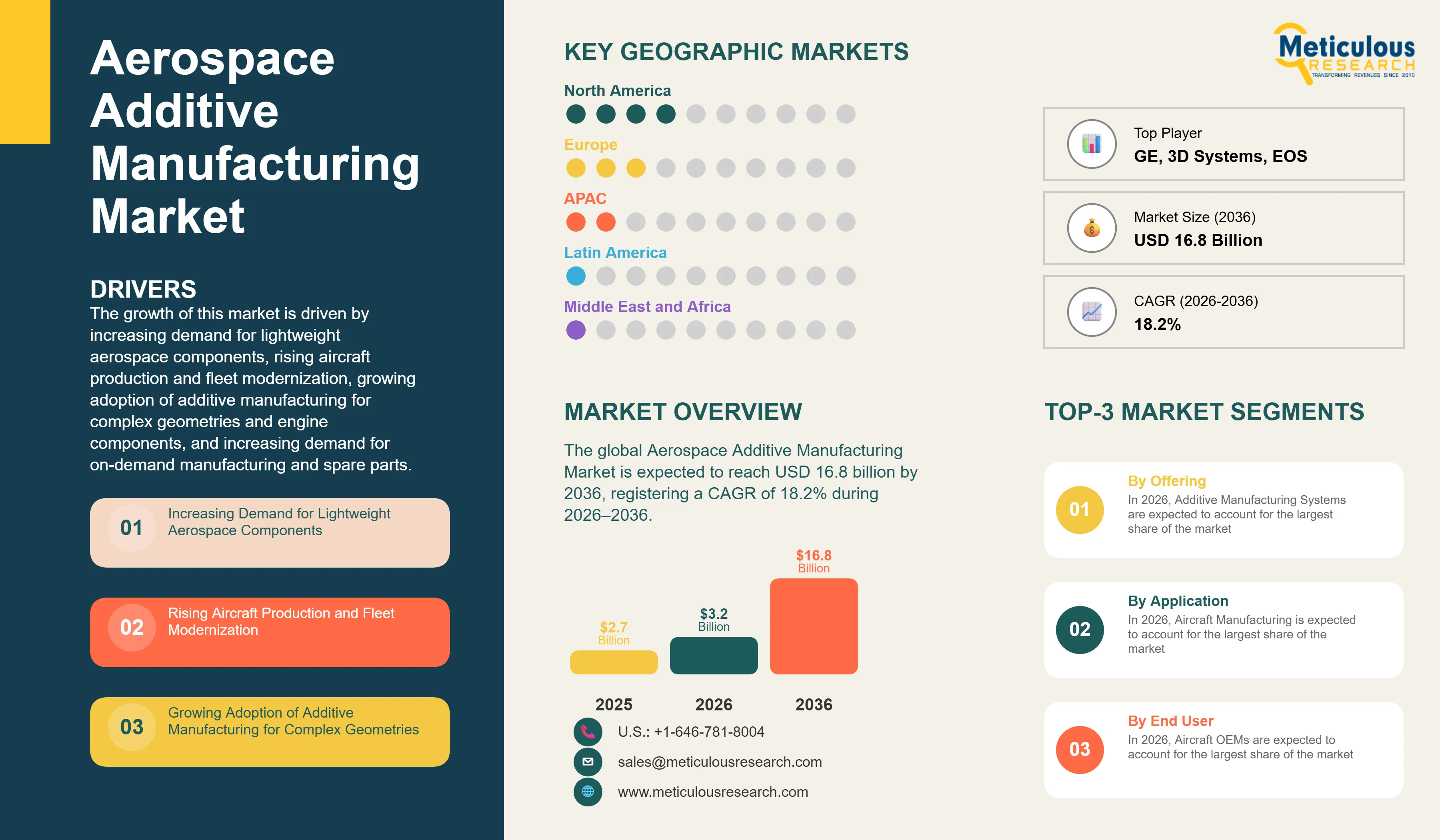
The global Aerospace Additive Manufacturing Market was valued at USD 2.7 billion in 2025 and is projected to reach USD 3.2 billion in 2026. The market is expected to reach USD 16.8 billion by 2036, registering a CAGR of 18.2% during the forecast period (2026-2036).

Key Highlights

  • The global Aerospace Additive Manufacturing Market is projected to reach USD 16.8 billion by 2036, driven by rising demand for lightweight aerospace components and growing adoption of metal additive manufacturing for flight-critical engine and structural parts.
  • North America is expected to account for the largest market share in 2026, while Asia-Pacific is projected to register the fastest growth during the forecast period.
  • By offering, Additive Manufacturing Systems are expected to account for the largest market share, whereas Services are projected to witness the fastest growth through 2036.
  • By technology, Powder Bed Fusion is expected to dominate the market, while Directed Energy Deposition is projected to register the highest CAGR during the forecast period.
  • GE Aerospace alone has shipped over 100,000 additively manufactured fuel nozzle tips for its CFM LEAP engine, illustrating the scale at which metal AM has moved from prototyping into certified, high-volume flight-part production.
  • Rising investment in metal additive manufacturing for spacecraft, launch vehicles, and hypersonic platforms is expected to create significant long-term growth opportunities.

Executive Summary

The Aerospace Additive Manufacturing Market comprises 3D printing systems, feedstock materials, software, and services used to design and produce aerospace components layer by layer, spanning technologies such as powder bed fusion, directed energy deposition, binder jetting, and material extrusion. These processes are used to manufacture engine components, structural parts, thermal management components, fluid and fuel system parts, interior components, tooling, and spare parts across commercial aircraft, military aircraft, helicopters, UAVs, spacecraft, and launch vehicles, enabling significant part consolidation, weight reduction, and design freedom compared with traditional subtractive manufacturing.

The market's transition from prototyping to certified production is accelerating as aerospace OEMs scale additive manufacturing for flight-critical components. GE Aerospace's Auburn, Alabama facility has produced more than 100,000 FAA-certified fuel nozzle tips for the CFM LEAP engine, with each engine incorporating 18–19 additively manufactured nozzles that consolidate approximately 20 conventionally manufactured parts into a single component, reducing weight by around 25% while improving durability and fuel efficiency. This milestone demonstrates the commercial maturity of metal additive manufacturing for high-volume aerospace production.

Demand is also being supported by the rapid expansion of commercial aviation. According to Airbus' 2025 Global Market Forecast, the global passenger aircraft fleet is expected to grow from about 24,730 aircraft in 2024 to more than 49,000 aircraft by 2044, requiring approximately 43,400 new aircraft deliveries over the next 20 years. The increasing production of next-generation aircraft, engines, and space platforms is driving sustained investment in lightweight titanium and nickel-alloy additive manufacturing, advanced qualification processes, and production-grade 3D printing capacity across the aerospace supply chain.

Market Growth Drivers

Increasing Demand for Lightweight Aerospace Components

Additive manufacturing enables the production of topology-optimized, lightweight components that reduce aircraft weight and improve fuel efficiency, a critical priority for airlines and OEMs. According to the International Air Transport Association (IATA), aviation accounted for approximately 2.5% of global energy-related COΓéé emissions in 2024, while global passenger demand reached a record level and is expected to continue increasing through 2025–2026. This growing emphasis on improving aircraft fuel efficiency and reducing emissions is encouraging OEMs to adopt lightweight manufacturing technologies. GE Aerospace's additively manufactured LEAP fuel nozzle, for example, is approximately 25% lighter than its traditionally manufactured predecessor while consolidating around 20 parts into one, demonstrating the weight and complexity advantages driving broader adoption across engine, structural, and thermal-management applications.

Rising Aircraft Production and Fleet Modernization

Growing commercial and military aircraft production, alongside fleet modernization and MRO programs supporting aging aircraft, is increasing demand for additively manufactured components. According to Airbus' 2025 Global Market Forecast, the global commercial aircraft fleet is projected to increase from approximately 24,730 aircraft in 2024 to more than 49,000 aircraft by 2044, requiring around 43,420 new aircraft deliveries over the 20-year period. This expanding installed base is expected to increase demand for lightweight, complex, and replacement components manufactured using additive technologies. The CFM LEAP engine fleet, which relies on additively manufactured fuel nozzles and other components, has surpassed 10 million flight hours, underscoring the scale at which AM-produced components are now embedded in active commercial fleets and reinforcing continued OEM investment in production-grade additive manufacturing capacity

Market Restraints

High Cost of Aerospace-Grade Additive Manufacturing Systems

Aerospace-grade metal additive manufacturing systems, along with qualified titanium, nickel-superalloy, and other aerospace feedstock powders, involve substantial capital investment. High equipment, material, and facility costs continue to limit adoption among smaller suppliers and constrain the pace at which additive manufacturing scales beyond well-capitalized OEMs and Tier-1 suppliers.

Stringent Qualification and Certification Requirements

Aerospace components must satisfy rigorous qualification and certification standards set by regulators such as the FAA and EASA, along with OEM-specific and NADCAP requirements, before entering flight service. The extensive testing, process validation, and documentation required to qualify new additively manufactured parts and materials significantly lengthens development timelines and raises the cost of bringing new AM applications into production.

Market Opportunities

Increasing Adoption of Metal Additive Manufacturing

The expanding use of metal additive manufacturing for flight-critical engine and structural components represents a significant opportunity for the market. As qualification pathways mature and production experience accumulates, exemplified by GE Aerospace's shift from prototype to mass production of printed fuel nozzles, OEMs are increasingly extending metal AM into new engine, airframe, and structural applications.

Increasing Use of Additive Manufacturing for Spacecraft and Launch Vehicles

Growing investment in commercial spaceflight and satellite manufacturing is creating new opportunities for additive manufacturing in propulsion components, structural parts, and thermal management systems for spacecraft and launch vehicles. The ability of AM to rapidly iterate designs and consolidate complex geometries is particularly valuable for space programs that prioritize speed of development and part performance over production volume.

Market Trends

Growing Shift Toward Production-Grade Metal Additive Manufacturing

The market is witnessing a clear shift from prototyping toward high-volume, production-grade use of metal additive manufacturing for flight-critical parts. GE Aerospace's Auburn facility, which now operates dozens of metal 3D printers dedicated to fuel nozzle production, exemplifies this transition, as aerospace manufacturers increasingly qualify AM as a primary production method rather than a supplementary prototyping tool.

Rising Adoption of Additive Manufacturing in MRO Operations

Maintenance, repair, and overhaul providers are increasingly adopting additive manufacturing to produce on-demand spare parts and restore worn components, reducing dependence on long traditional supply chains and legacy tooling. This trend is particularly relevant for aging aircraft fleets where original parts may be difficult to source, supporting faster turnaround times and lower inventory carrying costs for operators.

Segment Analysis

Market Analysis by Offering

Based on offering, the global Aerospace Additive Manufacturing Market is segmented into Additive Manufacturing Systems, Materials, Software, and Services.

In 2026, Additive Manufacturing Systems are expected to account for the largest market share, supported by continued capital investment by aerospace OEMs and Tier-1 suppliers in metal and polymer 3D printing equipment. However, the Services segment is projected to register the fastest growth during the forecast period, driven by rising demand for design, post-processing, inspection, and certification services that support the scale-up of production-grade additive manufacturing.

Market Analysis by Technology

Based on technology, the market is segmented into Powder Bed Fusion, Directed Energy Deposition, Binder Jetting, Material Extrusion, Material Jetting, Vat Photopolymerization, Sheet Lamination, and Cold Spray Additive Manufacturing.

In 2026, Powder Bed Fusion is expected to account for the largest market share, given its widespread use in producing high-strength, geometrically complex metal engine and structural components. However, Directed Energy Deposition is projected to register the highest CAGR during the forecast period, supported by its growing use in large-format structural repair and near-net-shape manufacturing applications.

Market Analysis by Material

Based on material, the market is segmented into Metals & Alloys, Polymers, Ceramics, and Composites.

In 2026, Metals & Alloys are expected to account for the largest market share, led by titanium, nickel-based superalloys, and aluminum alloys used extensively in engine and structural applications. However, Composites are projected to register the highest CAGR during the forecast period, as additive manufacturing of carbon fiber-reinforced and metal matrix composite components gains traction for lightweight structural applications.

Market Analysis by Application

Based on application, the market is segmented into Aircraft Manufacturing, Aircraft MRO, Spacecraft & Satellite Manufacturing, Launch Vehicles, Defense & Military Aerospace, and Advanced Air Mobility & eVTOL.

In 2026, Aircraft Manufacturing is expected to account for the largest market share, driven by growing use of additive manufacturing across airframe, engine, and cabin production programs. However, Advanced Air Mobility & eVTOL is projected to register the highest CAGR during the forecast period, as emerging eVTOL developers rely heavily on additive manufacturing to accelerate design iteration and reduce the weight of novel airframe structures.

Market Analysis by End User

Based on end user, the market is segmented into Aircraft OEMs, Engine Manufacturers, Aerospace Tier-I & Tier-II Suppliers, MRO Providers, Defense Contractors, Space Companies, and Additive Manufacturing Service Providers.

In 2026, Aircraft OEMs are expected to account for the largest market share, reflecting their central role in qualifying and scaling additive manufacturing across engine and airframe programs. However, Space Companies are projected to register the highest CAGR during the forecast period, driven by the rapid growth of commercial launch vehicle and satellite manufacturing programs that rely on additive manufacturing for speed and design flexibility.
Geographical Analysis

Based on geography, the global Aerospace Additive Manufacturing Market is segmented into North America, Europe, Asia-Pacific, Latin America, and the Middle East & Africa.

In 2026, North America is expected to account for the largest share of the global Aerospace Additive Manufacturing Market, supported by the region's concentration of leading aircraft and engine OEMs, established metal AM production infrastructure, and strong government support for domestic additive manufacturing capacity in aerospace and defense supply chains. The U.S. aerospace and defense sector remains one of the world's largest, with U.S. Department of Defense budget authority reaching approximately US$850 billion in FY2025, supporting continued investment in advanced manufacturing, propulsion, hypersonics, and defense platforms. In addition, GE Aerospace's Auburn, Alabama facility has produced more than 100,000 additively manufactured fuel nozzle tips for CFM LEAP engines, demonstrating the commercial-scale adoption of metal AM in North American aerospace production.

However, Asia-Pacific is projected to register the highest CAGR during the forecast period, driven by rising aircraft production, expanding domestic aerospace manufacturing capabilities in China, Japan, and India, and growing government and private investment in metal additive manufacturing to support both commercial aviation and space programs across the region. According to Airbus' 2025 Global Market Forecast, Asia-Pacific is expected to require approximately 20,700 new passenger and freighter aircraft through 2044, representing nearly half of global aircraft deliveries over the period. China alone is projected to require approximately 9,520 new aircraft during the next 20 years, strengthening demand for advanced manufacturing technologies, including metal additive manufacturing. The expansion of indigenous aircraft, engine, UAV, and space programs across the region is expected to further accelerate adoption of aerospace additive manufacturing.

Competitive Landscape

The global Aerospace Additive Manufacturing Market is moderately consolidated, with competition among established additive manufacturing equipment providers, aerospace materials suppliers, and aircraft and engine OEMs that have developed in-house AM capabilities. Companies compete primarily on part qualification track record, material portfolio breadth, production throughput, and the ability to support end-to-end workflows from design through post-processing and certification.

Leading market participants are investing in expanding metal AM production capacity, qualifying new aerospace-grade materials, and strengthening post-processing and inspection capabilities to support the transition from prototyping to certified, high-volume flight-part production. Strategic partnerships between AM equipment makers and aerospace OEMs, along with continued R&D investment in large-format and multi-material printing, remain key strategies adopted by major vendors.

The report provides a comprehensive competitive assessment of the leading companies operating in the global Aerospace Additive Manufacturing Market. The key players profiled in the report include Stratasys Ltd., 3D Systems Corporation, EOS GmbH, GE Aerospace, Renishaw plc, Nikon SLM Solutions AG, Velo3D, Inc., Materialise NV, Desktop Metal, Inc., Trumpf SE + Co. KG, HP Inc., Additive Industries B.V., SLM Solutions Group AG, and Safran S.A.

Market Research Summary

Particulars

Details

Forecast Period

2026-2036

Base Year

2025

Estimated Year

2026

CAGR (Value)

18.2%

Market Size (Value) in 2026

USD 3.2 Billion

Market Size (Value) in 2036

USD 16.8 Billion

Segments Covered

By Offering: Additive Manufacturing Systems, Materials, Software, Services. By Technology: Powder Bed Fusion, Directed Energy Deposition, Binder Jetting, Material Extrusion, Material Jetting, Vat Photopolymerization, Sheet Lamination, Cold Spray Additive Manufacturing. By Material: Metals & Alloys, Polymers, Ceramics, Composites.

By Component Type: Engine Components, Structural Components, Thermal Management Components, Fluid & Fuel System Components, Interior Components, Tooling & Production Aids, Spare & Replacement Components.

By Application: Aircraft Manufacturing, Aircraft MRO, Spacecraft & Satellite Manufacturing, Launch Vehicles, Defense & Military Aerospace, Advanced Air Mobility & eVTOL.

By Platform: Commercial Aircraft, Military Aircraft, Helicopters, UAVs, Business & General Aviation, Spacecraft & Satellites, Launch Vehicles, Advanced Air Mobility & eVTOL Aircraft.

By End User: Aircraft OEMs, Engine Manufacturers, Aerospace Tier-I & Tier-II Suppliers, MRO Providers, Defense Contractors, Space Companies, Additive Manufacturing Service Providers, Research & Development Organizations.

Countries Covered

North America: U.S., Canada.

Europe: Germany, France, U.K., Italy, Spain, Netherlands, Rest of Europe.

Asia-Pacific: China, Japan, South Korea, India, Singapore, Australia, Rest of Asia-Pacific.

Latin America: Brazil, Mexico, Argentina, Rest of Latin America.

Middle East & Africa: UAE, Saudi Arabia, Israel, South Africa, Rest of Middle East & Africa.

Key Companies

Stratasys Ltd., 3D Systems Corporation, EOS GmbH, GE Aerospace, Renishaw plc, Nikon SLM Solutions AG, Velo3D, Inc., Materialise NV, Desktop Metal, Inc., Trumpf SE + Co. KG, HP Inc., Additive Industries B.V., SLM Solutions Group AG, and Safran S.A.

Key Questions Answered in the Report

Frequently Asked Questions

How We Built This Intelligence

Table of Contents

Expand all

Access & Licensing

Choose how you access this intelligence — from a standalone data pack to organization-wide access. Every option is delivered within 24–48 hours and backed by analyst support.

Single User License
Instant access to full PDF report + Excel dataset.
$4,175
1–5 User Access
Full PDF Report + Excel Datasheets
1-Hour Analyst Call included
Free 10% Customization
POPULAR
Multi-User License
Instant access to full PDF report + Excel dataset.
$5,875
1–5 User Access
Full PDF Report + Excel Datasheets
1-Hour Analyst Call included
Free 10% Customization
Enterprise License
Instant access to full PDF report + Excel dataset.
$7,875
1–5 User Access
Full PDF Report + Excel Datasheets
1-Hour Analyst Call included
Free 10% Customization
Flexible Purchase Options
Buy the complete report, individual chapters, or only the data you need. Starting from $1,500.
Analyst-reviewed intelligence
Multi-source validation
Transparent methodology
Citation-ready data
Analyst assistance

Related Statistics & Insights

$2.7B
market value in 2025
$16.8B
projected market value by 2036
18.2%
compound annual growth rate
25%
while improving durability and fuel efficiency
Cite this report
Meticulous Research. (2026). Aerospace Additive Manufacturing Market- Global Opportunity Analysis and Industry Forecast to 2036 (Report No. MR-2134). Meticulous Market Research Pvt. Ltd. https://meticulousresearch.com/reports/aerospace-additive-manufacturing-market-6817
Custom Research

Need something more specific?

A custom-scoped study can target a single segment, geography, or competitor set — or answer a board-level question this syndicated report doesn't. Tell an analyst what decision you're making and we'll scope it.

Search Market Intelligence

Search across reports, blogs, press releases, and industries