Electric Vehicle Market (2024-2031)
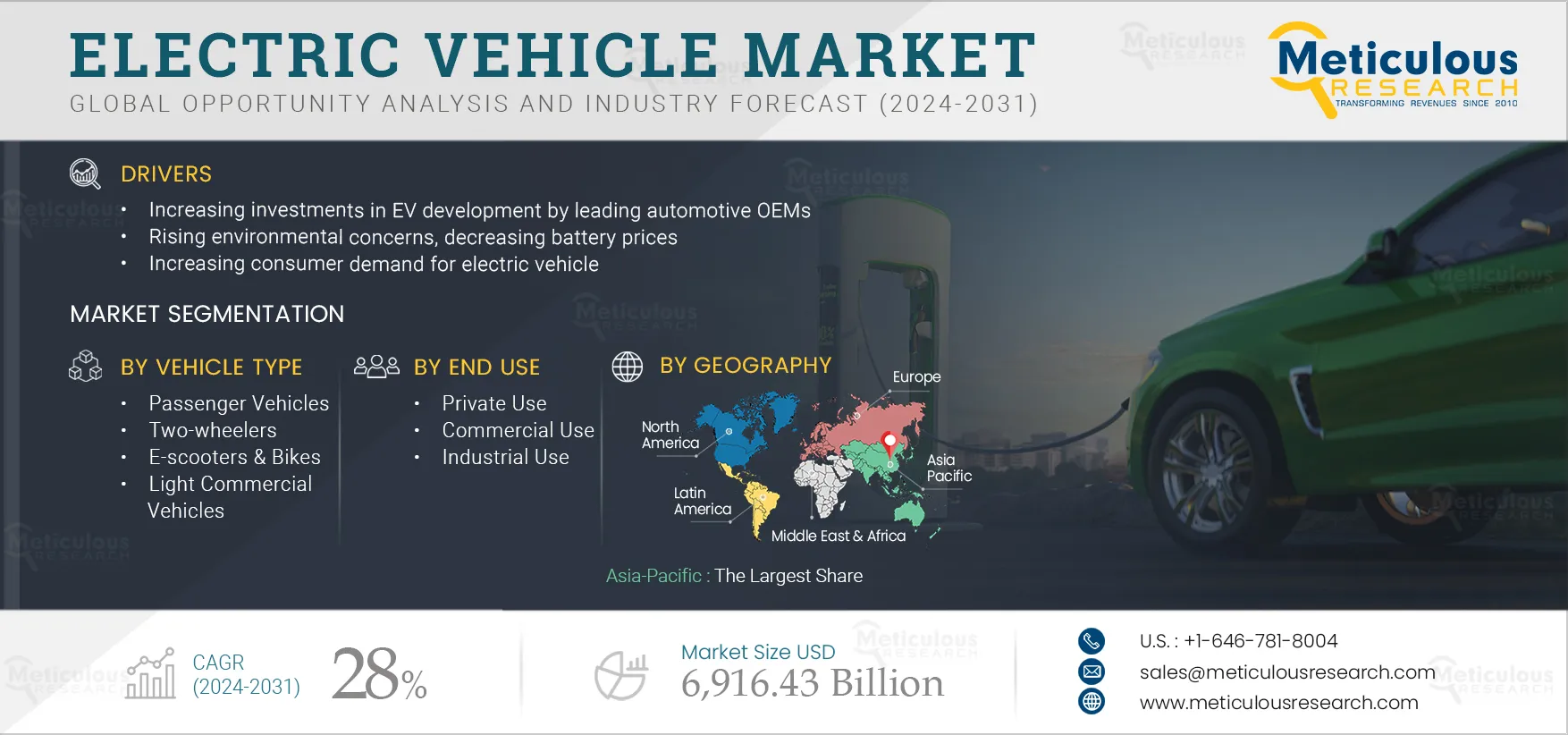
The Electric Vehicle Market is expected to reach $ 6,916.43 billion by 2031, at a CAGR of 28% from 2024–2031. By volume, this market is expected to reach 446.54 million units by 2031, at a CAGR of 20.5% from 2024–2031.
- Published
- Jan 2024
- Pages
- 265
- Format
- PDF + Excel
- Report ID
- MR-485
- Base year
- 2023
- 2031 · FORECAST
- $6.92T
- 2031
- $6.92T
- CAGR 2024–2031
- 28%
2023 baseline · 2024–2031 forecast at 28% CAGR · hover a bar for the value
Key highlights
By Vehicle Type: In 2024, the Passenger Vehicle Segment to Dominate the Electric Vehicle Market
By Power Output: In 2024, the Less Than 100 kW Segment to Dominate the Electric Vehicle Market
By Propulsion Type: In 2024, the Battery Electric Vehicle Segment to Dominate the Electric Vehicle Market
By End Use: In 2024, the Private Use Segment to Dominate the Electric Vehicle Market
Report summary
| Particulars | Details |
|---|---|
| Number of Pages | 265 |
| Format | |
| Forecast Period | 2024–2031 |
| Base Year | 2023 |
| CAGR (Units) | 20.5% |
| Market Size (Units) | 446.54 Million Units by 2031 |
| CAGR (Value) | 28% |
| Market Size (Value) | USD 6,916.43 Billion by 2031 |
| Segments Covered | By Vehicle Type · Passenger Vehicle · Two-wheelers · E-scooters & Bikes · Light Commercial Vehicle · Heavy Commercial Vehicle · By Power Output · Less Than 100 kW · 100 kW to 250 kW · More Than 250 kW · By Propulsion Type · Hybrid Electric Vehicle · Pure Hybrid Electric Vehicle · Plug-In Hybrid Electric Vehicle · Battery Electric Vehicle · By End Use · Private Use · Commercial Use · Shared Mobility · Micromobility · Public Transport · Industrial Use |
| Countries Covered | Asia-Pacific (China, India, Japan, South Korea, Singapore, Thailand, Rest of Asia-Pacific), Europe (Germany, France, U.K., Norway, Sweden, Netherlands, Italy, Spain, Switzerland, Denmark, Rest Of Europe), North America (U.S., Canada), Latin America, Middle East & Africa |
| Key Companies | Tesla, Inc. (U.S.), BMW AG (Germany), BYD Company Ltd. (China), Volkswagen AG (Germany), Hyundai Motor Company (South Korea), Volvo Group (Sweden), Mercedes-Benz Group AG (Germany), Ford Motor Company (U.S.), Honda Motor Co., Ltd. (Japan), General Motor Company (U.S.), Nissan Motor Co., Ltd. (Japan), Tata Motors Limited (India), Alcraft Motor Company Ltd. (U.K.), Zero Electric Vehicle Inc. (U.S.), and Faraday & Future Inc. (U.S.) |
Report overview
Segments covered: vehicle type, propulsion type, end use, power output, charging standard. Regions: Asia-Pacific, Europe, North America.
The growth of the global electric vehicle market is driven by factors such as supportive government policies and regulations, increasing investments in EV development by leading automotive OEMs, rising environmental concerns, decreasing battery prices, and the increasing consumer demand for electric vehicle. The growing adoption of autonomous electric vehicle and the increasing focus on electric mobility in emerging economies are expected to generate growth opportunities for the stakeholders in this market.
However, the high purchasing costs of electric vehicle and the lack of charging infrastructure in developing countries are expected to obstruct the growth of this market to some extent. The range anxiety among consumers and the low cold weather performance of electric vehicle are major challenges for market growth. Additionally, shared mobility, smart EV charging stations, wireless EV charging, and solar-powered EV charging stations are prominent trends in the global electric vehicle market.
Market dynamics
5 factors across 3 forcesSupportive Government Policies and Regulations is Driving the Demand for Electric Vehicle Market
Governments around the world are implementing policies and regulations to support EV adoption. Financial incentives, such as tax credits and rebates, are being offered to encourage consumers to purchase electric vehicle. These incentives are helping reduce the upfront costs of electric vehicle, making them more affordable for consumers. For instance, in July 2022, the Government of Chhattisgarh (India) announced an electric vehicle (EV) policy to help create robust EV charging infrastructure in the Indian state of Chhattisgarh, accelerate the transition from Internal Combustion Engine (ICE) vehicle to electric vehicle, and incentivize EV manufacturing. Many companies in the automotive industry are leveraging government policies and regulations and investing heavily in the development and production of electric vehicle as a part of their commitment to creating a more sustainable and environment-friendly future. The U.S. federal government under the Biden administration has shown a strong commitment to promoting EV adoption. For instance, in 2021, the U.S. federal government announced tax credits on the purchase of electric vehicle. Also, there were discussions about potentially expanding and extending these tax credits to further incentivize EV adoption.
Increasing Investments in EV Development by Leading Automotive OEMs Boosting Market Growth
The global automotive industry is gradually transitioning from fossil fuel-based vehicle to electric vehicle. Technological advancements and increasing investments in EV development by automotive OEMs, coupled with decreasing battery prices, are driving the growth of this market. In 2022, the Chinese government set targets requiring fixed parking spaces in newly built residential communities to have charging facilities and meet charging station installation requirements to make residential charging more accessible. Leading automotive companies are investing significantly in EV development to meet the increasing demand for electric vehicle.
Table of contents
13 chapters · 167 sections · 265 pages · click to expandSegmental analysis
| Segment | Largest share (2024) | Fastest growth (2024–2031) |
|---|---|---|
| By Vehicle Type | Passenger Vehicle | Light commercial |
| By Power Output | Less Than 100 kW | Less than 100 kW |
| By Propulsion Type | Battery Electric Vehicle | Battery electric vehicle |
| By End Use | Private Use | Commercial use |
By Vehicle Type
- The passenger vehicle segment is expected to account for the largest share of 76.2% of the global electric vehicle market.
- The large share of this segment is attributed to increasing favorable government policies and subsidies for promoting the adoption of electric vehicle, growing awareness regarding the role of electric vehicle in reducing emissions, increasing fuel prices, and proactive participation by automotive OEMs in producing electric passenger vehicle.
- However, the light commercial segment is expected to grow at the highest CAGR during the forecast period.
- The growth of this segment is attributed to the growing awareness regarding the role of electric vehicle in reducing emissions, the increase in demand for electric vehicle to reduce fleet emissions, and stringent government rules and regulations towards vehicle emissions.
By Power Output
- The Less Than 100 kW Segment to Dominate the Electric Vehicle Market
- The less than 100 kW segment is expected to account for the largest share of 67.0% of the global electric vehicle market.
- The large share of this segment is attributed to the increasing adoption of electric scooters and mopeds, increasing investments by government authorities in the development of EV charging infrastructure, and favorable policies, incentives, and subsidies introduced by several state governments.
- Moreover, the less than 100 kW segment is expected to grow at the highest CAGR during the forecast period.
- The high growth of this segment is attributed to the increasing adoption of electric scooters and mopeds, increasing investments by government authorities in the development of EV charging infrastructure, and favorable policies, incentives, and subsidies introduced by several state governments.
By Propulsion Type
- The battery electric vehicle segment is expected to account for the largest share of 64.9% of the global electric vehicle market.
- The large share of this segment is attributed to stringent emission standards, rising demand for increased fuel efficiency, growing demand for zero-emission vehicle, and increasing adoption of battery electric vehicle as private vehicle, autonomous delivery vehicle, industrial vehicle, and public transport.
- Moreover, the battery electric vehicle segment is expected to grow at the highest CAGR during the forecast period.
- Innovations in electric vehicles, such as improvements in power and torque, are creating new opportunities for utilizing battery electric vehicle (BEV) in diverse environments.
- In addition, increasing initiatives by local government bodies and automotive players for developing BEVs, the proliferation of fast & ultra-fast charging technologies, and increasing acceptance due to reduced noise & vibrations with no emissions drive the BEVs market.
By End Use
- The Private Use Segment to Dominate the Electric Vehicle Market
- The private use segment is expected to account for the largest share of 63.9% of the global electric vehicle.
- The growth of the segment is attributed to the growing awareness regarding the hazards associated with greenhouse gas emissions and environmental pollution, stringent emission norms, and demand for premium EVs among consumers.
- Also, supportive government incentives to promote the sales and manufacturing of EVs, tax rebates, and the decline in battery costs are further driving the adoption of EVs among consumers for private use.
- However, the commercial use segment is expected to grow at the highest CAGR during the forecast period.
- The growth of this segment is attributed to the increase in fuel prices and stringent emission norms set by governments, the growing adoption of autonomous delivery vehicle, and the increasing adoption of electric buses and trucks.
- Several manufacturers and suppliers in countries including Spain, the U.S., France, and Japan are focused on improving battery and charging technology efficiency for commercial EVs.
- China is by far the forerunner when it comes to making e-buses.
- For instance, in September 2021, Tata Motors announced the commercial launch of the ‘XPRES T EV’ for fleet customers with FAME subsidy pricing.
- The XPRES-T EV will come with an optimal battery size and a captive fast charging solution, ensuring outstandingly low ownership cost in addition to safety and passenger comfort, making it a comprehensive and attractive proposition for fleet owners and operators.
Geographic analysis
Asia-Pacific
Largest shareIn 2024, Asia-Pacific is expected to account for the largest share of 59.6% of the global electric vehicle market. Asia-Pacific electric vehicle market is estimated to be worth USD 733.44 billion in 2024. In recent years, the electric vehicle (EV) market has grown rapidly in the Asia Pacific region. China, Japan, and South Korea are providing subsidies and tax incentives and implementing regulations to support the development and adoption of EVs and reduce greenhouse gas emissions and air pollution. In 2024, Asia-Pacific Region to Dominate the Electric Vehicle Market
Europe
Fastest growthHowever, Europe is expected to become the fastest growing region in the global electric vehicle market by 2031. The high growth of the electric vehicle market in the European region is majorly attributed to the consistent developments in making stringent emission regulations by the European Union and increasing focus on reducing the number of conventional cars. Norway leads the way for electric mobility adoption in Europe. According to the European Automobile Manufacturers Association (ACEA) report, In June, new registrations of battery-electric cars in the EU increased by a significant 66.2%, reaching 158,252 units. Battery-electric cars are the third most popular choice among new car buyers, overtaking diesel cars. Most EU markets recorded impressive double- and triple-digit percentage gains, including the largest, such as the Netherlands (+90.1%), Germany (+64.4%), and France (+52.0%).
Competitive landscape
- September 2022
BYD Company Ltd. (China) partnered with the Los Olivos Elementary School District to bring a BYD Type A electric school bus. Students in Santa Barbara County and create the first U.S. school district to have a 100% zero-emission fleet of school buses.
- March 2021
Volkswagen AG (Germany) unveiled the first design preview of Project Trinity, an electrically powered sedan that will go into Wolfsburg's series production in 2026.
- June 2022
Hyundai Motor Company (South Korea) and Grab have expanded their partnership to accelerate the adoption of electric vehicle (EVs) in Southeast Asia.
- Tesla, Inc. (U.S.)
- BMW AG · Germany
- BYD Company Ltd. · China
- Volkswagen AG · Germany
- Hyundai Motor Company · South Korea
- Volvo Group · Sweden
- Mercedes-Benz Group AG · Germany
- Ford Motor Company (U.S.)
- Honda Motor Co., Ltd. · Japan
- General Motor Company (U.S.)
- Nissan Motor Co., Ltd. · Japan
- Tata Motors Limited · India
- Alcraft Motor Company Ltd. (U.K.)
- Zero Electric Vehicle Inc. (U.S.)
- Faraday & Future Inc. (U.S.)
Frequently asked questions
The electric vehicle market study focuses on the market assessment and opportunity analysis through the sales of electric vehicle across different region, and countries, this study is also focused on competitive analysis for electric vehicle based on an extensive assessment of the leading players’ product portfolios, geographic presence, and key growth strategies.
Cite this report
Meticulous Research. (2024). Electric Vehicle Market - Global Opportunity Analysis and Industry Forecast (2024-2031) (Report No. MR-485). Meticulous Market Research Pvt. Ltd. https://www.meticulousresearch.com/product/electric-vehicle-market-5179