- Home
- Reports
- Healthcare
- Targeted Drug Delivery Market
Targeted Drug Delivery Market Size, Share & Trends Analysis, by Technology, Application, End User, and Geography - Global Forecast to 2036
Market Overview
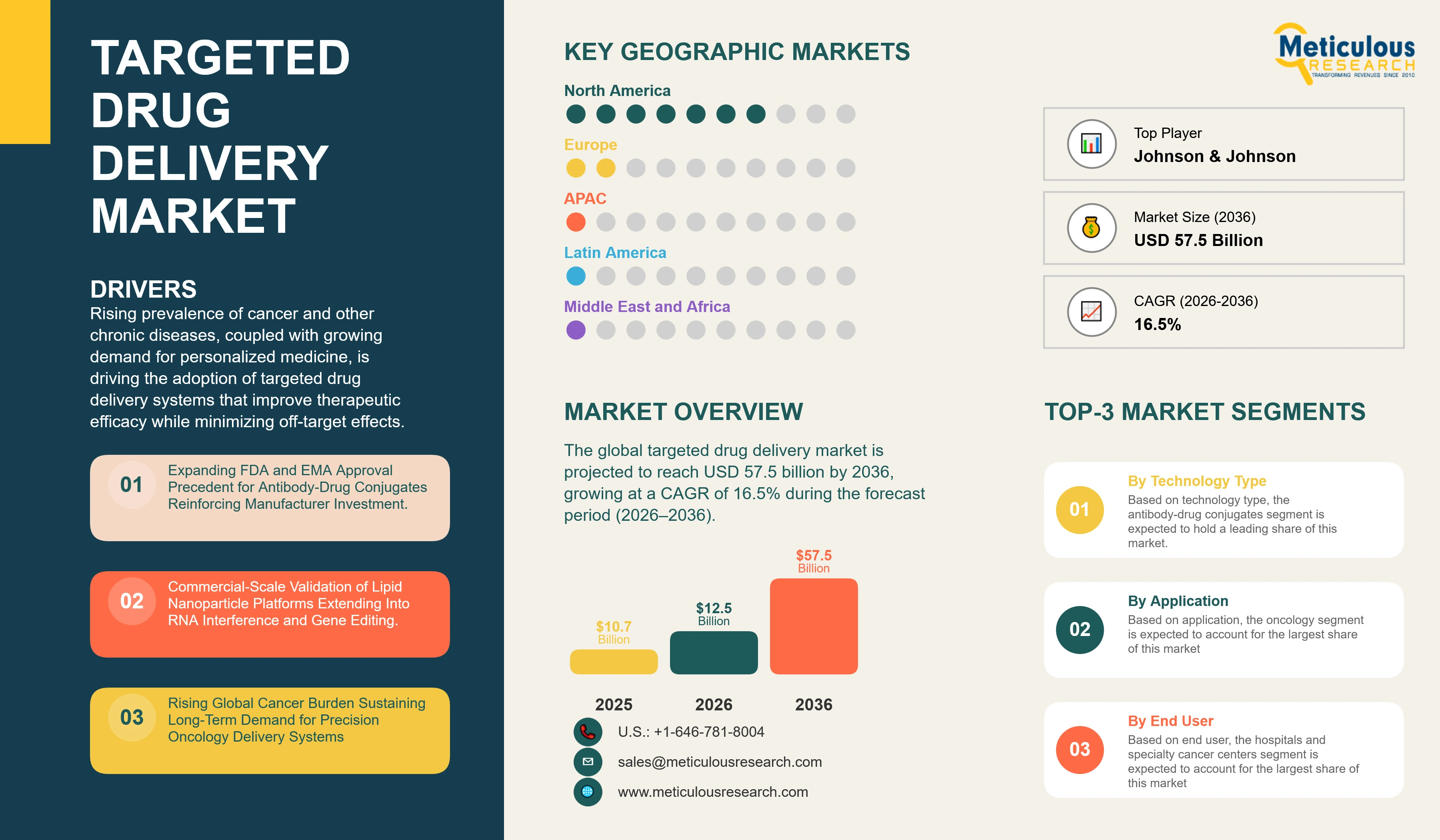
The global targeted drug delivery market was valued at USD 10.7 billion in 2025. The market is projected to reach USD 57.5 billion by 2036, growing from USD 12.5 billion in 2026 at a CAGR of 16.5% during the forecast period (2026–2036).
Key Highlights
- The global targeted drug delivery market is projected to reach USD 57.5 billion by 2036.
- The market is expected to grow at a CAGR of 16.5% during the forecast period 2026–2036.
- The total targeted drug delivery market was valued at USD 10.7 billion in 2025 and is estimated to reach USD 12.5 billion in 2026.
- North America is expected to dominate this market with the largest revenue share in 2026, driven by the concentration of oncology drug approvals through the U.S. FDA, the density of biopharmaceutical manufacturers developing antibody-drug conjugates and lipid nanoparticle platforms, and well-established reimbursement pathways for high-cost precision therapeutics.
- Asia Pacific is projected to witness the fastest revenue growth during the forecast period, driven by the rising cancer burden across China and India, expanding biologics manufacturing capacity, and growing government investment in nanomedicine and biotechnology research infrastructure.
- By technology, the antibody-drug conjugates segment is expected to hold a leading share of the market in 2026, supported by an expanding base of regulatory approvals and label extensions across solid tumor and hematologic cancer indications.
- By technology, the lipid nanoparticle segment is projected to register the highest growth during the forecast period, driven by the platform's validated clinical and manufacturing track record following its use in messenger RNA vaccines and its extension into RNA interference and gene-editing therapeutics.
- By application, the oncology segment is expected to account for the largest share of the market in 2026, while the genetic and rare disorders segment is projected to register the highest CAGR during the forecast period.
- By geography, North America is expected to dominate the market in 2026, while Asia Pacific is expected to witness the fastest growth during the forecast period.
Executive Summary

Click here to: Get Free Sample Pages
The global targeted drug delivery market comprises technologies designed to selectively deliver therapeutic agents to specific tissues, cells, or molecular targets while minimizing exposure to healthy tissues. The market includes antibody-drug conjugates (ADCs), lipid nanoparticles, liposomal drug delivery systems, polymeric nanoparticles and micelles, monoclonal antibody-based immunoconjugates, and other ligand-directed carrier platforms. These technologies are used across oncology, infectious diseases, genetic and rare disorders, cardiovascular diseases, central nervous system disorders, and autoimmune and inflammatory conditions.
Targeted delivery supports the pharmaceutical industry's transition toward precision medicine by improving drug biodistribution, cellular uptake, and therapeutic exposure at the intended site of action. These technologies are particularly important for biologics, cytotoxic payloads, and nucleic acid-based therapeutics, where conventional systemic administration may result in limited target-site delivery or increased toxicity.
The growing global burden of cancer and other chronic and complex diseases is a major driver of market growth. In oncology, ADCs and other targeted therapeutic platforms are increasingly used across multiple hematologic malignancies and solid tumors. Continued regulatory approvals and expanding clinical pipelines are strengthening investment in conjugate-based delivery technologies.
Lipid nanoparticle platforms have also gained significant commercial and clinical validation, particularly through large-scale mRNA vaccine manufacturing. This experience is supporting their broader application in RNA therapeutics, gene-editing technologies, and next-generation vaccines.
However, market growth is constrained by high development and manufacturing costs, complex formulation and quality-control requirements, and challenges related to payload stability, linker design, immunogenicity, and scalability. Nevertheless, the expanding precision medicine pipeline, increasing adoption of RNA-based therapeutics, and growing interest in targeted delivery for difficult-to-treat diseases are expected to create substantial opportunities for companies developing scalable and clinically validated delivery platforms.
Market Growth Drivers
Expanding FDA and EMA Approval Precedent for Antibody-Drug Conjugates Reinforcing Manufacturer Investment in Conjugate Platforms
The regulatory precedent for antibody-drug conjugates (ADCs) has strengthened substantially, reducing uncertainty for developers of conjugate-based therapies. The U.S. FDA reported 11 approved oncology ADCs as of January 2024 and issued its first dedicated Clinical Pharmacology Considerations for Antibody-Drug Conjugates guidance in March 2024, covering dosing, exposure-response, bioanalytical methods, immunogenicity, and drug-drug interactions. The agency subsequently approved datopotamab deruxtecan in January 2025 and telisotuzumab vedotin in May 2025, expanding ADC use into breast and lung cancers. This growing regulatory experience is strengthening confidence in ADC development and supporting investment in differentiated antibodies, payloads, and linker technologies.
Lipid Nanoparticle Platform Validated at Commercial Scale Extending Into RNA Interference and Gene Editing Applications
Lipid nanoparticles (LNPs) have progressed from a specialized nucleic-acid delivery technology to a clinically validated platform. The WHO reported that 13.6 billion COVID-19 vaccine doses had been administered globally by November 2023, with mRNA vaccines representing a major component of this deployment; mRNA vaccines use LNPs to deliver nucleic acids into cells. LNP technology also received direct therapeutic validation with FDA approval of patisiran (Onpattro) in 2018, the first LNP-formulated siRNA therapy. These milestones are supporting broader development of LNP-enabled RNA therapeutics and emerging gene-editing applications.
Rising Global Cancer Burden Sustaining Long-Term Demand for Precision Oncology Delivery Systems
Cancer remains the largest demand anchor for many targeted delivery technologies. The latest GLOBOCAN 2024 estimates report 20.6 million new cancer cases and 9.8 million deaths globally in 2024, with approximately 1 in 5 people developing cancer during their lifetime. The number of new cases is projected to reach 34.4 million by 2050, a 67% increase from 2024, driven primarily by population growth and aging. Breast, lung, colorectal, and prostate cancers remain among the most commonly diagnosed malignancies, sustaining demand for delivery approaches capable of improving tumor targeting and therapeutic exposure.
Segment Analysis
By Technology: In 2026, the Antibody-Drug Conjugates Segment to Lead the Global Targeted Drug Delivery Market
Based on technology, the targeted drug delivery market is segmented into antibody-drug conjugates, lipid nanoparticles, liposomal drug delivery systems, polymeric nanoparticles and micelles, monoclonal antibody-based immunoconjugates, and other targeted carrier platforms. In 2026, the antibody-drug conjugates segment is expected to hold a leading share of this market. This position mainly driven by the established regulatory precedent, its growing base of approved products across solid tumor and hematologic malignancy indications, and the depth of clinical experience biopharmaceutical developers have accumulated in linker chemistry, payload selection, and antigen target validation. Leading developers including F. Hoffmann-La Roche Ltd, AstraZeneca plc, Daiichi Sankyo Company, Limited, Pfizer Inc., Gilead Sciences, Inc., and AbbVie Inc. maintain approved or late-stage conjugate portfolios that continue to sustain this segment's leadership position.
However, the lipid nanoparticle segment is projected to register the highest growth during the forecast period. The high growth of this segment is driven by the platform's demonstrated manufacturing scalability following its central role in messenger RNA vaccine production, its extension into RNA interference and gene-editing therapeutic candidates, and continued platform licensing activity between specialized lipid nanoparticle technology developers and biopharmaceutical companies seeking to advance nucleic acid-based pipelines.
By Application: In 2026, the Oncology Segment to Hold the Largest Share
Based on application, the targeted drug delivery market is segmented into oncology, infectious diseases, genetic and rare disorders, cardiovascular diseases, central nervous system disorders, autoimmune and inflammatory diseases, and other applications. In 2026, the oncology segment is expected to account for the largest share of this market. This leadership due to increasing global cancer incidence, the concentration of approved targeted therapeutics in solid tumor and hematologic malignancy indications, and continued clinical trial investment directed at expanding existing conjugate and nanoparticle products into new tumor types and earlier lines of therapy.
However, the genetic and rare disorders segment is projected to register the highest growth during the forecast period. The high growth of this segment is driven by the extension of lipid nanoparticle and other nucleic acid delivery platforms into gene-editing and RNA interference candidates targeting inherited metabolic and neuromuscular disorders, along with regulatory incentives such as orphan drug designation that are shortening development timelines for rare disease programs.
By End User: In 2026, the Hospitals and Specialty Cancer Centers Segment to Hold the Largest Share
Based on end user, the targeted drug delivery market is segmented into hospitals and specialty cancer centers, biopharmaceutical manufacturers and research institutes, ambulatory and specialty infusion centers, and contract research and manufacturing organizations. In 2026, the hospitals and specialty cancer centers segment is expected to account for the largest share of this market, driven by the requirement for supervised intravenous administration and infusion monitoring associated with most approved antibody-drug conjugates and liposomal therapeutics.
However, the contract research and manufacturing organizations segment is projected to register meaningful growth during the forecast period, driven by the technical complexity of conjugation chemistry and lipid nanoparticle formulation, which is leading an increasing share of biopharmaceutical developers to outsource process development and commercial-scale manufacturing to specialized partners such as Lonza Group AG.
Geographical Analysis
Based on geography, the overall targeted drug delivery market is segmented into North America, Europe, Asia Pacific, Latin America, and the Middle East and Africa. In 2026, North America is expected to account for the largest share of this market. This position is supported by the concentration of oncology drug approvals through the U.S. FDA, a dense cluster of biopharmaceutical companies advancing antibody-drug conjugate and lipid nanoparticle pipelines, and established reimbursement frameworks for high-cost precision therapeutics within the U.S. healthcare system.
However, the Asia Pacific targeted drug delivery market is expected to grow at the fastest rate from 2026 to 2036. This growth is supported by the scale of the region's cancer burden, with China alone accounting for a substantial share of global cancer cases and deaths, alongside expanding biologics manufacturing capacity in China, India, South Korea, and Japan, and growing government investment in biotechnology and nanomedicine research infrastructure across the region.
Europe represents a large and well-established market for targeted drug delivery, supported by a coordinated regulatory framework under the European Medicines Agency and a strong base of academic and industrial nanomedicine research. The Middle East and Africa and Latin America regions represent developing markets, supported primarily by expanding access to oncology biologics and growing clinical trial activity in select countries.
Key Companies
The global targeted drug delivery market is moderately consolidated, with competition primarily driven by proprietary carrier platform technology, depth of clinical pipeline, manufacturing scale for complex biologic conjugates and nanoparticle formulations, and the strength of platform licensing and partnership networks with biopharmaceutical developers.
Large diversified biopharmaceutical companies including F. Hoffmann-La Roche Ltd, AstraZeneca plc, Pfizer Inc., Gilead Sciences, Inc., AbbVie Inc., and Johnson & Johnson compete through broad targeted therapeutic portfolios spanning antibody-drug conjugates and immunoconjugates, extensive global commercial infrastructure, and continued pipeline expansion through both internal development and acquisition of specialized platform developers. Specialized RNA and nucleic acid delivery companies including Alnylam Pharmaceuticals, Inc., Arrowhead Pharmaceuticals, Inc., Ionis Pharmaceuticals, Inc., Moderna, Inc., and BioNTech SE compete through proprietary lipid nanoparticle and conjugate delivery platforms. Platform technology licensors including Arbutus Biopharma Corporation and Halozyme Therapeutics, Inc. maintain strong positions through licensing arrangements with biopharmaceutical partners. Specialty conjugate developers including ADC Therapeutics SA, Mersana Therapeutics, Inc., CytomX Therapeutics, Inc., and Nanobiotix S.A. compete through differentiated platform chemistry and targeted clinical programs, while Ipsen S.A. and Jazz Pharmaceuticals plc maintain established positions in approved liposomal formulations, and Lonza Group AG competes as a leading manufacturing partner for complex conjugate and nanoparticle production.
The report provides a comprehensive competitive analysis based on an assessment of key players' product portfolios, pipeline depth, and strategic initiatives undertaken over the past few years.
Some of the key players operating in the global targeted drug delivery market include F. Hoffmann-La Roche Ltd (Switzerland), AstraZeneca plc (U.K.), Daiichi Sankyo Company, Limited (Japan), Pfizer Inc. (U.S.), Gilead Sciences, Inc. (U.S.), AbbVie Inc. (U.S.), Johnson & Johnson (U.S.), Ipsen S.A. (France), Jazz Pharmaceuticals plc (Ireland), Alnylam Pharmaceuticals, Inc. (U.S.), Arrowhead Pharmaceuticals, Inc. (U.S.), Ionis Pharmaceuticals, Inc. (U.S.), Moderna, Inc. (U.S.), BioNTech SE (Germany), Arbutus Biopharma Corporation (Canada), Halozyme Therapeutics, Inc. (U.S.), Lonza Group AG (Switzerland), ADC Therapeutics SA (Switzerland), Mersana Therapeutics, Inc. (U.S.), CytomX Therapeutics, Inc. (U.S.), and Nanobiotix S.A. (France), among others.
Market Research Summary
|
Parameters |
Details |
|
Market Size by 2036 |
USD 57.5 Billion |
|
Market Size in 2026 |
USD 12.5 Billion |
|
Market Size in 2025 |
USD 10.7 Billion |
|
Revenue Growth Rate (2026–2036) |
CAGR of 16.5% |
|
Dominating Technology |
Antibody-Drug Conjugates |
|
Fastest Growing Technology |
Lipid Nanoparticles |
|
Dominating Application |
Oncology |
|
Fastest Growing Application |
Genetic and Rare Disorders |
|
Dominating Geography |
North America |
|
Fastest Growing Geography |
Asia Pacific |
|
Base Year |
2025 |
|
Forecast Period |
2026 to 2036 |
Frequently Asked Questions
Related Tags
How We Built This Intelligence
Table of Contents
Expand allAccess & Licensing
Choose how you access this intelligence — from a standalone data pack to organization-wide access. Every option is delivered within 24–48 hours and backed by analyst support.
Related Statistics & Insights
Need something more specific?
A custom-scoped study can target a single segment, geography, or competitor set — or answer a board-level question this syndicated report doesn't. Tell an analyst what decision you're making and we'll scope it.