HealthcareReport ID: MR-2165Sep 2026308 PagesGlobal
Verified by the Meticulous Standard·Last verified: May 2026 by Specialist Analyst

Biologics Fermentation Capacity Market Size, Share, Trends & Forecast Analysis by System Type (Single-Use Bioreactor Systems, Stainless Steel/Reusable Bioreactor Systems, Hybrid Systems), Scale of Operation (Bench & Pilot Scale, Clinical Scale, Commercial/Large Scale), Mode of Operation (Batch, Fed-Batch, Perfusion/Continuous), Cell/Organism Type (Mammalian Cell Culture, Microbial Fermentation, Others), Application, End User, and Geography ΓÇö Global Forecast to 2036

Published Date: Sep 2026
Format: PDF + Excel + Cloud Portal
Pages / Size: 308 Pages
Analyst: Specialist Analyst
Secure checkout · Full methodology disclosure · Underwritten by lead analyst Specialist Analyst
Biologics Fermentation Capacity Market Size
Biologics Fermentation Capacity Market Sizing & Sourcing
Base year: 2025 · CAGR: 7.2%
$5.86B
Market size 2025
$6.42B
Market size 2026
$12.84B
Forecast by 2036
7.2%
CAGR 2026–2036

Market Overview

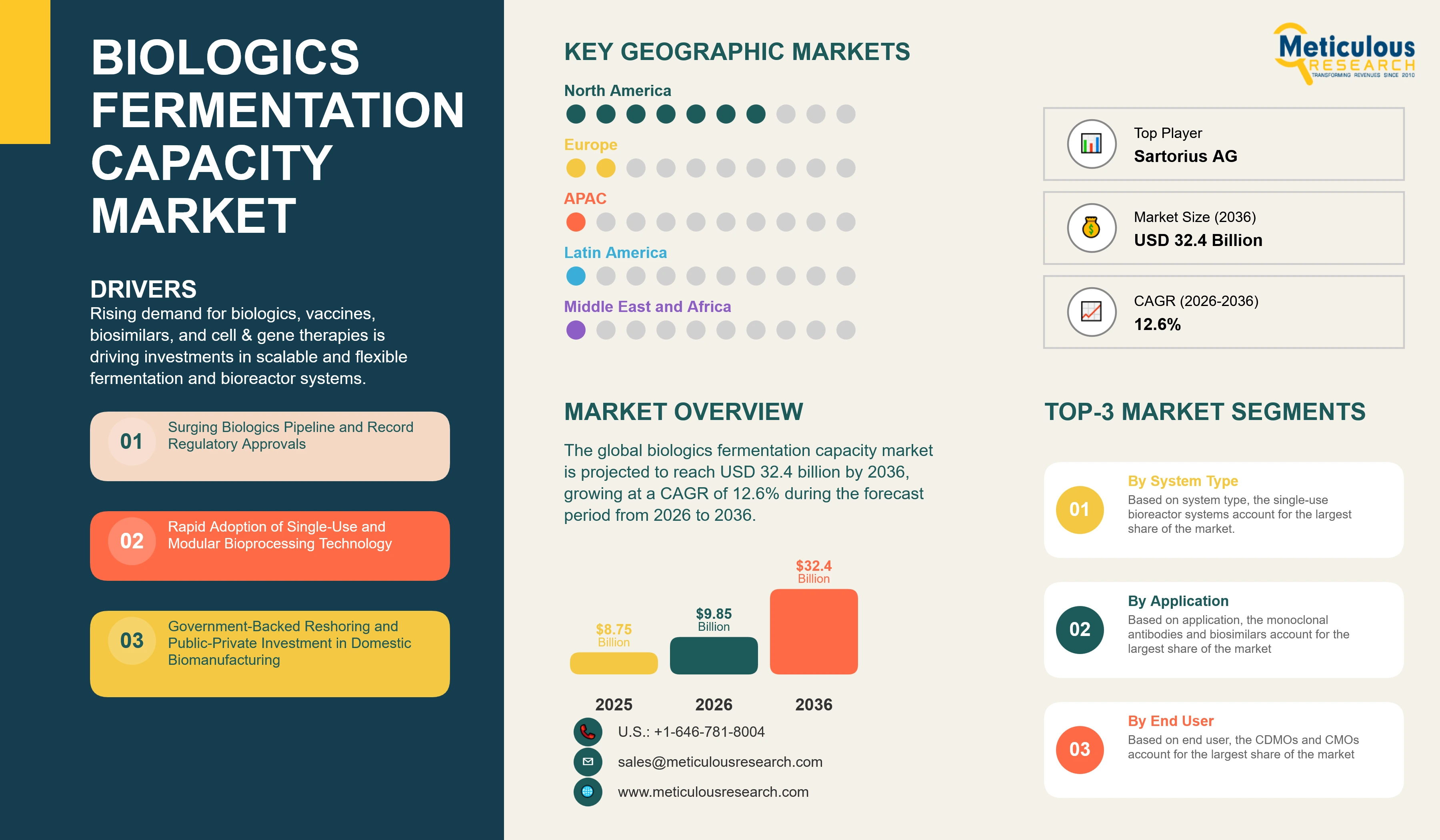
The global biologics fermentation capacity market is projected to reach USD 32.4 billion by 2036 from an estimated USD 9.85 billion in 2026, at a CAGR of 12.6% during the forecast period from 2026 to 2036. Single-use bioreactor systems account for the largest share of installed capacity additions through most of the forecast period, reflecting their lower capital intensity and faster commissioning timelines, while hybrid facility designs that combine single-use flexibility with stainless-steel scale represent the fastest-growing system category as large-scale commercial manufacturers balance speed-to-capacity with the economics of high-volume production.

Key Highlights

  • The global biologics fermentation capacity market is projected to reach USD 32.4 billion by 2036, growing at a CAGR of 12.6% during 2026–2036, driven by a record biologics pipeline, rapid adoption of single-use and modular bioprocessing technology, and government-backed reshoring of domestic biomanufacturing capacity.
  • The FDA's Center for Biologics Evaluation and Research approved 24 new Biologics License Applications in 2024, extending a multi-year climb from 12 and 13 approvals in 2021 and 2022, and included a record 13 new monoclonal antibodies, underscoring the growing volume of biologics requiring fermentation and cell culture capacity.
  • The competitive landscape spans established bioprocess equipment manufacturers including Sartorius AG, Cytiva (Danaher Corporation), Thermo Fisher Scientific, Merck KGaA (MilliporeSigma), Eppendorf SE, ABEC, PBS Biotech, Getinge (Applikon Biotechnology), Distek, Cellexus, Solaris Biotech, INFORS HT, Bioengineering AG, GEA Group, ZETA, and Pierre Guerin, each expanding single-use, stainless-steel, and hybrid bioreactor portfolios.
  • Thermo Fisher Scientific introduced its 5-liter DynaDrive single-use bioreactor in February 2026 for small-scale, GMP-ready bioprocessing, while Cytiva expanded its Xcellerex platform with 500-liter and 2,000-liter single-use systems in March 2025, illustrating continued platform broadening across scales.
  • The National Institute for Innovation in Manufacturing Biopharmaceuticals, a public-private partnership operating under a cooperative agreement with the U.S. National Institute of Standards and Technology, has awarded more than USD 111 million across over 120 biopharmaceutical manufacturing technology and workforce projects since its 2017 launch, including a testbed facility advancing continuous bioprocessing.
  • The European Commission proposed the European Biotech Act on December 16, 2025, alongside the earlier Critical Medicines Act of March 2025, both aimed at expanding EU biomanufacturing capacity through fast-tracked permitting, streamlined environmental assessments, and targeted financial support for strategic manufacturing projects.
  • India's Department of Pharmaceuticals operates a dedicated Production Linked Incentive Scheme for Bulk Drugs with a financial outlay of Γé╣6,940 crore, requiring a minimum domestic value addition of 90% for fermentation-based products and covering fermentation-based antibiotics such as erythromycin, neomycin, and gentamicin, though disbursement under the fermentation-heavy bulk drugs component has lagged the broader pharmaceuticals scheme.
  • FUJIFILM Diosynth Biotechnologies is expanding its Hillerød, Denmark site to twelve 20,000-liter mammalian cell bioreactors with integrated fill-finish capability, one of the largest single biologics drug substance capacity investments underway in Europe.
  • North America and Europe together hold the largest revenue share in 2026, supported by dense CDMO networks and regulatory approval volumes, while Asia-Pacific is expected to register the fastest CAGR on the back of large-scale capacity build-out in China and South Korea and national bulk drug and biopharma manufacturing incentive programmes in India.

Executive Summary

Click here to: Get Free Sample Pages

Fermentation capacity refers to the installed base of bioreactor and fermenter systems, together with the associated upstream processing equipment, used to cultivate mammalian cells, bacteria, yeast, and other production organisms for manufacturing biologic drugs. The category covers classical stainless-steel, reusable bioreactor vessels engineered for large, dedicated commercial production; single-use or disposable bioreactor systems built around pre-sterilized polymer bags that eliminate cleaning and sterilization cycles between batches; and hybrid facility designs that combine both formats within the same manufacturing footprint. Fermentation capacity is installed to produce monoclonal antibodies and biosimilars, vaccines, recombinant proteins and enzymes, and a fast-growing set of cell and gene therapy products, using either mammalian cell culture platforms such as CHO and HEK293 cell lines or microbial fermentation platforms based on bacteria and yeast.

The category has moved well beyond the era when stainless-steel vessels were the default choice for any biologics facility. Sartorius, Cytiva, Thermo Fisher Scientific, and Merck KGaA now offer single-use bioreactor platforms spanning bench-scale development systems through multi-thousand-liter commercial production vessels, while specialist manufacturers such as ABEC, PBS Biotech, and Distek focus on custom, large-format single-use systems and vertical-wheel or advanced therapy-specific designs. At the same time, contract development and manufacturing organizations including FUJIFILM Diosynth Biotechnologies and WuXi Biologics continue to invest in very large stainless-steel and microbial fermenter capacity for high-volume commercial programmes, reflecting the reality that no single system type serves every stage of the biologics manufacturing lifecycle.

Demand for fermentation capacity is increasingly shaped by the sheer scale of the biologics pipeline rather than by any single therapeutic class. Regulatory approval volumes for monoclonal antibodies, biosimilars, and cell and gene therapies continue to climb, placing sustained pressure on both in-house biopharmaceutical manufacturers and outsourced CDMO networks to add fermentation capacity quickly and predictably. Government policy is reinforcing this pressure in several major markets, such as, the United States has directed public-private investment through NIIMBL into manufacturing technology and workforce readiness, the European Union has proposed the Critical Medicines Act and European Biotech Act to fast-track EU-based manufacturing capacity, and India has structured a dedicated incentive scheme for fermentation-based bulk drug production. These factors are expected to support strong, sustained growth in the biologics fermentation capacity market through 2036.

Market Opportunities

  • Thermo Fisher Scientific introduced the 5-liter DynaDrive single-use bioreactor in February 2026, aimed at small-scale and academic GMP-ready bioprocessing.
  • Cytiva expanded its Xcellerex platform in March 2025 with the addition of 500-liter and 2,000-liter single-use bioreactors to support monoclonal antibody and vaccine production.
  • FUJIFILM Diosynth Biotechnologies launched the first phase of its Hillerød, Denmark expansion in November 2024, adding six mammalian cell bioreactors toward a site total of twelve 20,000-liter vessels with fill-finish capability.
  • ABEC launched its Advanced Therapy Bioreactor in March 2025, a single-use system designed to mimic human circulation for scalable cell therapy manufacturing.
  • PBS Biotech secured USD 17 million in funding in January 2025 from Avego Management and BroadOak Capital Partners to accelerate development of its Vertical-Wheel bioreactor platform.
  • Merck KGaA's MilliporeSigma business launched a dedicated antibody-drug-conjugate bioreactor within its Mobius single-use platform in September 2024.
  • Getinge's Applikon Biotechnology business introduced its SUPR production-scale single-use bioreactor in 2024.
  • WuXi Biologics commenced construction of a commercial microbial manufacturing site in Chengdu, China in May 2025, spanning 95,000 square meters and featuring a 15,000-liter fermenter.
  • The European Commission proposed the European Biotech Act on December 16, 2025, to complement the Critical Medicines Act and strengthen EU biotechnology research and manufacturing capacity.
  • India's Department of Pharmaceuticals opened the fifth round of applications under its Production Linked Incentive Scheme for Bulk Drugs in 2025, targeting fermentation-based antibiotics including erythromycin, neomycin, and gentamicin.

Market Research Summary

Particulars

Details

Forecast Period

2026–2036

Base Year

2025

Estimated Year

2026

CAGR (Value)

12.6%

Market Size (Value) in 2026

USD 9.85 Billion

Market Size (Value) in 2036

USD 32.4 Billion

Segments Covered

By System Type: Single-Use Bioreactor Systems; Stainless Steel/Reusable Bioreactor Systems; Hybrid Systems. By Scale of Operation: Bench & Pilot Scale; Clinical Scale; Commercial/Large Scale. By Mode of Operation: Batch; Fed-Batch; Perfusion/Continuous. By Cell/Organism Type: Mammalian Cell Culture; Microbial Fermentation; Others. By Application: Monoclonal Antibodies & Biosimilars; Vaccines; Cell & Gene Therapy; Recombinant Proteins & Enzymes. By End User: CDMOs/CMOs; Biopharmaceutical & Biotechnology Companies; Academic & Research Institutes

Countries Covered

North America (U.S., Canada), Europe (Germany, U.K., France, Denmark, Switzerland, Italy, Rest of Europe), Asia-Pacific (China, South Korea, India, Japan, Australia & New Zealand, Rest of Asia-Pacific), Latin America (Brazil, Argentina, Mexico, Rest of Latin America), and the Middle East & Africa (Saudi Arabia, UAE, South Africa, Rest of Middle East & Africa)

Key Companies

Sartorius AG (Germany), Danaher Corporation/Cytiva (U.S.), Thermo Fisher Scientific Inc. (U.S.), Merck KGaA (Germany), Eppendorf SE (Germany), ABEC, Inc. (U.S.), Getinge AB (Sweden), Tofflon Science and Technology Co., Ltd. (China), GEA Group Aktiengesellschaft (Germany), Pierre Guérin (France), ZETA GmbH (Austria), Bioengineering AG (Switzerland), INFORS HT (Switzerland), PBS Biotech, Inc. (U.S.), bbi-biotech GmbH (Germany), Solaris Biotech Solutions S.r.l. (Italy).

Primary Reference Sources

U.S. Food and Drug Administration, Center for Biologics Evaluation and Research (biologics approval data); National Institute for Innovation in Manufacturing Biopharmaceuticals, operating under cooperative agreement with the National Institute of Standards and Technology, U.S. Department of Commerce (manufacturing project investment data); European Commission (Critical Medicines Act and European Biotech Act proposals); Press Information Bureau and Department of Pharmaceuticals, Government of India (Production Linked Incentive Scheme data); company press releases, product documentation, and investor disclosures from Sartorius, Thermo Fisher Scientific, Cytiva/Danaher, Merck KGaA, ABEC, PBS Biotech, Getinge, FUJIFILM Diosynth Biotechnologies, and WuXi Biologics; and specialist trade press including BioProcess International and Fierce Pharma

Frequently Asked Questions

How We Built This Intelligence

Table of Contents

Expand all

Access & Licensing

Choose how you access this intelligence — from a standalone data pack to organization-wide access. Every option is delivered within 24–48 hours and backed by analyst support.

Single User License
Instant access to full PDF report + Excel dataset.
$4,175
1–5 User Access
Full PDF Report + Excel Datasheets
1-Hour Analyst Call included
Free 10% Customization
POPULAR
Multi-User License
Instant access to full PDF report + Excel dataset.
$5,875
1–5 User Access
Full PDF Report + Excel Datasheets
1-Hour Analyst Call included
Free 10% Customization
Enterprise License
Instant access to full PDF report + Excel dataset.
$7,875
1–5 User Access
Full PDF Report + Excel Datasheets
1-Hour Analyst Call included
Free 10% Customization
Flexible Purchase Options
Buy the complete report, individual chapters, or only the data you need. Starting from $1,500.
Analyst-reviewed intelligence
Multi-source validation
Transparent methodology
Citation-ready data
Analyst assistance

Related Statistics & Insights

$32.4B
projected market value by 2036
12.6%
CAGR, 2026–2036
$111million
across over 120 biopharmaceutical manufacturing technology and workforce projects since its…
90%
for fermentation-based products and covering fermentation-based antibiotics such as…
Cite this report
Meticulous Research. (2026). Biologics Fermentation Capacity Market - Global Opportunity Analysis and Industry Forecast (2026-2036) (Report No. MR-2165). Meticulous Market Research Pvt. Ltd. https://meticulousresearch.com/reports/biologics-fermentation-capacity-market-6848
Custom Research

Need something more specific?

A custom-scoped study can target a single segment, geography, or competitor set — or answer a board-level question this syndicated report doesn't. Tell an analyst what decision you're making and we'll scope it.

Search Market Intelligence

Search across reports, blogs, press releases, and industries