HealthcareReport ID: MR-658Mar 2024247 PagesGlobal
Verified by the Meticulous Standard·Last verified: May 2026 by Madhura Pawar

Remote Patient Monitoring Market by Product ([Blood Glucose, Respiratory, Blood Pressure, Fetal, Weight Monitoring] [Wearable, Portable, Benchtop]) Application (Diabetes, Oncology, Cardiovascular, Neurological Disorders) End User - Global Forecast to 2031

Published Date: Mar 2024
Format: PDF + Excel + Cloud Portal
Pages / Size: 247 Pages
Analyst: Madhura Pawar
Secure checkout · Full methodology disclosure · Underwritten by lead analyst Madhura Pawar
Remote Patient Monitoring Market Size
Remote Patient Monitoring Market Sizing & Sourcing
Base year: 2025 · CAGR: 7.2%
$5.86B
Market size 2025
$6.42B
Market size 2026
$12.84B
Forecast by 2036
7.2%
CAGR 2026–2036

Market Overview

Remote patient monitoring (RPM) is a sub-category of the telehealth market. It involves the use of connected medical devices to measure and monitor patient health data and transmit it to the healthcare provider. It also involves the use of software platforms to transmit the data to healthcare providers, where they can analyze the information and generate actionable insights. Healthcare professionals can intervene in disease management as necessary, either in person or virtually.

The rising prevalence of chronic diseases, shortage of healthcare professionals, growing awareness regarding the benefits of RPM, such as convenience and improved patient outcomes, rising need to reduce healthcare costs, and favorable government initiatives promoting remote patient monitoring are the factors driving the growth of the remote patient monitoring market.

Additionally, technological advancements in telehealth & remote patient monitoring, emerging economies with growing patient populations, increasing adoption of wearable devices, advancements in sensor technologies, and integration of artificial intelligence with RPM are expected to create market growth opportunities.

However, data accuracy & reliability concerns and barriers limiting the use of remote patient monitoring technologies, such as limited access and low technology literacy among patients, restrain the growth of the market. Additionally, data security & privacy concerns and increased overhead expenses due to the need for additional staff to manage the RPM system are some of the challenges impacting the market’s growth.

Increasing Adoption of Wearable...

Remote patient monitoring involves the use of different kinds of technologies, software, services, and devices, including wearable devices such as CGM patches and wearable vital monitors. In recent years, there has been an increase in the adoption of wearable devices that allow health monitoring. These devices are cost-effective and save time.

For instance, GluCare.Health (U.A.E.), a diabetes-centered and digital therapeutics company, uses remote patient monitoring systems and devices such as continuous glucose monitoring systems and connected weighing scales to measure and collect patient data and allow healthcare professionals to connect remotely with patients whenever required. The company also has a team that regularly monitors recorded patient vials.

Besides wearable technologies, RPM is also being integrated with artificial intelligence (AI) to enhance monitoring and evaluating patients’ diagnostic requirements. Artificial intelligence-driven smart solutions, including care-assistive apps and prediction algorithms, allow for the remote evaluation of patients. For instance, Waire Health Ltd. (U.K.), a wellness and fitness service company, has developed C-Detect.

This wearable sensor device uses AI to monitor health parameters such as respiration rates, blood oxygen saturation, heart rate, core body temperature, step count, and fall detection & prediction. Thus, the growing use of artificial intelligence and virtual assistants in remote patient monitoring is driving the development of innovative RPM solutions, creating growth opportunities for the players operating in the market.

Shift From Physician-driven to C...

Conventionally, healthcare providers oversee patient diagnosis, health monitoring, and treatment. Healthcare providers are responsible for determining the type of screening, diagnostic, or therapeutic monitoring required to be performed on a specific patient. Additionally, patients must visit physicians for diagnosis and then schedule a follow-up appointment for further treatment and consultations.

However, increased digitalization and internet penetration have improved remote access to healthcare. There is a growing focus on enabling patients to actively participate in managing their health. Patients can now take responsibility for their healthcare due to the shift from physician-driven to consumer-driven healthcare. This trend has boosted the demand for remote patient monitoring globally.

Remote patient monitoring or health monitoring allows patients to actively participate in their health management. Patients can self-monitor their vital signs, track symptoms, and manage their conditions from the comfort of their own homes. Ever since the COVID-19 pandemic, consumers have been participating more actively in health decisions, enabling them to stay informed about their health and lead healthy lifestyles.

Remote patient monitoring has become an important part of healthcare. Earlier, individuals could receive treatment or manage health emergencies only at hospitals. However, with the increased focus on remote patient monitoring, physicians can use RPM devices to remotely manage several patients simultaneously.

Remote Patient Monitoring Market

Click here to: Get Free Sample Pages of this Report

Key Findings in the Remote Patie...

The Monitoring Devices Segment is Expected to Account for the Largest Share of the Market in 2024

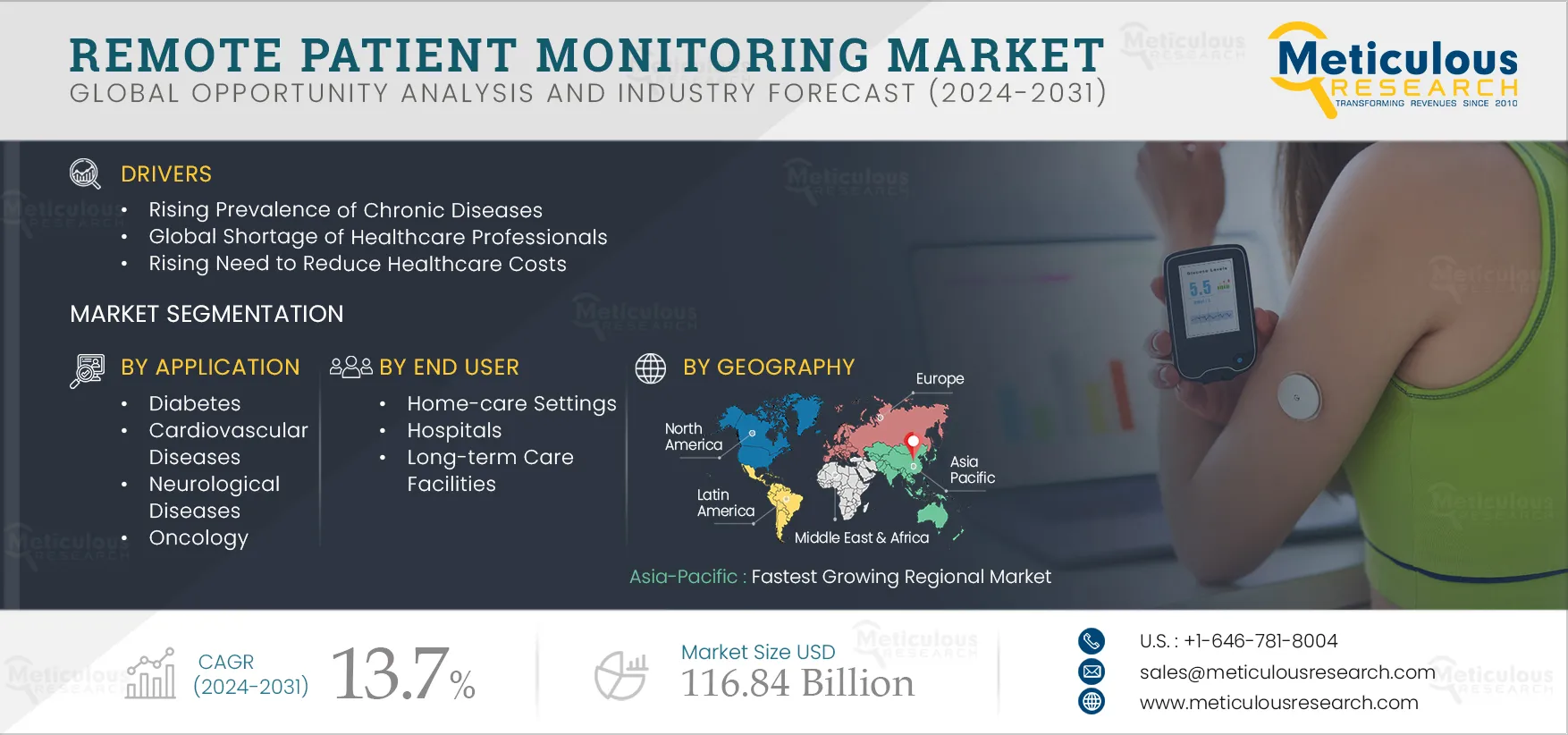
Based on product, the remote patient monitoring market is segmented into monitoring devices, software, and services. In 2024, the monitoring devices segment is expected to account for the largest share of the market. The main factors contributing to the large market share of this segment are the increasing prevalence of chronic diseases, the rising awareness and utilization of telehealth and RPM technologies, the growing consumer awareness regarding the importance of monitoring chronic diseases, the rising demand for personalized healthcare, and the integration of artificial intelligence and machine learning in monitoring devices.

Furthermore, the utilization of AI in health monitoring has enabled easy and efficient detection of potential health issues. For instance, DrKrumo, Inc. (U.S.) offers AI-driven Next-Gen RPM solutions that allow healthcare providers to make informed clinical decisions from the insights created by the multicast data live streaming.

The Diabetes Segment is Expected to Account for the Largest Share of the Market in 2024

Based on application, the remote patient monitoring market is segmented into diabetes, cardiovascular diseases, neurological diseases, respiratory diseases, oncology, and other applications. In 2024, the diabetes segment is expected to account for the largest share of the market. The large market share of this segment is attributed to the surge in the utilization of telehealth, the increased need to monitor diabetes patients, and the increasing prevalence of chronic diseases.

Furthermore, the challenge of providing continuous care due to limited medical resources has increased the adoption of RPM technologies. For instance, in 2021, the University of Mississippi Medical Center (UMMC) partnered with the North Mississippi Primary Health Care (MNPHC) to increase access to diabetes care through remote patient monitoring programs. Through this initiative, patients were provided with smart tablets to report their glucose level information to healthcare providers.

This data was accessed by the professionals using electronic health records (EHR), increasing the use of RPM technologies.

The Home-care Settings Segment is Expected to Account for the Largest Share of the Market in 2024

Based on end user, the remote patient monitoring market is segmented into home-care settings, hospitals, long-term care facilities, and other end users. In 2024, the home-care settings segment is expected to account for the largest share of the market. The large market share of this segment is attributed to the growing shift towards home-care settings, the rising prevalence of chronic diseases among the elderly population, the shortage of healthcare professionals, and increasing consumer awareness regarding the monitoring of chronic conditions through RPM tools.

According to the World Health Organization (WHO), there are approximately 23, 7, and 26 doctors per 10,000 people in China, India, and Japan, respectively. Remote patient monitoring technologies provide numerous benefits in home care settings. They allow patients to access specialized healthcare services while saving on travel costs. Additionally, these technologies enable a single healthcare provider to consult with and treat multiple patients simultaneously.

Asia-Pacific: Fastest Growing Regional Market

Asia-Pacific is slated to register the highest CAGR in the remote patient monitoring market during the forecast period. The growth of this regional market can be attributed to growing consumer awareness, increasing personal disposable incomes, a large target population, increasing prevalence of chronic & infectious diseases, and government initiatives aimed at promoting the use of remote patient monitoring solutions.

For instance, in June 2023, the Universitas Indonesia Hospital (RSUI) (Indonesia) collaborated with Indonesia’s Ministry of Health (MOH) to launch a new digital application called RSUI Telmon AI.

This application includes telemonitoring, remote patient monitoring, and artificial intelligence capabilities. Patients can use it to consult with general practitioners and also connect their wearable devices, such as blood glucose monitors and blood pressure monitors, to allow therapeutic monitoring by their healthcare providers.
Competitive Landscape

The report includes a competitive landscape based on an extensive assessment of the key growth strategies like new product launches, mergers & acquisitions, partneships & agreements; adopted by leading market players over the past three years.

The key players profiled in the global remote patient monitoring market report are Medtronic plc (Ireland), Koninklijke Philips N.V. (Netherlands), OMRON Corporation (Japan), Boston Scientific Corporation (U.S.), Abbott Laboratories (U.S.), Siemens Healthineers AG (Germany), GE HealthCare Technologies, Inc. (U.S.), F. Hoffmann-La Roche AG (Switzerland), Baxter International, Inc. (U.S.), Oracle Corporation (U.S.), DexCom, Inc. (U.S.), and VitalConnect, Inc. (U.S.).

Market Research Summary

Particulars

Details

Page No

247

Format

PDF

Forecast Period

2024-2031

Base Year

2024

CAGR

13.7%

Market Size (Value)

$116.84 billion

Segments Covered

By Product

  • Monitoring Devices
    • Monitoring Devices, by Functionality
      • Blood Glucose Monitoring Devices
      • Cardiac Monitoring Devices
      • Neurological Monitoring Devices
      • Respiratory Monitoring Devices
      • Multiparameter Monitoring Devices
      • Blood Pressure Monitoring Devices
      • Fetal and Neonatal Monitoring Devices
      • Weight Monitoring Devices
      • Other Monitoring Devices
        Note: Other monitoring devices include temperature monitors, brain monitoring (EEG), and prothrombin monitors.) 
    • Monitoring Devices, by Type
      • Wearable Monitoring Devices
      • Portable Monitoring Devices
      • Benchtop Monitoring Devices
  • Software
  • Services

By Application

  • Diabetes
  • Cardiovascular Diseases
  • Neurological Diseases
  • Respiratory Diseases
  • Oncology
  • Other Applications
    Note: Other applications include maternity care, post-surgery monitoring, elderly care, medical adherence, and sleep monitoring.)

By End User

  • Home-care Settings
  • Hospitals
  • Long-term Care Facilities
  • Other End Users
    Note: Other end users include ambulatory care, healthcare payers, and clinical research organizations.)

Countries Covered

North America (U.S., Canada), Europe (Germany, France, U.K., Italy, Spain, Rest of Europe), Asia-Pacific (China, Japan, India, and Rest of Asia-Pacific), Latin America, and Middle East & Africa

Key Companies

Medtronic plc (Ireland), Koninklijke Philips N.V. (Netherlands), OMRON Corporation (Japan), Boston Scientific Corporation (U.S.), Abbott Laboratories (U.S.), Siemens Healthineers AG (Germany), GE HealthCare Technologies, Inc. (U.S.), F. Hoffmann-La Roche AG (Switzerland), Baxter International, Inc. (U.S.), Oracle Corporation (U.S.), DexCom, Inc. (U.S.), and VitalConnect, Inc. (U.S.)

Frequently Asked Questions

How We Built This Intelligence

Table of Contents

Expand all

Access & Licensing

Choose how you access this intelligence — from a standalone data pack to organization-wide access. Every option is delivered within 24–48 hours and backed by analyst support.

Single User License
Instant access to full PDF report + Excel dataset.
$4,175
1–5 User Access
Full PDF Report + Excel Datasheets
1-Hour Analyst Call included
Free 10% Customization
POPULAR
Multi-User License
Instant access to full PDF report + Excel dataset.
$5,875
1–5 User Access
Full PDF Report + Excel Datasheets
1-Hour Analyst Call included
Free 10% Customization
Enterprise License
Instant access to full PDF report + Excel dataset.
$7,875
1–5 User Access
Full PDF Report + Excel Datasheets
1-Hour Analyst Call included
Free 10% Customization
Flexible Purchase Options
Buy the complete report, individual chapters, or only the data you need. Starting from $1,500.
Analyst-reviewed intelligence
Multi-source validation
Transparent methodology
Citation-ready data
Analyst assistance

Related Statistics & Insights

$41.59B
market value in 2023
$116.84B
projected market value by 2031
Cite this report
Meticulous Research. (2024). Remote Patient Monitoring Market - Global Opportunity Analysis And Industry Forecast (2024-2031) (Report No. MR-658). Meticulous Market Research Pvt. Ltd. https://meticulousresearch.com/reports/remote-patient-monitoring-market-5343
Custom Research

Need something more specific?

A custom-scoped study can target a single segment, geography, or competitor set — or answer a board-level question this syndicated report doesn't. Tell an analyst what decision you're making and we'll scope it.

Search Market Intelligence

Search across reports, blogs, press releases, and industries