- Home
- Reports
- Healthcare
- North America Medical Image Management Market
North America Medical Image Management Market by Product {PACS [Departmental (Radiology, Mammography, Cardiology), Enterprise], VNA [(On-premise, Hybrid), [Vendor (PACS, Software, Infrastructure)], AICA, Universal Viewer}, End User - Forecast to 2032
Market Overview
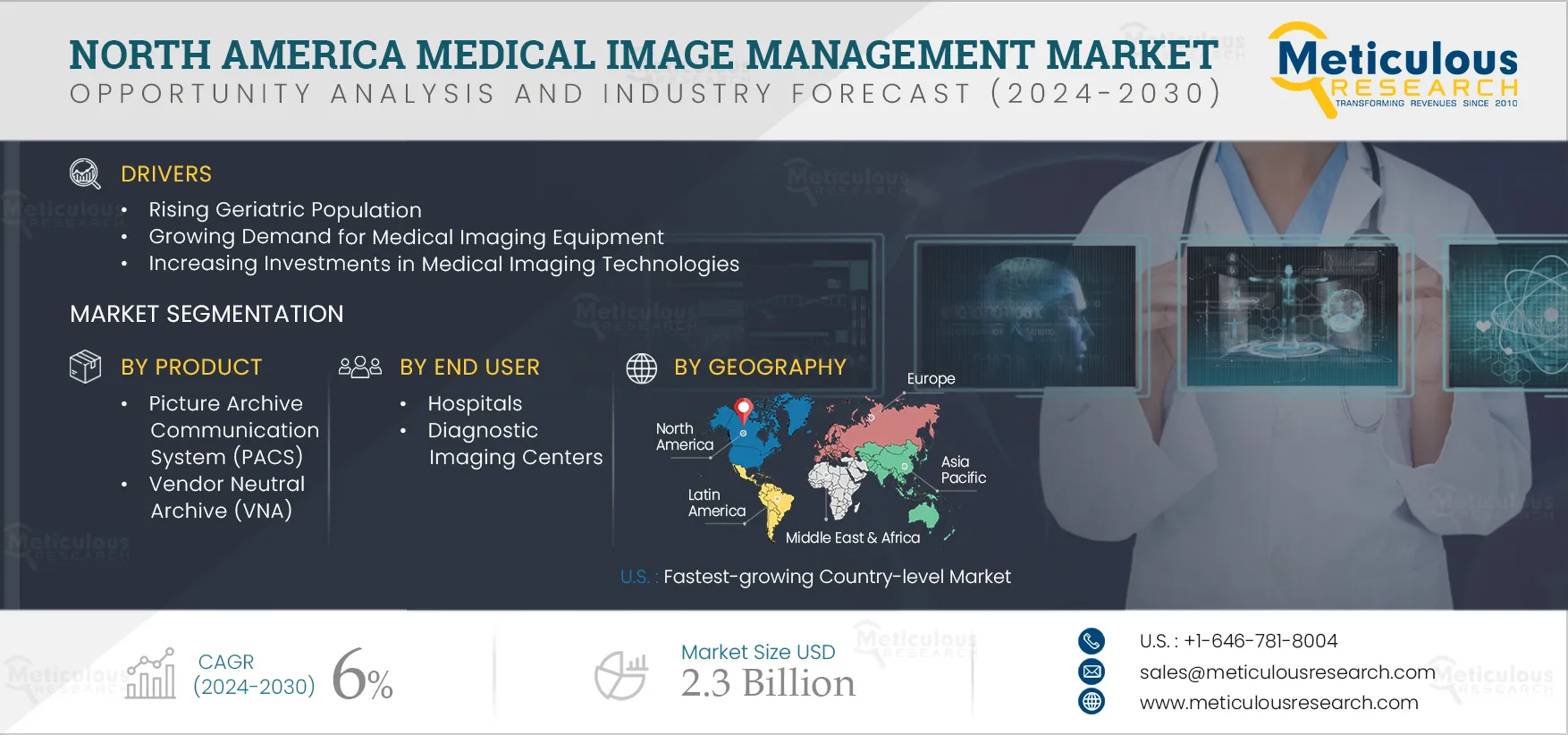
The North America Medical Image Management Market is projected to reach $2.3 billion by 2032, at a CAGR of 6% from 2025 to 2032. Medical imaging holds significant importance across different medical settings and at various levels of healthcare. Medical image management solutions enable the seamless integration of medical image data with patient information in other records, including electronic health records, health information systems, and radiology information systems (RIS).
The growth of this market is driven by the rising geriatric population, growing demand for medical imaging equipment, increasing investments in medical imaging technologies, technological advancements in diagnostic imaging modalities, and growing healthcare IT & EHR adoption. However, the long product lifecycle of vendor-neutral archive solutions and budgetary constraints restrains this market's growth.
Additionally, the growing integration of PACS & VNA with EMR, big data in the healthcare sector, penetration of artificial intelligence in medical imaging, adoption of hybrid & cloud-based medical imaging solutions, and telehealth market offer significant market growth opportunities. However, data migration and lack of interoperability are the major challenges for the market’s growth.

Market Opportunities
Telemedicine/telehealth provides improved accessibility, cost-effectiveness, and quality of care. According to Aluna Partners Ltd (U.K.), the global investment in telehealth has grown 169% year-on-year to USD 5 billion in the second quarter of 2021. Telehealth-related funding was also observed in North America. For instance, in August 2022, KeyCare, the telehealth platform developed in association with Epic Systems Corporation (U.S.) and KeyCare, Inc. (U.S.), received USD 24 million in series A funding. After receiving series, A funding, KeyCare, Inc. (U.S.) plans to provide more health systems with a one-stop platform.
Furthermore, the COVID-19 pandemic impacted the adoption of telehealth. For instance, in March 2020, telehealth visits surged by 50% amid the COVID-19 pandemic. Till June 2020, the Federal Communications Commission (FCC) COVID-19 Telehealth Program of the U.S., authorized by the CARES Act, approved funding for 305 healthcare providers in 42 states plus Washington, D.C., for a total of USD 104.98 million in funding telehealth program.
By increasing access to physicians and specialists, telehealth systems help patients receive the right care. Healthcare systems are increasingly recognizing the benefits of adopting telehealth. With technological advancements, companies are developing software to access medical images from computers and mobile devices. Telehealth-EHR integration will help healthcare systems with effective remote monitoring in the coming years. Thus, the increasing practice of telemedicine will serve as an opportunity for the market.
Penetration of Artificial Intell...
The emerging application of AI and ML in medical imaging is expected to bring various benefits, including augmentation and improvements in diagnosis. Moreover, radiologists use AI to enhance workflow and diagnostic efficiency, as well as in predictive healthcare. However, to create these image-analyzing algorithms, large amounts of medical images must be gathered in a curated form and fed to the algorithm to learn and decipher differentiating features. AI is utilized in medical image analysis for identifying changes in scans while reducing treatment planning time by analyzing vast amounts of data. AI also helps in improving operational efficiency, freeing experts from repetitive tasks.
Radiology PACS and diagnostic imaging vendors worldwide are actively advancing their AI solutions. In November 2021, Rad AI (U.S.) secured $25 million in Series A funding. This funding will accelerate the development and commercialization of Rad AI Omni and Rad AI Continuity, its pioneering AI platform designed to empower radiologists. This platform aims to streamline workflows, alleviate time constraints, combat burnout, and ultimately enhance the quality of patient care in radiology. Furthermore, in April 2020, Qure.ai Technologies Inc (U.S.) launched its COVID-19 progression monitoring software at Bolton NHS Foundation Trust. Qure.ai’s software automates the interpretation of COVID-19 progression by quantifying changes on chest X-rays, enabling localization, qualification of lesions and a case priority score generated in under a minute. Such initiatives by major market players to advance medical imaging through AI integration contribute to the growth of the North America medical image management market.
Key Findings of the North America Medical Image Management Market Study:
In 2025, the PACS Segment is Expected to Dominate the
North America Medical Image Management
Among the products, in 2025, the PACS segment is expected to account for the largest share of the North America medical image management market. PACS are increasingly being incorporated into other specialties, such as cardiology, ophthalmology, oncology, endoscopy, teleradiology, dermatology, pathology, neurology, and dentistry. Among these, PACS has been widely adopted in the radiology department. It is also commonly used in digital radiography as it helps to manage the storage, retrieval, distribution, and presentation of DICOM images (i.e., X-rays, MRIs, distribution, and CAT scans). These factors drive the growth of this segment.
In 2025, the Hospitals Segment is Expected to Dominate the
North America Medical Image Management Market
Among the end users, in 2025, the hospitals segment is expected to account for the largest share of the North America medical image management market. The large market share of this segment is attributed to the growing number of hospital admissions, the rising prevalence of diseases requiring medical imaging, increased investments in advancing healthcare infrastructure, and the growing adoption of medical image management solutions through contractual agreements. For instance, in February 2022, Novarad Corporation (U.S.) signed a contract with Lower Umpqua General Hospital of Reedsport (U.S.) and implemented Ncompass PACS and CryptoChart, a CD-free image-sharing solution.
U.S.: Fastest-growing Country-level Market
Based on geography, the U.S. is slated to record the highest growth rate during the forecast period. The growth of this market is primarily driven by the growing demand for advanced technologies in healthcare, the rise in the aging population, the increasing prevalence of chronic diseases, and the adoption of electronic medication administration record systems. According to the U.S. Census Bureau, in 2021, the number of adults aged 65 and older reached over 54 million in the U.S., which is 16.5% of the country's total population. This number is expected to reach an estimated 85.7% by 2050, roughly 20% of the overall U.S. population. With a larger proportion of the population being aged 65 and older, there will be an increased demand for disease diagnosis and management, including cardiology, chest radiology, and other imaging modalities. This growing need for medical imaging services is expected to drive the demand for medical image management solutions.
Key Companies
The key players profiled in this market study are Novarad Corporation (U.S.), GE HealthCare Technologies Inc. (U.S.), Hyland Software, Inc. (U.S.), Koninklijke Philips N.V. (Netherlands), INFINITT Healthcare Co., Ltd. (South Korea), Siemens Healthineers AG (Germany), Agfa-Gevaert NV (Belgium), Mach7 Technologies (U.S.), FUJIFILM Holdings Corporation (Japan), Merative (U.S.), Sectra AB (Sweden), and Change Healthcare Inc. (U.S.).
Scope of the Report:
North America Medical Image Management Market Assessment, by Product
- Picture Archive Communication System (PACS)
- PACS Market, by Type
- Departmental PACS
- Radiology PACS
- Cardiology PACS
- Mammography PACS
- Traditional Mammography PACS
- Vendor Neutral Mammography PACS
- Departmental PACS
- Enterprise PACS
- Departmental PACS
- PACS Market, by Delivery Model
- On-premise PACS
- Web/Cloud-based PACS
- PACS Market, by Type
- Vendor Neutral Archive (VNA)
- VNA Market, by Delivery Model
- On-premise VNA
- Hybrid VNA
- Web/Cloud-based VNA
- VNA Market, by Procurement Model
- Enterprise VNA
- Multi-departmental VNA
- Multi-site VNA
- Departmental VNA
- Enterprise VNA
- VNA Market, by Vendor Type
- PACS Vendors
- Independent Software Vendors
- Infrastructure Vendors
- VNA Market, by Delivery Model
- Application-independent Clinical Archives
- AICA Market, by Vendor Type
- VNA Vendors
- Native AICA Vendors
- AICA Market, by Vendor Type
- Enterprise/Universal Viewers
North America Medical Image Management Market Assessment, by End User
- Hospitals
- Diagnostic Imaging Centers
- Other End Users
North America Medical Image Management Market Assessment, by Country
- U.S.
- Canada
Key questions answered in the report:
Frequently Asked Questions
Related Tags
How We Built This Intelligence
Table of Contents
Expand allAccess & Licensing
Choose how you access this intelligence — from a standalone data pack to organization-wide access. Every option is delivered within 24–48 hours and backed by analyst support.
Related Statistics & Insights
Need something more specific?
A custom-scoped study can target a single segment, geography, or competitor set — or answer a board-level question this syndicated report doesn't. Tell an analyst what decision you're making and we'll scope it.