HealthcareReport ID: MR-249Jan 2025500 PagesGlobal
Verified by the Meticulous Standard·Last verified: May 2026 by Madhura Pawar

Medical Imaging Market Size, Share, Forecast, & Trends Analysis by Product (X-ray [Digital, Analog] MRI [Closed, Open] Ultrasound, CT, Nuclear Imaging [SPECT, PET]), Application (General, OB/GYN, Cardiology, Oncology), End UserΓÇöGlobal Forecast to 2032

Published Date: Jan 2025
Format: PDF + Excel + Cloud Portal
Pages / Size: 500 Pages
Analyst: Madhura Pawar
Secure checkout · Full methodology disclosure · Underwritten by lead analyst Madhura Pawar
Medical Imaging Market Size
Medical Imaging Market Sizing & Sourcing
Base year: 2025 · CAGR: 7.2%
$5.86B
Market size 2025
$6.42B
Market size 2026
$12.84B
Forecast by 2036
7.2%
CAGR 2026–2036

Market Overview

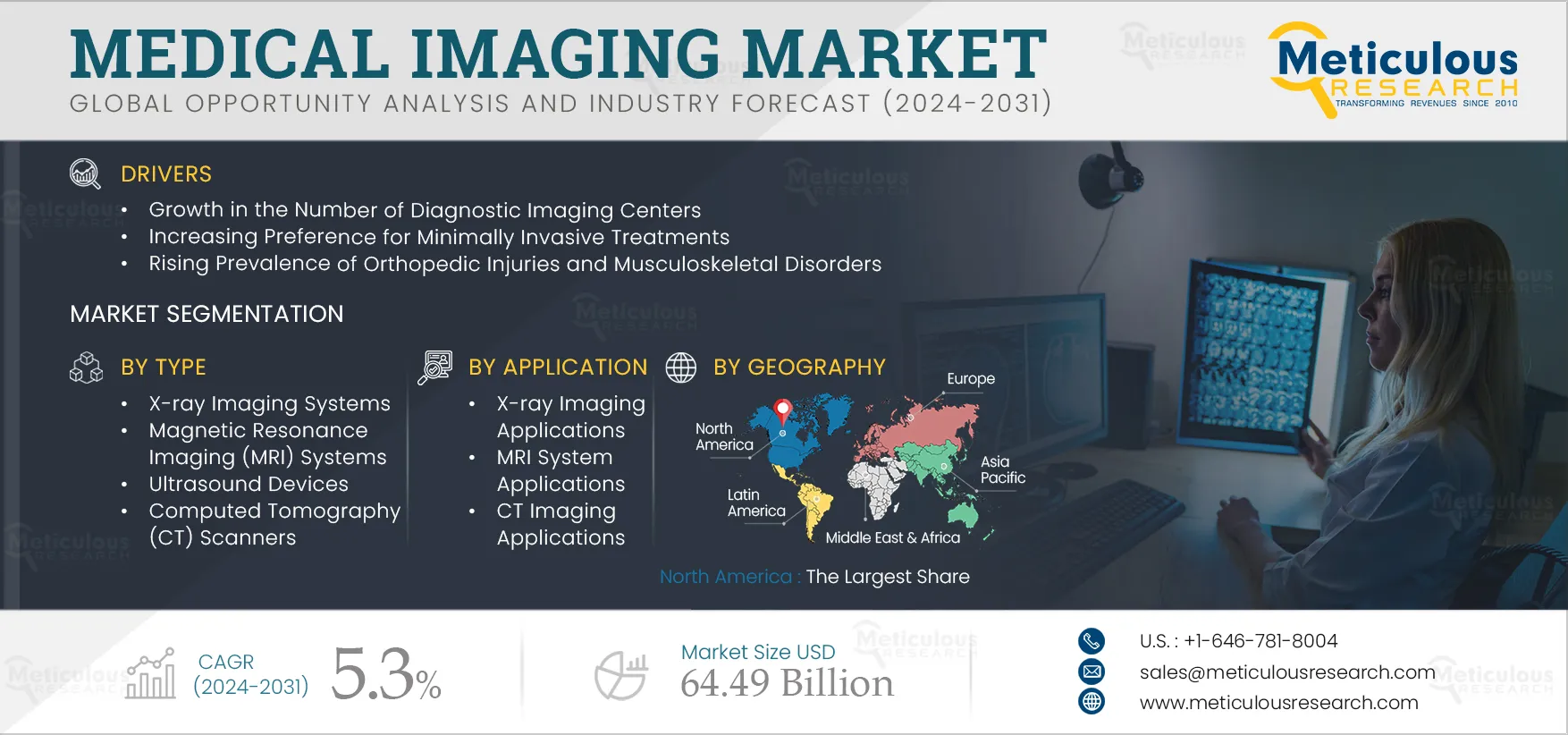
The growth of this market is driven by increasing government investments and funding in the modernization of imaging facilities, growth in the number of diagnostic imaging centers, increasing preference for minimally invasive treatments, growing focus on preventive care, and technological advancements. Moreover, the development of low-cost imaging systems and the increasing integration of artificial intelligence (AI) in digital X-ray systems are expected to offer growth opportunities for the players operating in this market.

Technological Advancements Leadi...

Technological advancements are leading to an increased preference for advanced medical imaging systems over conventional systems. Many advancements have been made in imaging systems, such as digital X-ray systems, which include AI-aided X-ray interpretation, tomosynthesis, dual-energy imaging, automatic image stitching, computer-aided diagnosis, and digital mobile radiography. For instance, in March 2024, Canon, Inc. (Japan) launched Celex, a computed tomography (CT) and multipurpose X-ray system that offers automated and adjustable capabilities to improve production efficiencies.

Other technologies being developed for medical imaging include augmented reality, three-dimensional printing, cinematic rendering, and digital twin technology. These will lead to reports of patients reaching the radiologists faster, personalized treatment regimens, higher efficiency and accuracy, reduced radiation exposure, and realistic visualization of organs.
Medical Imaging Market

Click here to: Get Free Sample Pages of this Report

Rising Prevalence of Orthopedic Injuries and Musculoskeletal Disorders

Musculoskeletal disorders are linked to occupational injuries, sports injuries, and age-related dysfunction. Common musculoskeletal conditions include rheumatoid arthritis, osteoarthritis, osteoporosis, and septic arthritis. Among the elderly population, bone fractures and broken hips are prevalent orthopedic injuries. Globally, many individuals experience musculoskeletal conditions. For instance, according to the World Health Organization (WHO), in 2021, approximately 1.71 billion people worldwide are affected by musculoskeletal conditions.

Musculoskeletal imaging systems can also aid in diagnosing conditions like work-related injuries and chronic conditions, including sprains, strains, tears, back pain, carpal tunnel syndrome, and hernias. Thus, the growing number of musculoskeletal injuries is driving the demand for medical imaging.

Market Trends

Increasing Adoption of Teleradiology

Teleradiology enables the sharing of radiographic images with physicians in distant locations to support interpretation and diagnosis. Telemedicine for radiology improves patient experience and care by allowing radiologists to provide services without traveling to a patient’s location. It also allows radiologists to consult with experts, such as neuroradiologists and pediatric radiologists, for streamlined and quick consultations that expedite patient diagnosis and help both parties initiate a treatment plan.

According to a survey by the American Medical Association (AMA), radiology makes more extensive use of telemedicine for patient interactions than any other medical specialty. The demand for telehealth has increased since the outbreak of the COVID-19 pandemic. Also, according to the American Hospital Association (AHA), in 2020, 76% of U.S. hospitals were using telehealth services, including teleradiology, compared to just 35% in 2010. Thus, the increasing utilization of teleradiology has positively impacted the adoption of medical imaging systems, driving the growth of the market.

Incorporation of AI Into Medical Diagnosis

The incorporation of artificial intelligence (AI) into medical diagnostics can make healthcare more accessible and affordable for patients and help healthcare providers make accurate and quick treatment decisions. The use of AI in medical diagnostics improves the accuracy of diagnosis and aids healthcare professionals in making clinical decisions. The Diagnosis Journal estimates that globally, about 10-15% of all diagnoses are incorrect. According to the Southern Medical Association, about 5% of outpatients in the U.S. receive correct diagnoses. Errors in the diagnoses of complicated life-threatening diseases can pose a serious risk to patient health.

AI and machine learning (ML) have emerged as powerful tools that enable more accurate diagnoses and help physicians in clinical decision-making. In March 2025, Koninklijke Philips N.V. (Netherlands) collaborated with SyntheticMR (Sweden) to develop quantitative brain imaging tools along with artificial intelligence (AI) to diagnose disorders such as multiple sclerosis (MS), traumatic brain injuries (TBI) and dementia.

Market Opportunities

Improving Healthcare Infrastructure in Emerging Economies

Developed economies, such as North America and Europe, contribute greatly to the medical imaging market. These markets are relatively better penetrated. Hence, the players operating in the medical imaging market are increasingly shifting their focus to underpenetrated markets in emerging economies such as Asia-Pacific and Latin America. Certain countries in these economies, such as India, Brazil, and Singapore, offer growth opportunities due to their improving healthcare infrastructures, growing aging population coupled with the high prevalence of chronic diseases, rising healthcare expenditures and income levels, improving access to healthcare services, and growing government investments in the development of healthcare infrastructure. According to the United Nations’ World Population Prospects, India’s population is expected to rise to 1.51 billion in 2032 from 1.42 billion in 2022.

Healthcare spending is gradually increasing in developed countries. Rising healthcare spending in emerging economies is expected to create growth opportunities for diagnostic imaging system manufacturers. For instance, according to the India Brand Equity Foundation, India’s Economic Survey 2022 revealed that public spending on healthcare was 2.1% of the country’s GDP in 2021–2022, an increase compared to 1.8% in 2020–2021 and 1.3% in 2019–2020.

Thus, emerging countries are expected to provide significant growth opportunities for the players operating in the medical imaging market.


Segment Analysis

Based on type, the market is segmented into X-ray imaging systems, magnetic resonance imaging (MRI) systems, ultrasound devices, computed tomography (CT) scanners, nuclear imaging systems, and software & services. In 2025, the X-ray imaging systems segment is expected to account for the largest share of 31% of the medical imaging market. X-ray is the most common and routinely performed imaging test in any healthcare setting. Growth in the number of hospitals and diagnostic centers and the rising number of injuries are increasing the demand for X-ray imaging.

However, the nuclear imaging segment is expected to register the fastest CAGR of 7.20% during the forecast period of 2025–2032. Nuclear imaging includes techniques such as positron emission tomography (PET) and single-photon emission computed tomography (SPECT). The growing application of nuclear imaging in oncology, neurology, and cardiology drives the market growth. For instance, in October 2022, Spectrum Dynamics Medical, Inc. (U.S.) launched the VERITON-CT 400 Series, which is a digital SPECT/CT scanner that can image high energy isotopes using the solid-state detector technology in a CZT-based, wide-bore SPECT/CT configuration, which enables the imaging of total body, brain, heart, and other imaging applications. Such advancements in the systems are expected to drive the demand for nuclear imaging.

Based on applications, the market is segmented into X-ray imaging applications, MRI system applications, ultrasound device applications, CT scanner applications, and nuclear imaging system applications. In 2025, the X-ray imaging applications segment is expected to account for the largest share of the medical imaging market.

X-ray imaging systems are extensively used for the diagnosis, treatment planning, and monitoring of various conditions, including chronic and traumatic conditions. These systems can be used in various applications such as dental, mammography, and general radiography, among others. The large share of the segment is attributed to factors such as rising incidence of cancer, growing dental disease burden, and wide accessibility to X-ray imaging for multiple applications. According to the U.S. Food and Drug Administration (FDA), as of March 2025, a total of 41,350,402 mammography procedures were performed in the U.S. The rising incidence of breast cancer is further driving the market growth.

Based on end users, the market is segmented into hospitals & clinics, diagnostic imaging centers, and other end users. In 2025, the hospitals & clinics segment is expected to account for the largest share of 43.5% of the medical imaging market. Hospitals and clinics also include ambulatory surgery centers and nursing care centers. The widespread adoption of medical imaging systems has improved patient care and streamlined workflows in hospitals and clinics worldwide. Hospitals, as a single healthcare setting, provide wide access to multiple healthcare services such as diagnosis, monitoring, and treatment. Hospitals use medical diagnostic systems for numerous applications, including mammography, chest and lung imaging, bone fracture screenings, angiography, dental imaging, and many more. Thus, the growing incidence of cancer and respiratory diseases and a rising number of injuries are supporting the largest share of hospitals & clinics.

Geographical Analysis

In 2025, North America is expected to account for the largest share of 37.6% of the medical imaging market, followed by Europe, Asia-Pacific, Latin America, and the Middle East & Africa. The largest share of the segment is primarily due to the high burden of chronic diseases due to the growing geriatric population, high adoption of teleradiology, technological advancements in medical imaging, and the growing preference for advanced imaging systems over conventional systems. Continuous advancements in medical imaging technologies have contributed to the market’s largest share in North America.

However, Asia-Pacific is slated to register the fastest CAGR of 7.80% during the forecast period. This is attributed to factors such as the increasing number of hospitals and diagnostic centers, favorable government policies and initiatives, increasing healthcare expenditure, improving infrastructure, an aging population, and the rising focus of key players in the region. The growing penetration of advanced technologies in medical imaging also supports market growth. For instance, as per the Philips Future Health Index survey, nearly 67% of healthcare facilities surveyed (above the global average of 56%) already use or plan to use digital health technology, such as artificial intelligence or predictive analytics, to reduce the impact of healthcare workforce shortages.

Key Companies

The report offers a competitive analysis based on an extensive assessment of the leading players’ product portfolios, geographic presence, and key growth strategies adopted in the last 3–4 years. Some of the key players operating in the medical imaging market are Carestream Health, Inc. (U.S.), Esaote S.P.A. (Italy), FUJIFILM Holdings Corporation (Japan), GE HealthCare (U.S.), Hitachi Ltd. (Japan), Koninklijke Philips N.V. (Netherlands), Siemens AG (Germany), Shimadzu Corporation (Japan), Samsung Medison Co., Ltd. (South Korea), and Canon Medical Systems Corporation (Japan). As of 2024, Siemens AG (Germany), GE HealthCare (U.S.), and Koninklijke Philips N.V. (Netherlands) collectively hold a share of 50-55% in the global medical imaging market.

Executive Summary

  • In February 2025, Visage Imaging, Inc. (U.S.) launched an immersive imaging platform for use with Apple, Inc.’s (U.S.) augmented reality headset, Apple Vision Pro. This platform includes AI-enabled enterprise imaging software, including Visage 7, Visage Ease, and Visage Ease Pro, to allow users to examine diagnostic images and also help improve radiologists' readings and workflows.

  • In August 2024, FUJIFILM Healthcare Americas Corporation (U.S.) received FDA 510(k) clearance for its 1.5 Tesla magnetic resonance imaging (MRI) system, the ECHELON Synergy. This system includes FUJIFILM’s Deep Learning Reconstruction (DLP) technology powered by artificial intelligence (AI) to enhance the sharpness of images and acquire scans faster, leading to high throughput, image quality, and patient satisfaction.

  • In May 2024, Koninklijke Philips N.V. (Netherlands) launched the CT 3500, an AI-powered CT system to accelerate routine radiology and high-volume screening programs. This system includes a range of image reconstruction and workflow-enhancing features that help deliver consistency, speed, and first-time-right image quality for confident diagnosis.
  • In July 2022, Siemens Healthineers AG (Germany) launched a new mobile X-ray system, Mobilett Impact, at the European Congress of Radiology (ECR) in Vienna. This system has the integrated advantages of the mobile X-ray system, enabling healthcare professionals to carry out X-rays beside the patient.

Market Research Summary

Particulars

Details

Number of Pages

500

Format

PDF

Forecast Period

2025–2032

Base Year

2024

CAGR (Value)

5.3%

Market Size (Value)

USD 64.49 Billion by 2032

Segments Covered

By Type

  • X-ray Imaging Systems
    • X-ray Imaging Systems Market, by Technology
      • Digital Imaging
        • Direct Radiography
        • Computed Radiography
      • Analog Imaging
    • X-ray Imaging Systems Market, by Portability
      • Stationary
        • Floor-to-Ceiling Mounted Systems
        • Ceiling Mounted Systems
      • Portable
        • Mobile X-ray Systems
        • Handheld X-ray Systems
  • Magnetic Resonance Imaging (MRI) Systems
    • MRI Systems Market, by Architecture
      • Closed MRI Systems
      • Open MRI Systems
      • Standard Bore MRI
      • Wide-Bore MRI
    • MRI Systems Market, by Field Strength
      • High- and Very High-Field MRI Systems (1.5T to 6T)
      • Low- to Mild-Field MRI Systems (<1.5T)
      • Ultra-High-Field MRI Systems (7T and Above)
  • Ultrasound Devices
    • Ultrasound Devices Market, by Portability
      • Trolley/Cart-Based Ultrasound Devices
      • Point-of-Care (PoC) Ultrasound Devices
        • Machines
        • Transducers
      • Handheld Ultrasound Devices
    • Ultrasound Devices Market, by Display
      • Color Ultrasound
      • Black & White (B/W) Ultrasound
    • Ultrasound Devices Market, by Technology
      • 2D Imaging Systems
      • 3D and 4D Imaging Systems
      • Doppler Imaging
        • Color Doppler Imaging
        • Continuous Doppler Imaging
        • Pulse Wave Doppler Imaging
  • Computed Tomography (CT) Scanners
    • Computed Tomography (CT) Scanners, by Slice Type
      • High-Slice CT Scanners
      • Mid-Slice CT Scanners
      • Low-Slice CT Scanners
    • Computed Tomography (CT) Scanners, by Portability
      • Stationary CT Scanners
      • Portable CT Scanners
  • Nuclear Imaging Systems
    • SPECT Systems, by Type
      • Hybrid SPECT Systems
      • Standalone SPECT Systems
    • PET Systems
  • Software & Services

By Application

  • X-ray Imaging Applications
    • General Radiography
    • Dental
    • Mammography
    • Other Applications
      (Note: Other applications include orthopedic, breast imaging, and neuroimaging)
  • MRI System Applications
    • Brain and Neurological MRI
    • Spine and Musculoskeletal MRI
    • Vascular MRI
    • Pelvic and Abdominal MRI
    • Breast MRI
    • Cardiac MRI
    • Other Applications
      (Note:Other applications include pediatric and whole-body imaging)
  • Ultrasound Imaging Applications
    • Radiology/General Imaging
    • Obstetrics/Gynecology (OB/GYN)
    • Cardiology
    • Vascular
    • Urology
    • Other Applications
      (Note:Other applications include anesthesiology, image guidance, and some abdominal applications)
  • CT Imaging Applications
    • Cardiology
    • Oncology
    • Neurology
    • Other Applications
      (Note: Other applications include orthopedic, general, and dental)
  • Nuclear Imaging System Applications
    • Cardiology
    • Neurology
    • Other Applications
      (Note:Other applications include oncology, urology, orthopedics, and endocrinology)

By End User

  • Hospitals & Clinics
  • Diagnostic Imaging Centers
  • Other End Users
    (Note: Other end users include ambulatory care centers, academic & research institutes, and homecare settings)

Countries Covered

North America (U.S., Canada), Europe (Germany, France, U.K., Italy, Spain, Netherlands, Switzerland, and Rest of Europe), Asia-Pacific (China, Japan, India, South Korea, and Rest of Asia-Pacific), Latin America (Brazil, Mexico, and Rest of Latin America), and Middle East & Africa

Key Companies

Carestream Health, Inc. (U.S.), Esaote S.P.A. (Italy), FUJIFILM Holdings Corporation (Japan), GE HealthCare (U.S.), Hitachi Ltd. (Japan), Koninklijke Philips N.V. (Netherlands), Siemens AG (Germany), Shimadzu Corporation (Japan), Samsung Medison Co., Ltd. (South Korea), and Canon Medical Systems Corporation (Japan)

Frequently Asked Questions

How We Built This Intelligence

Table of Contents

Expand all

Access & Licensing

Choose how you access this intelligence — from a standalone data pack to organization-wide access. Every option is delivered within 24–48 hours and backed by analyst support.

Single User License
Instant access to full PDF report + Excel dataset.
$4,175
1–5 User Access
Full PDF Report + Excel Datasheets
1-Hour Analyst Call included
Free 10% Customization
POPULAR
Multi-User License
Instant access to full PDF report + Excel dataset.
$5,875
1–5 User Access
Full PDF Report + Excel Datasheets
1-Hour Analyst Call included
Free 10% Customization
Enterprise License
Instant access to full PDF report + Excel dataset.
$7,875
1–5 User Access
Full PDF Report + Excel Datasheets
1-Hour Analyst Call included
Free 10% Customization
Flexible Purchase Options
Buy the complete report, individual chapters, or only the data you need. Starting from $1,500.
Analyst-reviewed intelligence
Multi-source validation
Transparent methodology
Citation-ready data
Analyst assistance

Related Statistics & Insights

$42.52B
market value in 2024
$64.49B
projected market value by 2032
5.3%
compound annual growth rate
15%
of all diagnoses are incorrect
Cite this report
Meticulous Research. (2025). Medical Imaging Market - Global Opportunity Analysis and Industry Forecast (2025-2032) (Report No. MR-249). Meticulous Market Research Pvt. Ltd. https://meticulousresearch.com/reports/medical-imaging-market-4950
Custom Research

Need something more specific?

A custom-scoped study can target a single segment, geography, or competitor set — or answer a board-level question this syndicated report doesn't. Tell an analyst what decision you're making and we'll scope it.

Search Market Intelligence

Search across reports, blogs, press releases, and industries