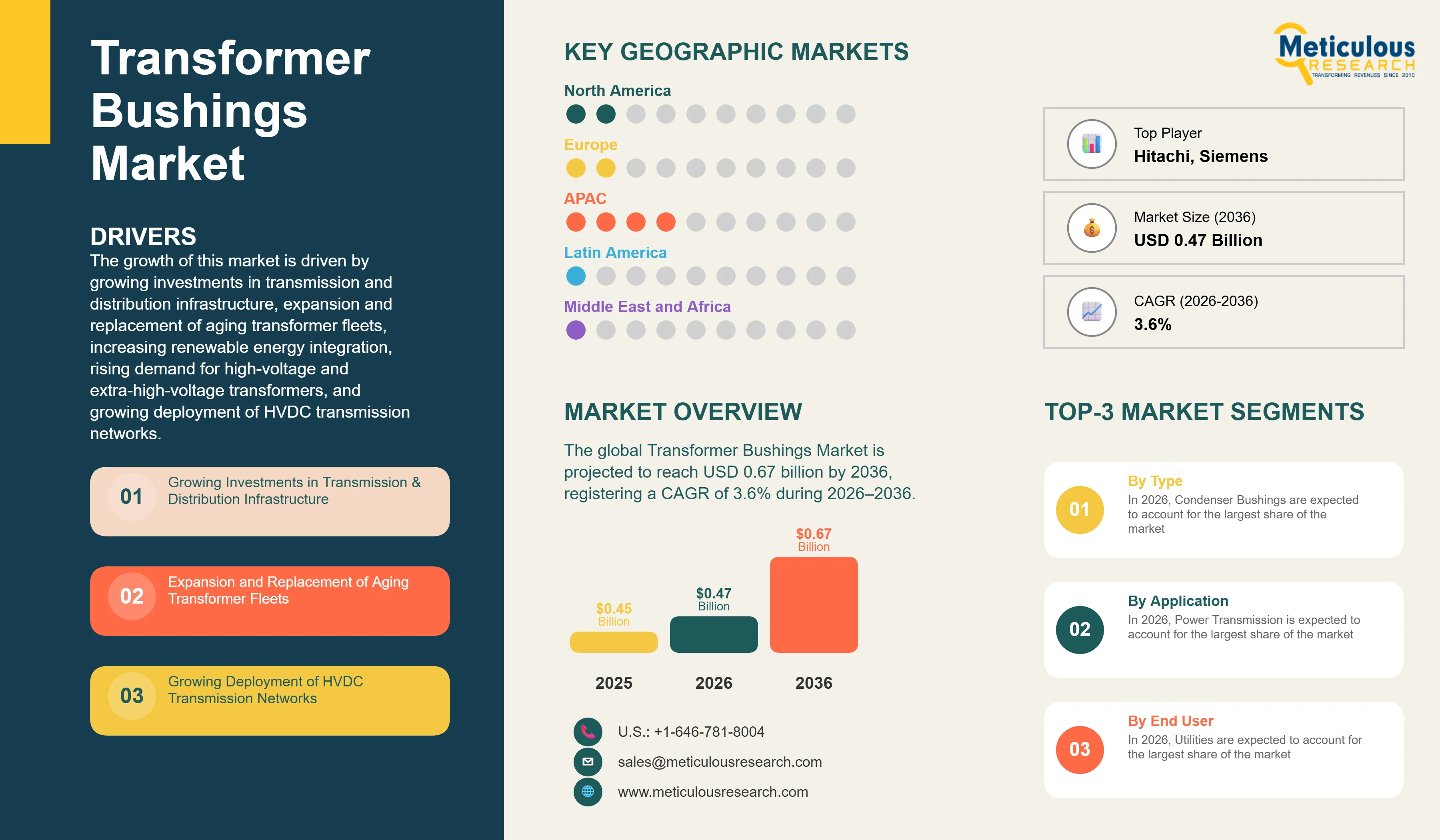
Growing Investments in Transmission & Distribution Infrastructure
Increasing investments in electricity transmission and distribution infrastructure are among the primary factors driving demand for transformer bushings. Electricity grids are being expanded and modernized to accommodate rising electricity consumption, renewable energy generation, electrification, and increasingly decentralized power systems. According to the International Energy Agency (IEA), annual global investment in electricity grids needs to increase from approximately US$400 billion today to more than US$600 billion by 2030 to support rising electricity demand and clean-energy deployment. The IEA also estimates that more than 80 million kilometers of electricity grids worldwide must be added or refurbished by 2040—roughly equivalent to the entire existing global grid network. New substations and transformer installations require multiple high-voltage bushings, while upgrades to existing substations create additional replacement demand.
The IEA highlights the urgency of expanding and modernizing electricity transmission infrastructure and notes that increasing infrastructure requirements are already putting pressure on supply chains for critical grid components. The IEA estimates that the number of grid connections required for new renewable and electrification projects is increasing rapidly, with more than 1,500 GW of renewable projects already waiting in grid connection queues worldwide. This combination of large-scale grid investment, transmission expansion, and substantial connection backlogs is expected to sustain demand for transformers and associated components, including high-voltage and extra-high-voltage transformer bushings, throughout the forecast period.
Expansion and Replacement of Aging Transformer Fleets
Aging transformer fleets across developed electricity markets are creating a substantial replacement and retrofit opportunity for transformer bushing manufacturers. Utilities increasingly replace deteriorated bushings as part of transformer refurbishment programs or install upgraded bushing technologies to improve reliability and monitoring capabilities.
The replacement market is particularly important because transformer bushings operate under continuous electrical, thermal, and mechanical stress. Aging insulation, moisture ingress, thermal deterioration, and electrical faults can compromise bushing performance and increase the risk of transformer failure. Consequently, utilities are placing greater emphasis on preventive maintenance, condition assessment, and replacement of critical transformer components.
Market Restraints
High Cost of Advanced Condenser Bushings
Advanced condenser bushings, particularly those designed for high- and extra-high-voltage applications, require sophisticated insulation systems, precision manufacturing, extensive testing, and stringent quality control. These factors increase acquisition costs compared with conventional bushing technologies. The higher upfront cost can make utilities and smaller grid operators more cautious about adopting advanced technologies, particularly in cost-sensitive markets.
Long Qualification and Replacement Cycles
Transformer bushings are safety- and reliability-critical components and therefore require extensive testing and qualification before deployment. Utilities and transformer manufacturers typically have long procurement and qualification cycles because bushing performance directly affects transformer reliability and grid safety. This can slow the adoption of new bushing technologies and extend replacement decision timelines.
Availability of Low-Cost Conventional Technologies
Conventional porcelain and other established bushing technologies continue to compete with advanced RIP, RIS, composite, and smart bushing technologies. In price-sensitive applications, buyers may prioritize proven, lower-cost solutions over advanced technologies with higher initial costs. This can constrain the penetration of newer bushing technologies, particularly in emerging markets.
Market Opportunities
Replacement of Aging Transformer Bushings
The replacement of aging transformer bushings represents a significant opportunity for market participants. A large installed base of transformers in mature electricity markets is approaching or exceeding its original service life, increasing the need for bushing inspection, refurbishment, and replacement. Utilities and transmission system operators are increasingly prioritizing the replacement of aging components to improve transformer reliability, reduce unplanned outages, and extend the operating life of existing grid assets.
Growing Adoption of Smart & Sensor-Enabled Bushings
The increasing adoption of smart and sensor-enabled bushings is creating new opportunities beyond conventional component replacement. These bushings can support continuous monitoring of electrical and operating conditions, enabling utilities to identify degradation at an earlier stage and transition from reactive maintenance toward condition-based and predictive maintenance. Growing digitalization of transformer monitoring and increasing emphasis on grid reliability are expected to support adoption of sensor-enabled bushing technologies.
Expansion of Offshore Wind and Renewable Energy Grids
The rapid expansion of renewable energy infrastructure is creating additional demand for transformer bushings. Offshore wind farms, large-scale solar projects, and other renewable generation facilities require extensive transmission and substation infrastructure to connect generation assets to electricity grids. Offshore wind projects are particularly relevant because they increasingly rely on high-voltage transmission and subsea power infrastructure, creating demand for high-performance transformer components capable of operating at elevated voltage levels and under demanding environmental conditions.
Increasing Demand for HVDC Converter Transformers
The expansion of HVDC transmission networks is creating an important opportunity for specialized transformer bushings. HVDC converter stations rely on converter transformers that require purpose-designed high-voltage bushings capable of meeting demanding electrical and insulation requirements. Increasing deployment of long-distance transmission corridors, renewable-energy interconnections, and cross-border electricity links is expected to support demand for HVDC-compatible bushing technologies.
Market Challenges
Transformer Bushing Failure and Grid Reliability Risks
Transformer bushing failure represents a major technical challenge because bushings are critical insulation and current-carrying components. Failure can contribute to transformer outages, equipment damage, and disruption of electricity supply. Factors such as insulation deterioration, moisture ingress, thermal stress, electrical aging, and mechanical damage can reduce bushing reliability. Consequently, manufacturers and utilities must maintain stringent testing, monitoring, and maintenance practices throughout the bushing lifecycle.
Supply Chain Constraints for High-Voltage Insulating Materials
The availability of specialized insulating materials and components can create supply chain challenges for high-voltage bushing manufacturers. Advanced transformer bushings require high-quality insulating paper, resin systems, composite materials, conductive components, and other specialized inputs. Disruptions in the availability of these materials can increase manufacturing lead times and costs, particularly for high-voltage and extra-high-voltage applications.
Market Trends
Growing Adoption of RIP and RIS Bushing Technologies
Resin-Impregnated Paper (RIP) and Resin-Impregnated Synthetic (RIS) technologies are gaining importance as alternatives to conventional Oil-Impregnated Paper (OIP) designs. These technologies offer opportunities for improved fire safety, reduced environmental risks associated with insulating oil, and enhanced suitability for certain high-voltage applications.
Increasing Digitalization of Transformer Monitoring
Digitalization is becoming increasingly important in transformer asset management. Utilities and transmission operators are adopting monitoring technologies to obtain better visibility into transformer and bushing operating conditions and identify potential failures before they result in outages. The integration of sensors with transformer bushings can support continuous condition monitoring and data-driven maintenance decisions.
Segment Analysis
Market Analysis by Type
Based on type, the global Transformer Bushings Market is segmented into Condenser Bushings, Non-Condenser Bushings, Oil-Filled Bushings, Gas-Insulated Bushings, and Dry-Type Bushings. In 2026, Condenser Bushings are expected to account for the largest share of the global Transformer Bushings Market, supported by their extensive use in high-voltage and extra-high-voltage transformer applications. The Gas-Insulated Bushings and Dry-Type Bushings segments are expected to benefit from increasing demand for compact, reliable, and environmentally preferable insulation solutions, particularly across specialized transformer and grid applications.
Market Analysis by Insulation Technology
Based on insulation technology, the market is segmented into Oil-Impregnated Paper (OIP), Resin-Impregnated Paper (RIP), Resin-Impregnated Synthetic (RIS), Oil-Filled Insulation, Gas Insulation, and Solid & Composite Insulation.
In 2026, Oil-Impregnated Paper (OIP) is expected to account for a significant share of the market due to its established installed base and extensive use in conventional transformer bushing applications. However, Resin-Impregnated Paper (RIP) and Resin-Impregnated Synthetic (RIS) technologies are expected to gain traction during the forecast period as utilities and transformer manufacturers increasingly seek advanced insulation technologies for modern high-voltage applications.
Market Analysis by Voltage Rating
Based on voltage rating, the market is segmented into Up to 72.5 kV, 72.6–145 kV, 146–245 kV, 246–550 kV, and Above 550 kV.
In 2026, the 246–550 kV segment is expected to account for a significant market share, supported by continued investments in high-voltage transmission infrastructure and large power transformer installations. The Above 550 kV segment is expected to witness strong growth as utilities expand ultra-high-voltage transmission networks and countries invest in long-distance electricity transmission and HVDC infrastructure.
Market Analysis by Transformer Type
Based on transformer type, the market is segmented into Power Transformers, Distribution Transformers, and Specialty Transformers.
In 2026, Power Transformers are expected to account for the largest market share because of their extensive deployment across transmission networks and large substations. The Specialty Transformers segment is expected to benefit from increasing deployment of converter, furnace, traction, and phase-shifting transformers, particularly as HVDC systems, industrial electrification, and specialized grid applications expand.
Market Analysis by Bushing Configuration
Based on bushing configuration, the market is segmented into Transformer Tank-Mounted Bushings, Turret-Mounted Bushings, Cover-Mounted Bushings, and Conservator-Mounted Bushings.
In 2026, Transformer Tank-Mounted Bushings are expected to account for the largest market share due to their widespread use across conventional transformer configurations. Demand across different configurations is influenced by transformer design, voltage class, installation requirements, mechanical arrangement, and manufacturer specifications.
Market Analysis by Conductor Type
Based on conductor type, the market is segmented into Copper Conductors and Aluminum Conductors.
In 2026, Copper Conductors are expected to maintain a significant market position because of their high electrical conductivity and established use in high-performance electrical applications. However, aluminum conductors remain important in applications where lower weight and material cost are prioritized, creating continued demand for both conductor types across the transformer bushing market.
Market Analysis by Application
Based on application, the global Transformer Bushings Market is segmented into Power Generation, Power Transmission, Power Distribution, and Industrial Power Systems.
In 2026, Power Transmission is expected to account for the largest share of the global Transformer Bushings Market. The segment's dominance is supported by continued investments in transmission substations, high-voltage transformer installations, HVDC converter stations, and cross-border electricity interconnection projects. The increasing need to expand and modernize transmission infrastructure is expected to sustain demand for high-voltage and extra-high-voltage transformer bushings. The Power Generation segment is also expected to represent a significant market opportunity, supported by continued investments in conventional power generation, hydropower, nuclear power, and renewable energy projects. The growing integration of renewable generation into transmission networks is creating additional demand for transformers and associated high-voltage components.
Market Analysis by Installation
Based on installation, the market is segmented into New Transformer Installations, Replacement & Retrofit, and Maintenance & Emergency Replacement.
In 2026, New Transformer Installations are expected to account for the largest market share, supported by expansion of transmission and distribution infrastructure, new power generation capacity, renewable energy projects, and increasing deployment of high-voltage substations. However, Replacement & Retrofit represents an increasingly important growth opportunity as utilities and transmission system operators address aging transformer fleets. Replacement programs allow operators to upgrade aging bushings with newer insulation, monitoring, and reliability technologies while extending the operating life of existing transformers.
Market Analysis by End User
Based on end user, the global Transformer Bushings Market is segmented into Utilities, Transmission System Operators, Distribution System Operators, Transformer Manufacturers, Industrial Facilities, Renewable Energy Developers, and EPC Contractors.
In 2026, Utilities are expected to account for the largest market share. Utilities operate extensive transmission and distribution assets and are therefore major purchasers of transformers, transformer bushings, replacement components, and maintenance services. Transmission System Operators and Distribution System Operators are also important market participants because of their responsibility for maintaining grid reliability and replacing aging high-voltage equipment. Increasing investments in grid modernization and network expansion are expected to support demand from these end users.