- Home
- Reports
- Information and Communications Technology
- Southeast Asia Smart Electric Appliances Market
Southeast Asia Smart Electric Appliances Market Size, Share & Forecast by Product Type (Smart Kitchen Appliances, Smart Laundry Appliances, Smart Climate Control, Smart Lighting Solutions), Protocols (Wireless, Wired, Hybrid), Country (Indonesia, Vietnam, Thailand, Singapore, Malaysia, Philippines) - Regional Forecast to 2032
Market Overview
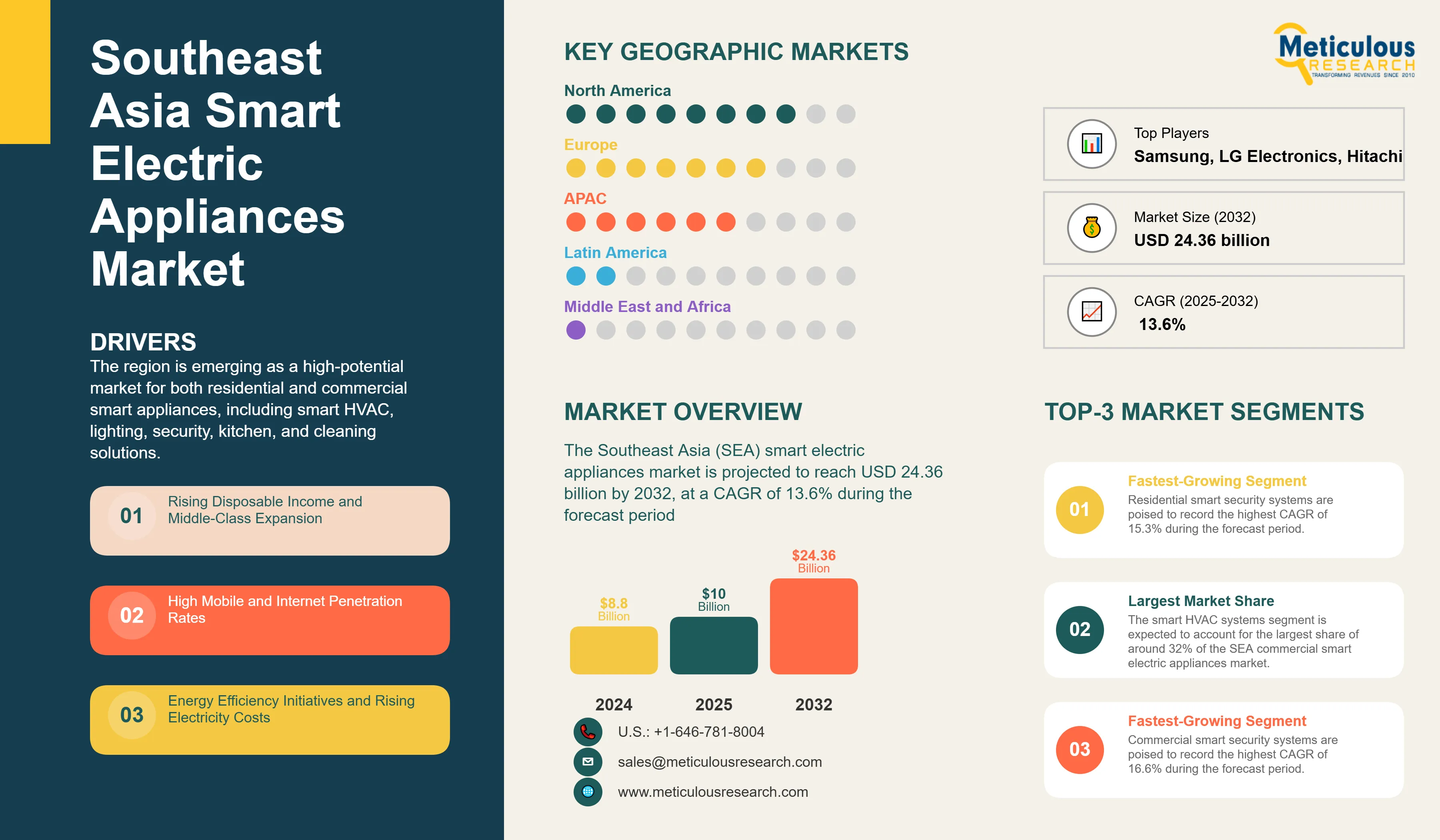
The Southeast Asia (SEA) smart electric appliances market is projected to reach USD 24.36 billion by 2032 from an estimated USD 10 billion in 2025, at a CAGR of 13.6% during the forecast period. The growth of this market is driven by several key factors, including:
- Rising disposable income and middle-class expansion
- High mobile and internet penetration rates
- Growth in tech-savvy consumers
- Energy efficiency initiatives and rising electricity costs
- Smart city projects across major SEA countries
The region is emerging as a high-potential market for both residential and commercial smart appliances, including smart HVAC, lighting, security, kitchen, and cleaning solutions. Moreover, technological advancements such as AI-driven appliances, IoT integration, and enhanced energy efficiency are further propelling market expansion. However, challenges like high initial costs, security concerns, and regulatory hurdles persist. Key players are actively engaging in strategic partnerships, mergers, and new product launches to strengthen their foothold in this dynamic market.
Market Segmentation and Insights
Click here to: Get Free Sample Pages of this Report
The SEA smart electric appliances market is segmented by product type (residential smart electric appliances {smart entertainment appliances, smart kitchen appliances, smart climate control, smart laundry appliances, smart cleaning appliances, smart security systems, smart lighting solutions, and smart water appliances} and commercial smart electric appliances {smart HVAC systems, smart security systems, smart lighting systems, smart office equipment, smart energy management systems, smart kitchen appliances, smart water management, and smart cleaning solutions}), and by protocols & standards (wireless protocols, wired protocols, and hybrid protocols). The study also evaluates industry competitors and analyzes the market at the country and regional levels.
Segmental Analysis
Residential Smart Electric Appliances Market
In 2025, the residential smart electric appliances segment is expected to account for a larger share of around 68% of the overall SEA smart electric appliances market and is expected to grow at a CAGR of 13% during the forecast period of 2025-2032.
Market Growth Drivers
- Rapid urbanization and evolving lifestyles
- Integration of Wi-Fi and Bluetooth technologies in appliances
- Rising disposable incomes
- Increasing adoption of smart home technologies
- Growing smartphone penetration
Fastest-Growing Segment:
Residential smart security systems are poised to record the highest CAGR of 15.3% during the forecast period. Rising concerns over personal and property security are leading consumers to adopt smart locks, surveillance cameras, and integrated alarm systems.
Commercial Smart Electric Appliances Market
The commercial smart electric appliances segment is projected to register a higher CAGR of 14.6% during the forecast period. The fast growth of this segment is driven by:
- Economic growth and industrialization
- Energy efficiency regulations
- Technological integration
Largest Market Share:
The smart HVAC systems segment is expected to account for the largest share of around 32% of the SEA commercial smart electric appliances market. This segment is projected to grow at a CAGR of 13.3% from 2025 to 2032. The demand for energy-efficient and sustainable cooling solutions is increasing due to:
- Rising temperatures
- Urbanization
- Expanding commercial construction activities
- Adoption of IoT-enabled devices & AI-based solutions
Fastest-Growing Segment:
Commercial smart security systems are poised to record the highest CAGR of 16.6% during the forecast period. The growth is driven by rising concerns over safety in commercial spaces such as offices, retail centers, and healthcare facilities.
Market Insights
Indonesia: Largest Market Share
In 2025, Indonesia is expected to account for the largest share of around 22% of the overall SEA smart electric appliances market. The market is projected to grow at a CAGR of 12.2% from 2025-2032, mainly driven by:
- Large population and rapid urbanization
- Increasing adoption of smart technologies in residential and commercial sectors
- Government initiatives promoting energy efficiency
Singapore: Fastest-Growing Market:
Singapore is slated to register the highest CAGR of 15.9% during 2025–2032 in the overall SEA smart electric appliances market. The country’s rapid market growth is attributed to:
- Advanced digital infrastructure
- Widespread adoption of 5G technology
- Strong government support for smart city initiatives
- Tech-savvy population demanding smart home solutions
- Rising investments in energy-efficient smart appliances
Competitive Landscape
Major companies in the SEA smart electric appliances market have implemented various strategies to expand their product offerings' footprints and augment their market shares. The key strategies followed by most companies in the smart electric appliances market were product launches, expansions, mergers & acquisitions, agreements, collaborations, and partnerships. Product launches accounted for a major share of the total strategic developments from key players between 2022 and 2025 followed by expansions, and partnerships, agreements, and collaborations.
Some of the prominent players operating in the Southeast Asia smart electric appliances market and implementing various strategies to maintain their leading position in the market are Samsung Electronics Co., Ltd. (South Korea), LG Electronics Inc. (South Korea), Panasonic Holdings Corporation (Japan), Electrolux AB (Sweden), Hitachi, Ltd. (Japan), Xiaomi Corporation (China), ABB LTD. (Switzerland), Toshiba Lifestyle Products & Services Corporation (Japan), Daikin Industries, Ltd. (Japan), Schneider Electric SE (France), Johnson Controls International PLC (Ireland), Siemens AG (Germany), and Honeywell International Inc. (U.S.).
Market Research Summary
|
Particulars |
Details |
|
Number of Pages |
285 |
|
Format |
PDF & Excel |
|
Forecast Period |
2025–2032 |
|
Base Year |
2024 |
|
CAGR (Value) |
13.6% |
|
Market Size (Value)in 2025 |
USD 10 Billion |
|
Market Size (Value) in 2032 |
USD 24.36 Billion |
|
Segments Covered |
|
|
Countries Covered |
Indonesia, Vietnam, Thailand, Singapore, Malaysia, Philippines, Rest of SEA |
|
Key Companies |
Samsung Electronics Co., Ltd. (South Korea), LG Electronics Inc. (South Korea), Panasonic Holdings Corporation (Japan), Electrolux AB (Sweden), Hitachi, Ltd. (Japan), Xiaomi Corporation (China), ABB LTD. (Switzerland), Toshiba Lifestyle Products & Services Corporation (Japan), Daikin Industries, Ltd. (Japan), Schneider Electric SE (France), Johnson Controls International PLC (Ireland), Siemens AG (Germany), and Honeywell International Inc. (U.S.). |
Frequently Asked Questions
Related Tags
How We Built This Intelligence
Table of Contents
Expand allAccess & Licensing
Choose how you access this intelligence — from a standalone data pack to organization-wide access. Every option is delivered within 24–48 hours and backed by analyst support.
Related Statistics & Insights
Need something more specific?
A custom-scoped study can target a single segment, geography, or competitor set — or answer a board-level question this syndicated report doesn't. Tell an analyst what decision you're making and we'll scope it.