Information and Communications TechnologyReport ID: MR-948Jan 2025180 PagesAsia-Pacific
Verified by the Meticulous Standard·Last verified: May 2026 by Rajdeep Bhawal

South East Asia Online Language Learning Market by Learning Mode (Self-learning Apps, Tutoring), Age Group, Language (English, Mandarin, Spanish), End User (Individual Learners, Educational Institutions), and Country - Forecast to 2032

Published Date: Jan 2025
Format: PDF + Excel + Cloud Portal
Pages / Size: 180 Pages
Analyst: Rajdeep Bhawal
Secure checkout · Full methodology disclosure · Underwritten by lead analyst Rajdeep Bhawal
South East Asia Online Language Learning Market Size
South East Asia Online Language Learning Market Sizing & Sourcing
Base year: 2025 · CAGR: 7.2%
$5.86B
Market size 2025
$6.42B
Market size 2026
$12.84B
Forecast by 2036
7.2%
CAGR 2026–2036

Market Overview

The South East Asia Online Language Learning Market

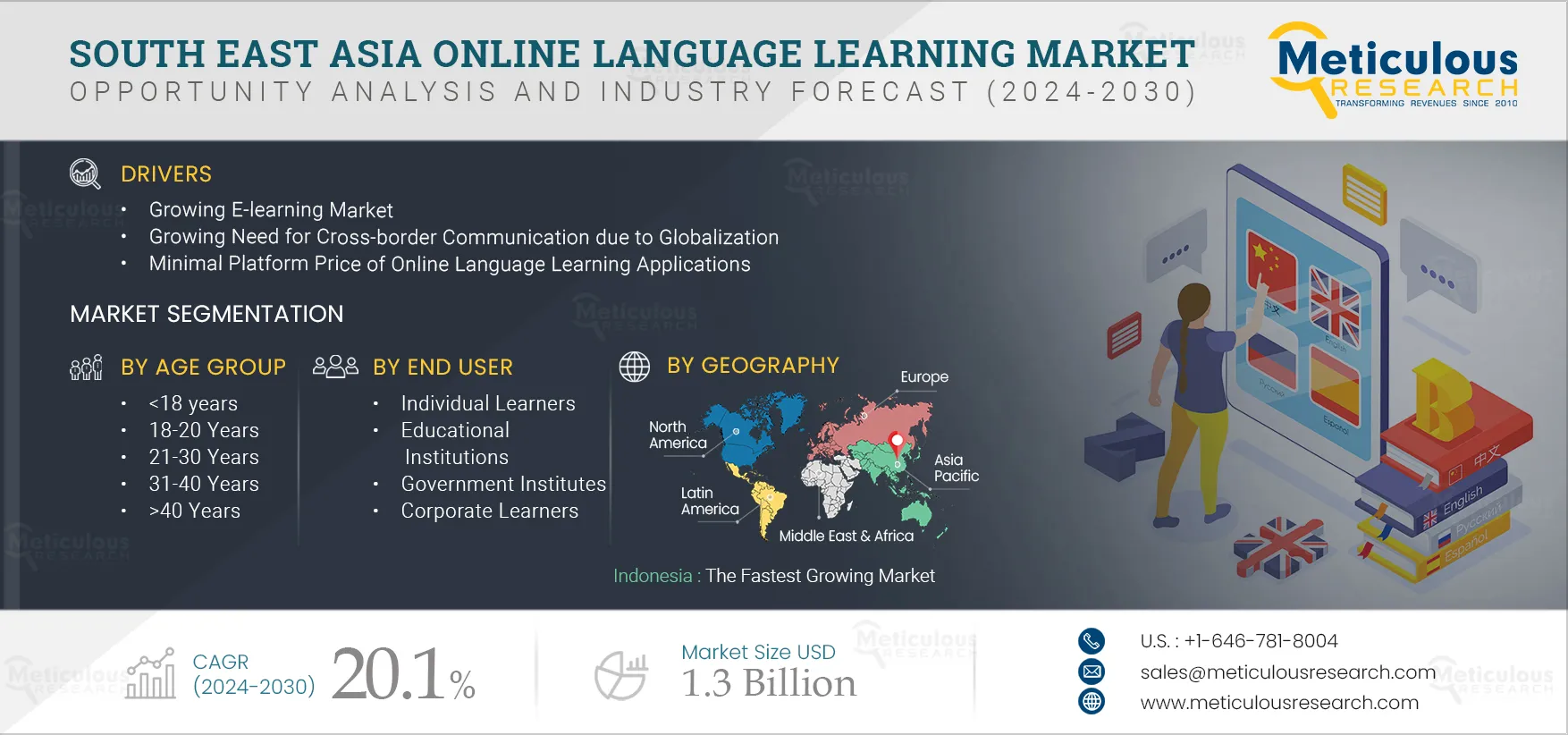
is projected to reach $1.3 billion by 2032, at a CAGR of 20.1% during the forecast period 20252032. The growth of this market is driven by the increasing demand for easily accessible and cost-effective online language learning programs, the growth in the E-learning market, the growing need for cross-border communication due to globalization, and the affordability of online language learning applications. Furthermore, the rising investments in language teaching start-ups and small companies, the rising internet and smartphone penetration, and the growing preference for multilingual employees among multinational corporations are expected to create opportunities for market growth.

However, data security and privacy concerns restrain the growth of this market. The lack of trained professionals to teach languages is a major challenge for players in this market. Prominent trends in the South East Asia online language learning market include the emergence of gamified language learning apps and platforms, the adoption of AI-powered language learning platforms, and the increasing popularity of transnational education (TNE).

South East Asia Online Language Learning Market

The Growth in the E-learning Mar...

The E-learning market is growing rapidly, enabling individuals from different countries to stay connected and learn different online courses. Flexibility in learning, low cost, easy accessibility, growing investments in digital learning activities, and high effectiveness of animated learning are some factors favoring market growth. Moreover, the user demand for ease of access and improved effectiveness through new animated, engaging, and interactive learning tools has increased in recent years. The rise in internet users and growing access to mobile phones with online capabilities make it easy to opt for E-learning.

Technology-enabled learning that helps individuals and organizations train their workforce is further driving the growth of the E-learning market. These training modules offer continuous and effective learning at an optimal cost and provide customized course content that meets the specific requirements of the end users. Furthermore, the availability of a visually engaging interface in e-learning is increasing employee productivity over traditional learning methods.

Advancements in internet technologies, such as big data and cloud computing, have resulted in flexible storage and easy access to content. Cloud-based solutions have made the processing of learning content easier and boosted its accessibility. In addition, the rising interest in distance language learning will likely benefit the E-learning market. Distance learning has been proven effective for language learners to receive instruction in an adaptable environment. This approach allows flexibility to the learners and helps them manage time while juggling different tasks. Additionally, distance learning offers face-to-face interaction with native speakers, accelerating the learning process and providing tailored lessons according to the learner’s ability. Therefore, with technological improvements in learning and teaching, the interest in E-learning platforms is growing rapidly, driving the growth of the South East Asia online language learning market.

Several countries in the region, including Taiwan, Malaysia, Vietnam, and Indonesia, are focusing on launching various initiatives to integrate the educational system with smart technology and increase bilingual education and online teaching modules. For instance, in June 2022, Taiwan's Industrial Development Bureau of the Ministry of Economic Affairs (IDB) worked with local enterprises to use smart technology to ensure inclusive and equitable education for all as part of the Smart City Taiwan project. In September 2022, the National Development Council (NDC), the Ministry of Education (MOE), and the Australian Office signed the "Australia-Taiwan English Language Learning Partnership Action Plan 2022" to strengthen cooperation between Taiwan and Australia in English language learning. The Action Plan will promote a wide range of language learning initiatives to help Taiwan achieve its goal of becoming a bilingual nation by 2032. Such developments and the growing E-learning market in the region contribute to the overall market growth.


Key Findings in the South East A...

In 2025, the Self-learning Apps and Applications Segment is Expected to Dominate the South East Asia Online Language Learning Market

Based on learning mode, the South East Asia online language learning market is broadly segmented into self-learning apps and tutoring. In 2025, the self-learning apps segment is expected to account for the largest share of the South East Asia online language learning market. The large market share of this segment is attributed to the growing integration of self-learning apps and information and communication technology (ICT) within educational institutions, a surge in corporate initiatives focused on mobile apps offering customization and language choices, often at minimal or no cost, and a free subscription model, and the continuous advances in technologies such as AI and AR/VR.

In 2025, the <18 years Segment is Expected to Dominate the South East Asia Online Language Learning Market

Based on age group, the South East Asia online language learning market is broadly segmented into <18 years, 18-20 years, 21-30 years, 31-40 years, and >40 years. In 2025, the <18 years segment is expected to account for the largest share of the South East Asia online language learning market. This segment is also projected to register the highest CAGR during the forecast period. The large market share of this segment is attributed to the growing demand for diverse language learning methods, including online interactive language games, printed language learning flashcards, printable language alphabet worksheets, and language books and stories, the increasing need for immersive and practical language practice among this demographic, and the rise in the number of online language learning programs for children.

In 2025, the English Segment is Expected to Dominate the South East Asia Online Language Learning Market

Based on language, the South East Asia online language learning market is broadly segmented into English, French, Spanish, Mandarin, German, Italian, Arabic, Japanese, Korean, And Other Languages. In 2025, the English segment is expected to account for the largest share of the South East Asia online language learning market. The large market share of this segment is attributed to the increasing preference for English as a primary language over other languages, the effects of globalization and urbanization, the growing global community of English language learners, and the increasing emphasis on English language education in schools and educational institutions.

However, the Mandarin segment is projected to register the highest CAGR during the forecast period due to the growing global demand for Mandarin-speaking professionals, increasing business opportunities in China, and growing cross-cultural communication and globalization.

Indonesia to be the Fastest Growing Market

Based on geography, the South East Asia online language learning market is segmented into Indonesia, Vietnam, Thailand, Malaysia, Singapore, Philippines, and the Rest of South East Asia. In 2025, Indonesia is projected to register the highest CAGR during the forecast period. The market growth in Indonesia can be attributed to the increasing emphasis on digitizing traditional classroom learning, government initiatives to integrate digital tools into the education sector, growing utilization of mobile devices and internet connectivity in rural areas and small towns, and the rising demand for language skills to facilitate cross-border work and collaboration.
Key Companies

The report includes a competitive landscape based on an extensive assessment of the key growth strategies adopted by the leading market participants in the South East Asia online language learning market in the last three to four years. The key players profiled in the South East Asia online language learning market report are Berlitz Corporation (U.S.), Rosetta Stone, Inc. (U.S.), Memrise Inc. (U.K.), Inlingua International Ltd. (France), Sanako Corporation (Finland), Duolingo Inc. (U.S.), Babble GmbH (Germany), Busuu Limited (U.K.), Transparent Language, Inc. (U.S.), Open Education LLC (U.S.), Linguistica 360, Inc. (U.S.), Mondly (Romania), FluentU (A part of Enux Education Limited), Mango Languages (U.S.), Cambridge University Press (U.K.), New Oriental Education & Technology Group Inc. (China), Houghton Mifflin Harcourt Company (U.S.), McGraw-Hill Education, Inc. (U.S.), and ELSA Corp. (U.S.).

Scope of the report:

South East Asia Online Language Learning Market Assessment, by Learning Mode

  • Self-learning Apps
  • Tutoring
    • One-on-one Learning
    • Group Learning

South East Asia Online Language Learning Market Assessment, by Age Group

  • <18 years
  • 18-20 Years
  • 21-30 Years
  • 31-40 Years
  • >40 Years

South East Asia Online Language Learning Market Assessment, by Language

  • English
  • French
  • Spanish
  • Mandarin
  • German
  • Italian
  • Arabic
  • Japanese
  • Korean
  • Other Languages

South East Asia Online Language Learning Market Assessment, by End User

  • Individual Learners
  • Educational Institutions
    • K-12
    • Higher Education
  • Government Institutes
  • Corporate Learners

South East Asia Online Language Learning Market Assessment, by Country

  • Indonesia
  • Vietnam
  • Thailand
  • Malaysia
  • Singapore
  • Philippines
  • Rest of South East Asia (RoSEA)

Key questions answered in the report:

Frequently Asked Questions

How We Built This Intelligence

Table of Contents

Expand all

Access & Licensing

Choose how you access this intelligence — from a standalone data pack to organization-wide access. Every option is delivered within 24–48 hours and backed by analyst support.

Single User License
Instant access to full PDF report + Excel dataset.
$4,175
1–5 User Access
Full PDF Report + Excel Datasheets
1-Hour Analyst Call included
Free 10% Customization
POPULAR
Multi-User License
Instant access to full PDF report + Excel dataset.
$5,875
1–5 User Access
Full PDF Report + Excel Datasheets
1-Hour Analyst Call included
Free 10% Customization
Enterprise License
Instant access to full PDF report + Excel dataset.
$7,875
1–5 User Access
Full PDF Report + Excel Datasheets
1-Hour Analyst Call included
Free 10% Customization
Flexible Purchase Options
Buy the complete report, individual chapters, or only the data you need. Starting from $1,500.
Analyst-reviewed intelligence
Multi-source validation
Transparent methodology
Citation-ready data
Analyst assistance

Related Statistics & Insights

$1.3B
projected market value by 2032
20.1%
compound annual growth rate
Cite this report
Meticulous Research. (2025). South East Asia Online Language Learning Market - Opportunity Analysis and Industry Forecast (2025-2032) (Report No. MR-948). Meticulous Market Research Pvt. Ltd. https://meticulousresearch.com/reports/south-east-asia-online-language-learning-market-5631
Custom Research

Need something more specific?

A custom-scoped study can target a single segment, geography, or competitor set — or answer a board-level question this syndicated report doesn't. Tell an analyst what decision you're making and we'll scope it.

Search Market Intelligence

Search across reports, blogs, press releases, and industries