Information and Communications TechnologyReport ID: MR-329Jul 2024250 PagesGlobal
Verified by the Meticulous Standard·Last verified: May 2026 by Aniket Hade

Smart Home Market Size, Share, Forecast, & Trends Analysis by Product Type (Smart Lightning Systems, Smart Speakers, Smart Security & Monitoring Systems, Smart Home Appliances), Protocol & Standard (Wireless Protocols, Wired Protocols, Hybrid Protocols), and Geography - Global Forecast to 2031

Published Date: Jul 2024
Format: PDF + Excel + Cloud Portal
Pages / Size: 250 Pages
Analyst: Aniket Hade
Secure checkout · Full methodology disclosure · Underwritten by lead analyst Aniket Hade
Smart Home Market Size
Smart Home Market Sizing & Sourcing
Base year: 2025 · CAGR: 7.2%
$5.86B
Market size 2025
$6.42B
Market size 2026
$12.84B
Forecast by 2036
7.2%
CAGR 2026–2036

Market Overview

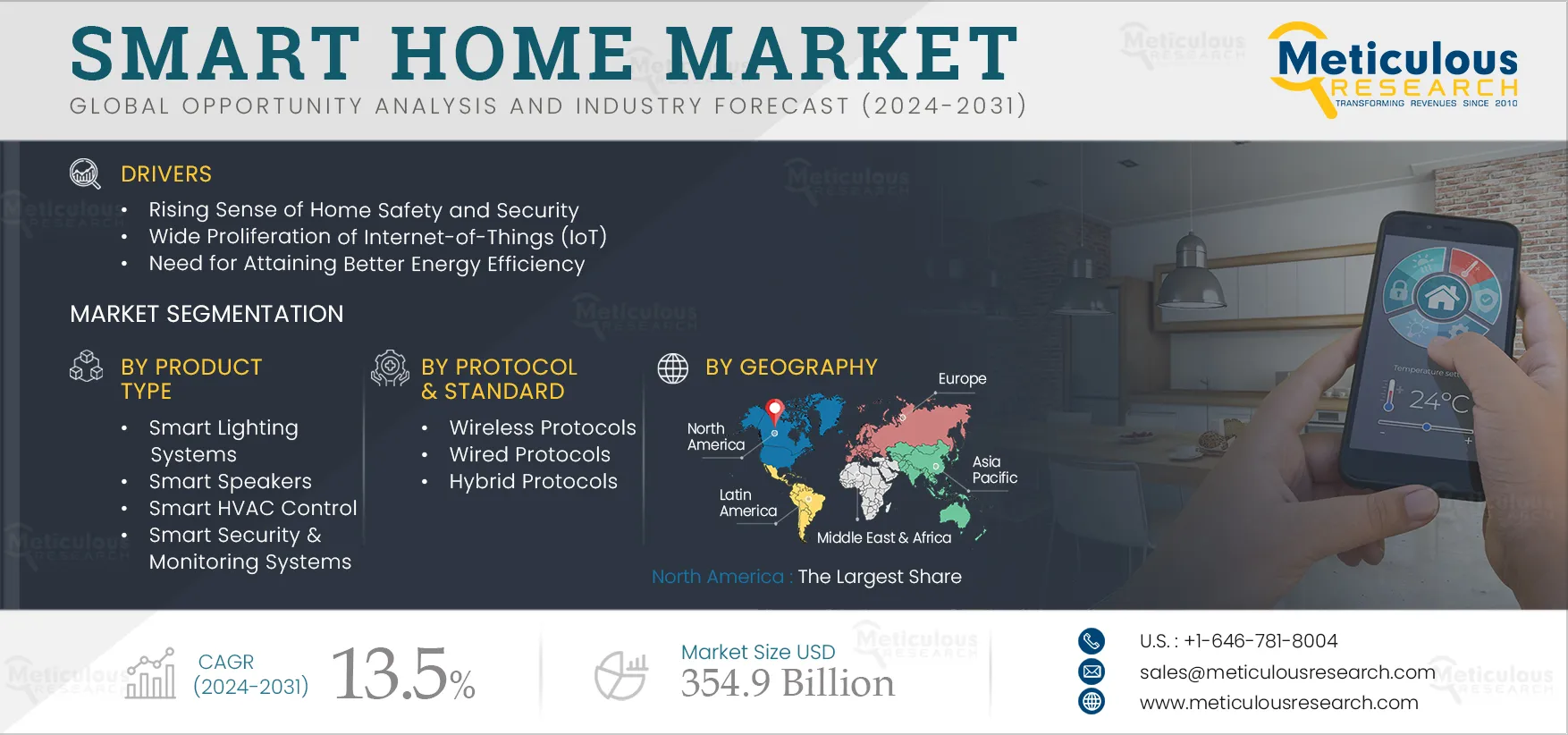
The growth of this market is attributed to the rising sense of home safety & security, the wider proliferation of the Internet of Things (IoT), and the need for better energy efficiency. Moreover, the significant growth opportunities in emerging Asia-Pacific and the Middle East & Africa and the need for complete flexibility & customization for consumers are expected to offer growth opportunities for the players operating in this market.

Market Growth Drivers

Rising Sense of Home Safety and Security Supports the Growth of Smart Home Market

Physical safety and security have become one of the major concerns in the global real estate industry. Homeowners today are increasingly concerned about their families' and possessions' safety and security. This is largely driven by the large number of thefts and burglaries and the effectiveness of home security systems in curtailing these to a large extent. For instance, in 2021, 619,811 burglary cases were recorded in the U.S. However, cases have steadily declined, and security systems are crucial in bringing down those numbers. In the U.S., four out of ten consumers are willing to adopt smart home systems to prioritize making their home more secure. Besides security systems, smart safety devices, including motion sensors, fire & smoke sensors, and leak detectors, among others, are also some of the key products adopted from the safety point of view.

Government bodies and several organizations are also focusing on offering various smart devices for consumer protection and security. For instance, in February 2022, Thales Group (France) launched its new IoT connectivity solution with improved reliability and security for smart grids and connected home appliances. Consequently, the growing sense of home safety and security is driving the adoption of smart security and safety devices, thereby contributing to the growth of the overall smart home market.
Wider Proliferation of Internet of Things (IoT) Drives the Growth of Smart Home Market

Over the past decade, the power of the internet has projected its power beyond computers and smartphones and has made a huge impact across various sectors. IoT devices have become one of the prominent global economic drivers changing diverse sectors, including healthcare, industrial, commercial, and residential. According to a report published by the U.K. government's chief scientific adviser, the growth of the IoT industry is majorly attributed to the availability of inexpensive semiconductors, wider network availability, boosted capacity, and technological advancement in data management and storage.

While IoT is revolutionizing the industrial sectors, its application and impact on the commercial and residential sectors is seen in the form of greater deployment of smart home systems. Several organizations are providing smart technologies integrated with IoT devices for home applications. For instance, in July 2021, China Mobile International Limited (China) launched a smart home IoT management platform to provide consumers with one-stop access to IoT hardware and standardized end-to-end applications with unified connectivity and provide a digital lifestyle across Europe. Thus, as new applications of IoT are developed for smart home systems, their adoption is slated to grow over the coming years, thereby driving the market growth.

Market Opportunities

Need for Complete Flexibility & Customization for Consumers Offer Growth Opportunities in the Global Smart Home Market

Smart home technology encompasses a variety of devices, applications, services, and interfaces, among others. All these smart home products are designed and developed with a view to appeal to a mass market. However, barring a few categories of smart devices, such as smart safety & security devices, individual consumers have individual user preferences for smart home applications and devices. This has been one of the challenges for smart home device manufacturers failing to attract individual consumers. The pre-ordered package solution provided by a single brand could not gratify the unique needs of every single consumer. This indeed opens a world of opportunity for the smart home device providers to offer an open platform capable of hosting all third-party systems and devices. This will give complete freedom to the users to customize their smart home ecosystem according to personal requirements.

Many of the leading smart home device providers have already started to collaborate with other companies to provide complete personalization and customization to customers. For instance, devices such as Amazon Echo of Amazon Web Services, Inc. (U.S.) and Google Home of Google LLC (U.S.) work on the platform, which is compatible with several other home automation systems such as Phillips Hue lightbulbs and Belkin’s WeMo product line. Similarly, several smart TV manufacturers are introducing their products as the main control hub to control other smart devices seamlessly. Although achieving absolute customization is challenging in the present time, companies are cooperating to offer a maximum degree of personalization and customization to consumers. Such factors are providing opportunities for smart home device providers to support market growth.

Smart Home Market Analysis

By Product Type: In 2024, the Smart Security & Monitoring Systems Segment to Dominate the Smart Home Market

Based on product type, the global smart home market is segmented into smart lighting systems, smart speakers, smart HVAC control, smart security & monitoring systems, smart entertainment systems, smart home appliances, smart kitchen appliances, smart home healthcare systems, and smart furniture. In 2024, the smart security & monitoring systems segment is expected to account for the largest share of over 23% of the global smart home market. The large market share of this segment is attributed to the rising sense of home safety and security. The smart security systems industry is evolving with technological developments, leading to the availability of systems with better security features and improved performance. In March 2023, Google LLC (U.S.) and ADT (U.S.) launched a smart home security system to offer internet-connected security features with their existing smart home ecosystem for consumers. As smartphones and the Internet have gained wider penetration, the security and monitoring systems industry immediately leveraged this and integrated connectivity and remote access into the systems. This ensures that the benefits of these systems are realized without compromising individual rights and privacy.

However, the smart speakers segment is projected to register the highest CAGR during the forecast period. The growth of this segment is driven by the increasing consumer preference for technologically advanced products, the increasing demand for display-based smart speaker devices, and the growing demand for voice-activated devices.

By Protocol & Standard: In 2024, the Wired Protocols Segment to Dominate the Smart Home Market

Based on protocol & standard, the global smart home market is segmented into wireless protocols, wired protocols, and hybrid protocols. In 2024, the wired protocols segment is expected to account for the largest share of over 47% of the global smart home market. The large market share of this segment is attributed to the rising need to attain better energy efficiency and changing consumers' preference for stable and reliable wired standards for home automation systems. Wired protocols are crucial in establishing reliable and secure communication within smart home systems. They involve using physical cables to transmit data and signals between devices and components. Ethernet is a well-established wired networking protocol for local area networks (LANs). It provides high-speed data transmission and is commonly used for connecting devices that require fast and reliable internet connectivity, such as smart TVs, computers, and networked security cameras.

However, the hybrid protocols segment is projected to register the highest CAGR during the period. Hybrid protocols use the capabilities of both wired and wireless protocols and combine them to achieve better outcome. The network is segmented into zones and uses diverse protocols in two different zones such that one protocol is used within the zone and the other is used among them. It offers several advantages over conventional wired, wireless, and hybrid protocols such as C-Bus. It does not interfere with existing Wi-Fi networks and can easily be incorporated with smart devices. The limit to connect smart devices is quite large and can work through power lines, hence eliminating the need for routers. It also offers the flexibility of wireless protocols and the reliability of wired protocols, increasingly drawing consumers' attention.

Geographical Analysis

In 2024, North America is Expected to Dominate the Smart home Market

In 2024, North America is expected to account for the largest share of over 36% of the global smart home market. The market growth in North America is driven by the availability of smart appliances and systems in the region, greater adoption of advanced technologies, growing sense of safety and security among consumers, growing need for energy-efficient products and systems, innovation in the field of IoT devices, and presence of major players in this region.

However, Asia-Pacific is projected to record the highest CAGR of over 16.9% during the forecast period. The region’s growth is attributed to the growing number of young and tech-savvy population, increasing disposable income, increasing government initiatives for the adoption of smart devices, and significant growth opportunities in emerging countries of Asia-Pacific.

Key Companies

The report offers a competitive analysis based on an extensive assessment of the leading players’ product portfolios, geographic presence, and key growth strategies adopted in the last three to four years. Some of the key players operating in the Smart home market are Google LLC (U.S.), Apple, Inc. (U.S.), Amazon.com, Inc. (U.S.), Siemens AG (Germany), United Technologies Corporation (U.S.), Samsung Electronics Co., Ltd. (South Korea), Honeywell International, Inc. (U.S.), Johnson Controls International plc (Ireland), Schneider Electric SE (France), LG Electronics, Inc. (South Korea), Robert Bosch GmbH (Germany), ABB Ltd. (Switzerland), ASSA ABLOY AB (Sweden), General Electric Company (U.S.), Legrand SA (France), and Sony Corporation (Japan).

Smart Home Industry Overview: Latest Developments from Key Industry Players

  • In November 2023, Inter IKEA Systems B.V. (Netherlands) launched three new smart home Zigbee sensors, Vallhorn, Parasoll, and Badring, for water leakage and motion detection. These sensors will provide customers with a greater sense of control and comfort, allowing them to stay connected to home devices.

  • In June 2021, ProKNX (France) launched an offline multilingual voice-controlled system for smart home. This system performs all the functions of traditional home automation assistants while prioritizing user privacy. The ProKNX plug-and-play smart speaker operates locally via Wi-Fi, allowing users to control lights, blinds, heating, Sonos speakers, and smart televisions using natural voice commands without recording or storing user data.

Market Research Summary

Particulars

Details

Number of Pages

250

Format

PDF

Forecast Period

2024–2031

Base Year

2023

CAGR (Value)

13.5%

Market Size (Value)

USD 354.9 Billion by 2031

Segments Covered

By Product Type

  • Smart Lightning Systems
  • Smart Speakers
  • Smart HVAC Control
    • Smart Thermostats
    • Smart Vents
    • Smart Air Conditioning
  • Smart Security & Monitoring Systems
    • Security Cameras
    • Interface
    • Smart Locks & Access Control
  • Smart Entertainment Systems
  • Smart Home Appliances
  • Smart Kitchen Appliances
    • Smart Refrigerators
    • Smart Coffee Makers
    • Smart Dishwashers
    • Smart Ovens
  • Smart Home Healthcare Systems
  • Smart Furniture
    • Smart Sofas and Recliners
    • Smart Tables & Desks

By Protocol & Standard

  • Wireless Protocols
    • ZigBee
    • Wi-Fi
    • Bluetooth
    • Z-Wave
    • Thread
    • Enocean
  • Wired Protocols
    • KNX
    • UPB
    • X10
    • BACNET
    • LONWORKS
    • DALI
    • MODBUS
    • ETHERNET
  • Hybrid Protocols
    • Insteon
    • C-bus

Countries Covered

North America (U.S., Canada), Europe (Germany, U.K., France, Italy, Spain, Rest of Europe), Asia-Pacific (Japan, China, India, South Korea, Rest of Asia-Pacific), Latin America, and the Middle East & Africa

Key Companies

Google LLC (U.S.), Apple, Inc. (U.S.), Amazon.com, Inc. (U.S.), Siemens AG (Germany), United Technologies Corporation (U.S.), Samsung Electronics Co., Ltd. (South Korea), Honeywell International, Inc. (U.S.), Johnson Controls International plc (Ireland), Schneider Electric SE (France), LG Electronics, Inc. (South Korea), Robert Bosch GmbH (Germany), ABB Ltd. (Switzerland), ASSA ABLOY AB (Sweden), General Electric Company (U.S.), Legrand SA (France), and Sony Corporation (Japan)

Frequently Asked Questions

How We Built This Intelligence

Table of Contents

Expand all

Access & Licensing

Choose how you access this intelligence — from a standalone data pack to organization-wide access. Every option is delivered within 24–48 hours and backed by analyst support.

Single User License
Instant access to full PDF report + Excel dataset.
$4,175
1–5 User Access
Full PDF Report + Excel Datasheets
1-Hour Analyst Call included
Free 10% Customization
POPULAR
Multi-User License
Instant access to full PDF report + Excel dataset.
$5,875
1–5 User Access
Full PDF Report + Excel Datasheets
1-Hour Analyst Call included
Free 10% Customization
Enterprise License
Instant access to full PDF report + Excel dataset.
$7,875
1–5 User Access
Full PDF Report + Excel Datasheets
1-Hour Analyst Call included
Free 10% Customization
Flexible Purchase Options
Buy the complete report, individual chapters, or only the data you need. Starting from $1,500.
Analyst-reviewed intelligence
Multi-source validation
Transparent methodology
Citation-ready data
Analyst assistance

Related Statistics & Insights

$133.8B
market value in 2023
$354.9B
projected market value by 2031
13.5%
compound annual growth rate
23%
of the global smart home market
Cite this report
Meticulous Research. (2024). Smart Home Market - Global Opportunity Analysis and Industry Forecast (2024-2031) (Report No. MR-329). Meticulous Market Research Pvt. Ltd. https://meticulousresearch.com/reports/smart-home-market-5029
Custom Research

Need something more specific?

A custom-scoped study can target a single segment, geography, or competitor set — or answer a board-level question this syndicated report doesn't. Tell an analyst what decision you're making and we'll scope it.

Search Market Intelligence

Search across reports, blogs, press releases, and industries