Semiconductor and ElectronicsReport ID: MR-617Sep 2022327 PagesGlobal
Verified by the Meticulous Standard·Last verified: May 2026 by Aniket Hade

Robotic Welding Market by Component (Robots, End of Arm Tooling, Controllers), Welding Process, Payload (Less than 25 kg Payload, 25 kg to 100 kg Payload, More than 100 kg Payload), End-use Industry, and Geography - Global Forecast to 2029

Published Date: Sep 2022
Format: PDF + Excel + Cloud Portal
Pages / Size: 327 Pages
Analyst: Aniket Hade
Secure checkout · Full methodology disclosure · Underwritten by lead analyst Aniket Hade
Robotic Welding Market Size
Robotic Welding Market Sizing & Sourcing
Base year: 2025 · CAGR: 7.2%
$5.86B
Market size 2025
$6.42B
Market size 2026
$12.84B
Forecast by 2036
7.2%
CAGR 2026–2036

Market Overview

The

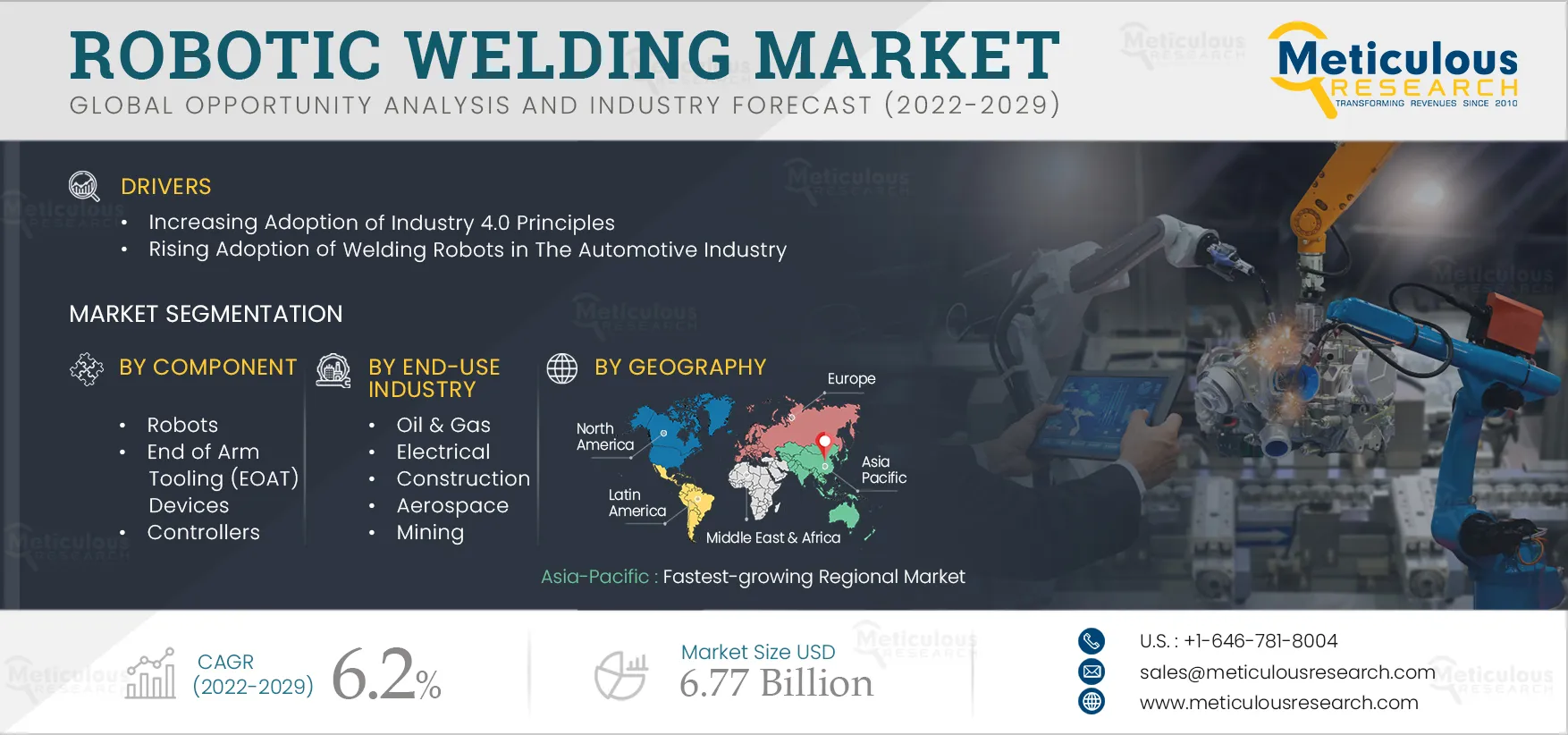
Robotic Welding Market is expected to reach $6.77 billion by 2029, at a CAGR of 6.2% during the forecast period of 20222029. By volume, this market is expected to reach 163.3 thousand units by 2029, at a CAGR of 11.2% from 2022 to 2029. The growth of this market is driven by the increasing adoption of industry 4.0 principles and the rising adoption of welding robots in the automotive industry. However, the high initial cost of installing welding robots is expected to restrain the growth of this market.

Government initiatives to support digital transformation in Asia-Pacific and the emergence of laser & plasma welding technologies are expected to provide significant growth opportunities for stakeholders in this market. However, the lack of skilled workers for operating welding robots is expected to pose a major challenge to the growth of this market.

Impact of COVID-19 on the Roboti...

The COVID-19 outbreak caused a widespread economic downturn as several countries imposed strict lockdowns to contain the infection, resulting in the closure of manufacturing facilities and disruptions in supply chains and production schedules. The outbreak of the COVID-19 pandemic had a significant impact on technology and component supply chains globally. Furthermore, restrictions placed on transport led to the shortage of raw materials required for the production of advanced welding equipment

The top players in the welding robotics market are headquartered in Japan. These players witnessed a major decline in their revenue in 2019. For instance, in March 2020, FANUC (Japan) announced that its ROBOT division revenue was down 6.9% in 2019 compared to 2018. The COVID-19 pandemic disrupted the global supply chain and reduced the installation of industrial robots in various key industries, such as automotive, electrical, electronics, and metals & machinery.

The pandemic adversely affected the industrial sector due to the reduced demand for high-cost products. During the nationwide lockdowns, consumers limited their spending on only the most essential goods & services, reducing the demand for consumer goods, high-cost electronics, textiles, automobiles, and machinery, which impacted the major application sectors of the robotic welding market. With countries resuming trade and economic activity and stability in consumer lifestyles, the spending on these products and services is expected to increase, boosting the demand for automation solutions over the coming years. The market is expected to recover in 2022 due to restrictions on the number of personnel allowed at manufacturing facilities.
Robotic Welding Market

Laser and Plasma Welding Technologies

A laser welding robot uses a laser beam, which is developed using carbon dioxide and targeted with the help of optics at workpieces to weld different parts together. Laser welding technology offers numerous advantages in the production of medium- and large-batch sizes of output products at a low unit cost. It offers high welding speed, reduces rework, provides high reliability, ensures increased weld quality, and offers high precision. This technology allows narrow welds that require minimal changes to the welded items.

Laser welding technology is used in remote welding locations that are hard to reach. It can also be used in high-volume applications that require increased accuracy in the automotive & transportation, electrical and electronics, and aerospace & defense industries.

Similarly, plasma welding technology offers numerous advantages, including high power density, clean and smooth welds, high welding speed, low distortion, and improved gap bridging. The welds produced through plasma welding are durable and less noticeable. The numerous advantages offered by plasma welding technology drive its adoption in the automotive & transportation and electrical & electronics industries.

Key Findings in the Global Robot...

Robots Segment Expected to Account for Largest Market Share in 2022

Based on component, the robotic welding market is segmented into robots, end of arm tooling (EOAT) devices, controllers, and software. The robots segment is further subsegmented into articulated robots, cartesian robots, cylindrical robots, SCARA robots, collaborative robots, delta robots, and other robots. Furthermore, the end of arm tooling (EOAT) devices segment is subsegmented into welding torches, vision systems, sensors, feeder systems, plasma flow controllers, and other EOAT devices.

In 2022, the robots segment is expected to account for the largest share of the robotic welding market. The large market share of this segment is attributed to the wide usage of robots across various industries, including automobile, oil & gas, general manufacturing, and defense. These robots are highly flexible in their configurations, enabling users to adjust their speed, precision, stroke length, and size.


Resistance Spot Welding Segment Slated to Register Fastest Growth Rate During Forecast Period

Based on welding process, the robotic welding market is segmented into resistance spot welding, arc welding, laser welding, plasma welding, ultrasonic welding, and other welding processes. The resistance spot welding segment is slated to register the highest CAGR during the forecast period. High payload resistance spot welding robots are widely used in the automotive & transportation, construction, and metals & machinery industries for heavy-duty applications. Hence, the increased demand from these industries contributes to the growth of this segment.

25 kg to 100 kg Segment Slated to Register Fastest Growth Rate During Forecast Period

Based on payload, the robotic welding market is segmented into less than 25 kg payload, 25 kg to 100 kg payload, and more than 100 kg payload. The 25 kg to 100 kg segment is slated to register the highest CAGR during the forecast period. The automotive & transportation, construction, and shipbuilding industries are the largest end users of welding robots with payloads of 25 kg to 100 kg. Thus, the increasing demand from these industries for welding heavy-body panels contributes to the high market growth of this segment.

Automotive & Transportation Segment Slated to Register Fastest Growth Rate During Forecast Period

Based on end-use industry, the robotic welding market is segmented into automotive & transportation, oil & gas, electrical, construction, aerospace, mining, shipbuilding, heavy engineering equipment, defense, and other end-use industries. The automotive & transportation segment is slated to register the highest CAGR during the forecast period. The growth of this segment is driven by the benefits offered by welding robots in the automotive industry’s manufacturing process, such as cost-effectiveness, high efficiency, safety, and speed & precision, resulting in the increased adoption of these welding robots. Furthermore, using robots enables car & automotive component makers to accelerate production, reduce costs, improve quality, and ensure workers' safety.

Asia-Pacific: Fastest-growing Regional Market

Based on geography, the robotic welding market is segmented into North America, Europe, Asia-Pacific, Latin America, and the Middle East & Africa. Asia-Pacific is slated to register the highest CAGR during the forecast period. The high market growth in Asia-Pacific is attributed to the increasing labor costs, driving manufacturers to automate the manufacturing processes to maintain their cost advantage.

Furthermore, Asia-Pacific is poised to retain a strong market position in the welding robots market due to cheap manufacturing costs attributable to the availability of cheap labor, high safety standards, and government initiatives to accelerate foreign direct investments (FDIs).

Key Companies

The report includes a competitive landscape based on an extensive assessment of the key growth strategies adopted by key market players in the robotic welding market over the last few years. The key players profiled in the robotic welding market are ABB Ltd (Europe), FANUC Corporation (Japan), KUKA AG (Germany), Yaskawa Electric Corporation (Japan), Kawasaki Heavy Industries, Ltd. (Japan), DAIHEN Corporation (Japan), Stäubli International AG (Switzerland), EVS Tech Co., Ltd (China), Panasonic Corporation (Japan), Estun Automation Co., Ltd. (China), United ProArc Corporation (Taiwan), Nachi-Fujikoshi Corp. (Japan), igm Robotersysteme AG (Austria), and Universal Robots A/S (Denmark).

Scope of the Report:

Robotic Welding Market, by Component                                

  • Robots
    • Articulated Robots
    • Cartesian Robots 
    • Cylindrical Robots
    • SCARA Robots
    • Collaborative Robots
    • Delta Robots
    • Other Robots
  • End of Arm Tooling (EOAT) Devices     
    • Welding Torches
    • Vision Systems
    • Sensors
    • Feeder Systems
    • Plasma Flow Controllers
    • Other EOAT Devices
  • Controllers
  • Software                      

Robotic Welding Market, by Payload              

  • Less than 25 kg Payload
  • 25 kg to 100 kg Payload
  • More than 100 kg Payload

Robotic Welding Market, by Welding Process

  • Resistance Spot Welding
  • Arc Welding
  • Laser Welding
  • Plasma Welding
  • Ultrasonic Welding
  • Other Welding Processes

Robotic Welding Market

, by End-use Industry                       

  • Automotive & Transportation
  • Oil & Gas
  • Electrical
  • Construction
  • Aerospace
  • Mining
  • Shipbuilding
  • Heavy Engineering Equipment
  • Defense
  • Other End-use Industries

Robotic Welding Market, by Geography

  • Asia-Pacific
    • China
    • Japan
    • South Korea
    • Australia & New Zealand
    • India
    • Thailand
    • Singapore
    • Taiwan
    • Rest of Asia-Pacific
  • North America
    • U.S.
    • Canada
  • Europe
    • Germany
    • Norway
    • U.K.
    • Netherlands
    • France
    • Sweden
    • Italy
    • Spain
    • Denmark
    • Austria
    • Rest of Europe
  • Latin America
  • Middle East & Africa

Key questions answered in the report:

Frequently Asked Questions

How We Built This Intelligence

Table of Contents

Expand all

Access & Licensing

Choose how you access this intelligence — from a standalone data pack to organization-wide access. Every option is delivered within 24–48 hours and backed by analyst support.

Single User License
Instant access to full PDF report + Excel dataset.
$4,175
1–5 User Access
Full PDF Report + Excel Datasheets
1-Hour Analyst Call included
Free 10% Customization
POPULAR
Multi-User License
Instant access to full PDF report + Excel dataset.
$5,875
1–5 User Access
Full PDF Report + Excel Datasheets
1-Hour Analyst Call included
Free 10% Customization
Enterprise License
Instant access to full PDF report + Excel dataset.
$7,875
1–5 User Access
Full PDF Report + Excel Datasheets
1-Hour Analyst Call included
Free 10% Customization
Flexible Purchase Options
Buy the complete report, individual chapters, or only the data you need. Starting from $1,500.
Analyst-reviewed intelligence
Multi-source validation
Transparent methodology
Citation-ready data
Analyst assistance

Related Statistics & Insights

$6.77B
projected market value by 2029
6.2%
compound annual growth rate
Cite this report
Meticulous Research. (2022). Robotic Welding Market - Global Opportunity Analysis And Industry Forecast (2022-2029) (Report No. MR-617). Meticulous Market Research Pvt. Ltd. https://meticulousresearch.com/reports/robotic-welding-market-5303
Custom Research

Need something more specific?

A custom-scoped study can target a single segment, geography, or competitor set — or answer a board-level question this syndicated report doesn't. Tell an analyst what decision you're making and we'll scope it.

Search Market Intelligence

Search across reports, blogs, press releases, and industries