Food and BeveragesReport ID: MR-656Dec 2022149 PagesGlobal
Verified by the Meticulous Standard·Last verified: May 2026 by Shubham Lawande

Plant-based Protein Processing Equipment Market by Type (Dryers, Centrifuges, Filtration Systems, Mixers, Evaporators), Mode of Operation (Automatic), Production Capacity (SMEs, Large Scale), Application (Soy Protein, Pea Protein)ΓÇöGlobal Forecast to 2029

Published Date: Dec 2022
Format: PDF + Excel + Cloud Portal
Pages / Size: 149 Pages
Analyst: Shubham Lawande
Secure checkout · Full methodology disclosure · Underwritten by lead analyst Shubham Lawande
Plant-based Protein Processing Equipment Market Size
Plant-based Protein Processing Equipment Market Sizing & Sourcing
Base year: 2025 · CAGR: 7.2%
$5.86B
Market size 2025
$6.42B
Market size 2026
$12.84B
Forecast by 2036
7.2%
CAGR 2026–2036

Market Overview

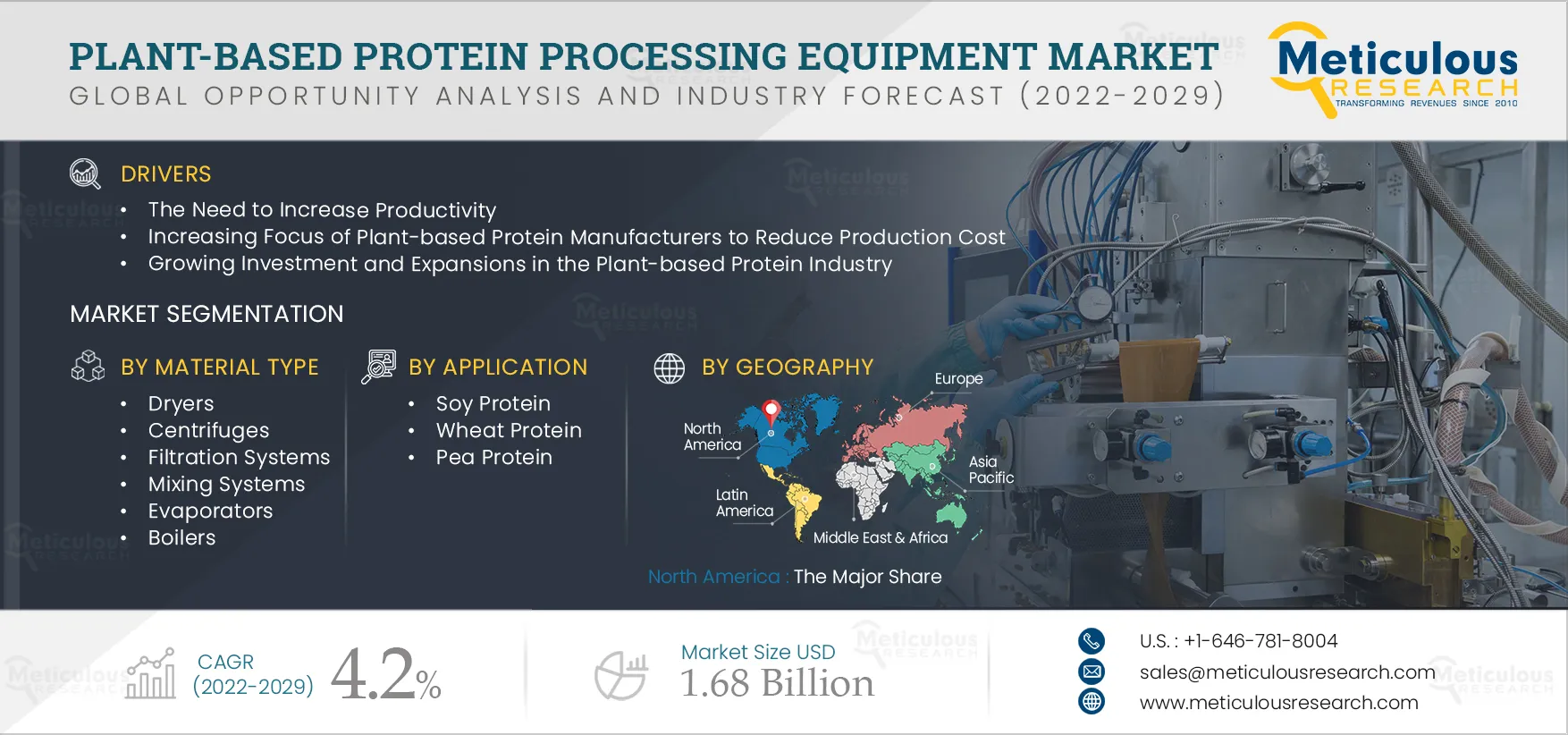
The Plant-Based Protein Processing Equipment Market is projected to reach $1.68 billion by 2029, at a CAGR of 4.2% from 2022 to 2029. The growth of this market is driven by the growing need to increase productivity, the increasing focus of plant-protein manufacturers to reduce production costs, increased investment in the plant-based protein industry, and increased usage of plant protein as an ingredient in various food & beverage products. Moreover, the growing markets such as Asia, Latin America, and Africa and the increasing plant-based food market are expected to create lucrative opportunities for players operating in this market. However, its high equipment cost and preference for animal-based protein ingredients are expected to hinder the growth of this market to some extent.

Impact of Covid-19 on Plant-base...

Various restrictions imposed by the national and local governments, such as lockdowns and restrictions related to limited workforce, resulted in shutdowns of various manufacturing facilities. Due to these lockdowns, the revenues of the majority of companies were at the risk of stagnancy, owing to which the companies are now hesitant to invest huge amounts as capital investments in these types of machinery. Several plant-based protein processing companies have also reduced their functions by closing certain operations for a certain period, reducing the requirement for expansion and limiting the demand for machinery.

The COVID-19 volatile environment impacted the supply chain of companies operating in the plant-based protein processing equipment market due to increased costs and more complex and time-consuming routing of goods. Due to disrupted supply chain and logistic facilities, the global players operating in the plant-based protein processing market faced challenges in providing their services and products at their optimum capacity compared to pre-COVID-19. All these factors cumulatively restrained the market from growing. However, factors such as a limited workforce directed many companies to invest in automated plant-based protein processing equipment, boosting the market at a relatively positive rate for companies offering automated plant-based protein processing equipment.  
Plant-based Protein Processing Equipment Market
Click here to: Get Free Sample Copy of this report

The Increasing Plant-based Food Market drives the Market for Plant-based Protein Processing Equipment

In the era of modernization, there is a huge change in eating habits and consumer behavior. Consumers are shifting from animal-based products to plant-based alternatives, as they have various products to choose from. Additionally, each plant-based product offers a unique nutritional profile, with a wide range of values for protein, carbohydrates, and fats, along with vitamins and minerals. The factors attributed to driving the plant-based products are the increasing popularity of vegan products, the rising incidences of allergies such as lactose intolerance, the increasing adherence to a vegan/plant-based diet, and consumer concern over saturated fat levels, hormone content, and antibiotic use in dairy cattle.

According to the meat atlas of the friends of the earth and the Heinrich Boll Foundation, 9% of the world’s population was vegetarian in 2019. In recent years, the plant-based food industry has witnessed large investments looking to capitalize on the veganism trend and surging demand for sustainable foods. Alongside the growing risk profile of livestock production, well-established meat and dairy players are increasingly under attack. This protein diversification has the potential to transform a food company’s core business and value proposition due to its growth, profitability, risk exposure, and ability to compete and innovate. In 2020, plant-based meat, egg, and dairy companies across the globe received more than USD 3.1 billion in investments. This is the most capital raised in any year in the industry’s history (Source: Good Food Institute). This record surge in capital investment was three times more than what was raised in 2019 and 4.5 times more than in 2018. The pandemic has reshaped the North American food market, where plant-based meat sales increased by 200% compared to last year in the last week of April 2020.

Thus, the growing venture capital investments, which support the growth of plant-based product companies, are expected to drive the global plant-based protein market, showing the potential for the plant-based protein processing equipment market.

Key Findings in the Global Plant...


Based on Type, in 2022, the Dryers Segment is Expected to Account for the Largest Share of the Market

Based on type, the global plant-based protein processing equipment market is segmented into dryers, centrifuges, filtration systems, mixing systems, evaporators, boilers, and other equipment. In 2022, the dryers segment is expected to account for the largest share of the plant-based protein processing equipment market. The dominant position of this segment is attributed to higher production throughput, improved process hygiene, increased customization, and replacement of traditional dryers. However, the filtration systems segment is expected to register the highest CAGR during the forecast period due to its benefits over conventional separation methods, the rising awareness about filtration processes, and the increasing demand for better quality products.

Based on Mode of Operation, in 2022, the Semi-Automatic Segment is Expected to Account for the Largest Share of the Market

Based on mode of operation, the global plant-based protein processing equipment market is segmented into semi-automatic and automatic. In 2022, the semi-automatic segment is expected to account for the largest share of the global plant-based protein processing equipment market. The large market share of this segment is attributed to its benefits, such as greatly improved labor productivity, flexibility in production processes, and technical & economic feasibility. However, the automatic segment is projected to register the highest CAGR during the forecast period due to the increasing demand to meet the needs of the plant-based protein industry, such as carefully monitored production, reduced labor costs, automatic tracking of individual loads, no human errors, effective cleaning, and no cross-contamination.

Based on Production Capacity,

in 2022, the Small & Medium Scale Segment is Expected to Account for the Largest Share of the Market

Based on the production capacity, the global plant-based protein processing equipment market is mainly segmented into small & medium scale and large scale. In 2022, the small & medium scale segment is expected to account for the largest share of the global plant-based protein processing equipment market. The large market share of this market is attributed to increased government support for developing small-scale processing enterprises, low financing needs, and increased productivity. This segment is also projected to register the highest CAGR during the forecast period due to the increasing need for flexibility and innovation in the plant-based protein processing sector.

Based on Application, in 2022, the Soy Protein Segment is Expected to Account for the Largest Share of the Market

Based on application, the global plant-based protein processing equipment market is segmented into soy protein, wheat protein, pea protein, and other plant-based protein. In 2022, the soy protein segment is expected to account for the largest share of the plant-based protein processing equipment market. The leading position of this segment is attributed to the huge availability of raw materials, increased demand for soy protein from plant-based food manufacturers, and higher consumer acceptance level. However, the pea protein segment is projected to register the highest CAGR during the forecast period due to the increasing soy-free and gluten-free trend and the growing investment in pea protein manufacturing.

Based on Geography, in 2022,

North America is Expected to Dominate the Global Plant-based Protein Processing Equipment Market

Based on geography, the plant-based protein processing equipment market is segmented into North America, Europe, Asia-Pacific, Latin America, and the Middle East & Africa. In 2022, the North America market is expected to account for the major share of the global plant-based protein processing equipment market. The leading position of this regional market is primarily attributed to the high presence of key plant-protein manufacturers, the growing awareness level regarding vegan products, a well-established economy, and increased investment in R&D for food processing equipment.

However, Asia-Pacific plant-based protein processing equipment market is developing and expanding significantly. Among other regional markets, this region is demonstrating signs of strong growth in the near future. The rapid growth of this regional market is attributed to the increasing government support for small & medium-scale enterprises, the growing technological advancements in the food industry, the increasing raw material availability, and the growing investment in the plant-protein sector.

Key Companies

The plant-based protein processing equipment market is fragmented in nature, with several small and medium-sized companies and new players. These players have implemented various strategies to expand their product offerings and global footprints and augment their market shares over the past 4-5 years. Most companies in the plant-based protein processing equipment market followed key strategies: product launches; agreements, collaborations, and partnerships; expansions; and acquisitions.

The key players operating in the global plant-based protein processing equipment market are Alfa Laval AB (Sweden), Bühler AG (Switzerland), GEA Group Aktiengesellschaft (Germany), Flottweg SE (Germany), SPX Flow Inc. (U.S.), Coperion GmbH (Germany), Hosokawa Micron Corporation (Japan), Netzsch-Feinmahltechnik GmbH (Germany), SiccaDania (Denmark), Koch Separation Solutions (U.S.), Bepex International LLC (U.S.), and Clextral (France).

Scope of the report

Plant-based Protein Processing Equipment Market, by Type

  • Dryers
  • Centrifuges
  • Filtration Systems
  • Mixing Systems
  • Evaporators
  • Boilers
  • Other Equipment

Plant-based Protein Processing Equipment Market, by Mode of Operation

  • Semi-Automatic
  • Automatic

Plant-based Protein Processing Equipment Market, by Production Capacity

  • Small & Medium Scale
  • Large Scale

Plant-based Protein Processing Equipment Market, by Application  

  • Soy Protein
  • Wheat Protein
  • Pea Protein
  • Other Plant-based Protein

Plant-based Protein Processing Equipment Market, by Geography

  • North America
    • U.S.
    • Canada
  • Europe
    • Germany
    • France
    • U.K.
    • Italy
    • Spain
    • Rest of Europe (RoE)
  • Asia-Pacific (APAC)
    • China
    • Japan
    • India
    • Rest of Asia-Pacific (RoAPAC)
  • Latin America
  • Middle East & Africa

Key Questions Answered in the Report-

Frequently Asked Questions

How We Built This Intelligence

Table of Contents

Expand all

Access & Licensing

Choose how you access this intelligence — from a standalone data pack to organization-wide access. Every option is delivered within 24–48 hours and backed by analyst support.

Single User License
Instant access to full PDF report + Excel dataset.
$4,175
1–5 User Access
Full PDF Report + Excel Datasheets
1-Hour Analyst Call included
Free 10% Customization
POPULAR
Multi-User License
Instant access to full PDF report + Excel dataset.
$5,875
1–5 User Access
Full PDF Report + Excel Datasheets
1-Hour Analyst Call included
Free 10% Customization
Enterprise License
Instant access to full PDF report + Excel dataset.
$7,875
1–5 User Access
Full PDF Report + Excel Datasheets
1-Hour Analyst Call included
Free 10% Customization
Flexible Purchase Options
Buy the complete report, individual chapters, or only the data you need. Starting from $1,500.
Analyst-reviewed intelligence
Multi-source validation
Transparent methodology
Citation-ready data
Analyst assistance

Related Statistics & Insights

$1.68B
projected market value by 2029
4.2%
compound annual growth rate
9%
of the world's population was vegetarian in 2019
200%
compared to last year in the last week of April 2020
Cite this report
Meticulous Research. (2022). Plant-based Protein Processing Equipment Market - Global Opportunity Analysis And Industry Forecast (2022-2029) (Report No. MR-656). Meticulous Market Research Pvt. Ltd. https://meticulousresearch.com/reports/plant-based-protein-processing-equipment-market-5341
Custom Research

Need something more specific?

A custom-scoped study can target a single segment, geography, or competitor set — or answer a board-level question this syndicated report doesn't. Tell an analyst what decision you're making and we'll scope it.

Search Market Intelligence

Search across reports, blogs, press releases, and industries