Food and BeveragesReport ID: MR-809Apr 2023134 PagesGlobal
Verified by the Meticulous Standard·Last verified: May 2026 by Shubham Lawande

Plant-based Food Processing Equipment Market by Type (Dryers, Mixers & Grinders, Pasteurizers); by Mode of Operation (Semi-automatic, Automatic); by Production Facility Size (Small & Medium Scale, Large Scale); and Geography - Global Forecasts to 2030

Published Date: Apr 2023
Format: PDF + Excel + Cloud Portal
Pages / Size: 134 Pages
Analyst: Shubham Lawande
Secure checkout · Full methodology disclosure · Underwritten by lead analyst Shubham Lawande
Plant-based Food Processing Equipment Market Size
Plant-based Food Processing Equipment Market Sizing & Sourcing
Base year: 2025 · CAGR: 7.2%
$5.86B
Market size 2025
$6.42B
Market size 2026
$12.84B
Forecast by 2036
7.2%
CAGR 2026–2036

Market Overview

Plant-based food processing equipment refers to machinery and tools used to manufacture food products from plant-based ingredients. These equipment are designed to process and transform raw plant materials into a wide range of plant-based food products such as tofu, plant-based meat alternatives, dairy alternatives, and more. Plant-based food is one of the fastest-growing segments of the food industry. Plant-based dairy alternatives, meat alternatives, and plant-based beverages are among the commonly consumed plant-based foods. Plant-based foods are manufactured using various processes and consist of equipment such as extruders, mixers, dryers, fryers, coaters, ovens, and formers, among others.

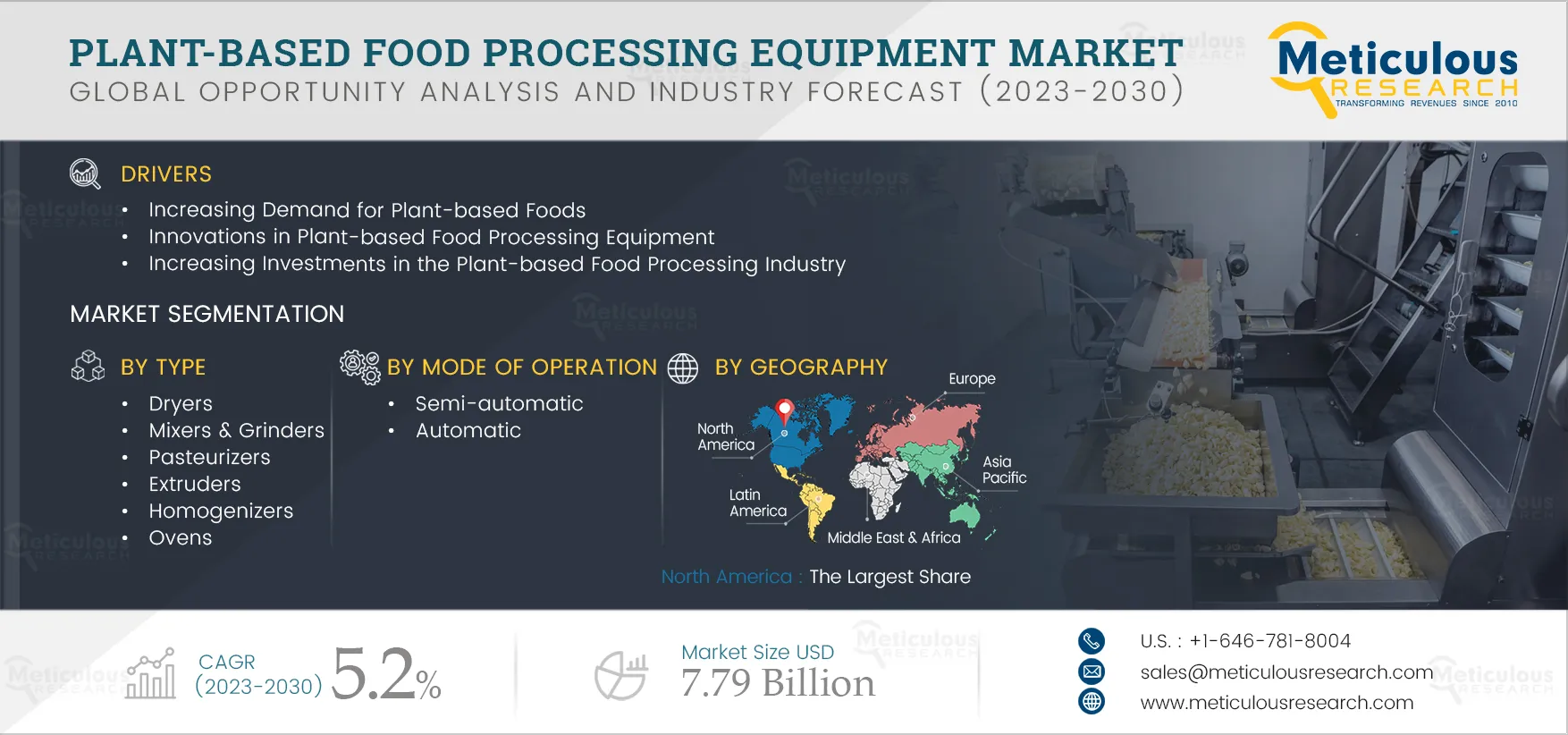
According to this latest publication from Meticulous Research®, the Plant-based Food Processing Equipment Market is projected to reach $7.79 billion by 2030 at a CAGR of 5.2% from 2023 to 2030. The growth of this market is mainly attributed to the increasing demand for plant-based foods, innovations in plant-based food processing equipment, and increasing investments in the plant-based food processing industry. However, the high cost of food processing equipment restrains the growth of this market. Furthermore, advancements in plant-based food processing technologies are expected to create growth opportunities for the players operating in the plant-based food processing equipment market. However, the shortage of skilled labor is a major challenge for market growth.

Increasing Demand for Plant-base...

Millennials’ food habits are changing, with an increasing preference for vegan and plant-based foods over meat and meat products. According to the Plant Based Foods Association and the Good Food Institute, in 2021, 47% of the total population in the U.S., including millennials and Gen Z, relied on plant-based foods. In recent years, there has been significant growth in the sales of plant-based foods globally. For instance, according to the Plant Based Foods Association, retail sales of plant-based foods increased by 6.2% from 2020, reaching USD 7.4 billion in 2021. Rapid urbanization and industrialization, changing lifestyles, economic development, health & wellness trends, and consumers’ rising awareness about health concerns caused by the long-term use of animal proteins are creating growth opportunities for the manufacturers of plant-based food products. The traction in the plant-based protein products market is also attributed to food security challenges in terms of the growing demand from the livestock industry and the human population to ensure the longer sustainability of the animal protein model. In 2020, the U.S. News & World Report ranked the Mediterranean Diet—a meal pattern with a high proportion of plant-based foods—as the ‘No 1 Best Overall Diet.’

Moreover, consumers’ growing inclination toward healthy, clean, sustainable, and cruelty-free products and the rising need for sustainable food systems are driving the plant-based foods market globally. The recent trend of healthy snacking also supports the demand for plant-based foods.

Plant-based foods are easily consumable and developed according to consumer requirements without compromising their taste, texture, flavor, aroma, and mouthfeel. Various categories of plant-based foods are gaining popularity among consumers. Thus, the increasing demand for plant-based foods has encouraged manufacturers to increase production capacities.

With the growing demand for plant-based food options, manufacturers are implementing new technologies for food production.

Thus, the increasing demand for plant-based foods drives the growth of the plant-based food processing equipment market.
Plant-based Food Processing Equipment

Click here to: Get a Free Sample Copy of this report

Innovations in Plant-based Food Processing Equipment

Advances in technologies are driving innovations in plant-based food processing equipment. Plant-based foods undergo various processes to replicate the texture, taste, and flavor of meat products. Such applications require the food processing equipment to have specific attributes. Innovations in the plant-based food processing equipment market are mainly focused on new extrusion equipment, mixers, pasteurizers, and dryers, to extend the shelf life of food products and impart the desired mouthfeel.

Moreover, high-pressure processing (HPP), a cold pasteurization technique, is an innovation that helps in the post-packaging process. It allows food products to retain their freshness and nutritional content and extends their shelf life.

Additionally, the players operating in the plant-based food processing equipment market are focusing on developing advanced offerings to meet the growing demand and enhance the quality of their customers’ products. For instance, in February 2021, Bühler AG launched the PolyCool 1000, a high-performance cooling die combined with an extruder. With the PolyCool 1000, it is possible to produce wet textured proteins using a wide range of raw materials, including soy, pulses, oilseeds, grains, and microalgae, at throughputs of up to 1,000 kilograms per hour. Also, in January 2021, Bühler AG (Switzerland) partnered with DIL Deutsches Institut für Lebensmitteltechnik e. V., to develop new production technologies for extruded alternative meat substitutes.

Furthermore, the rising demand for convenience foods has boosted the production of plant-based snacks, including burgers, schnitzels, and nuggets. However, processors of convenience foods face various challenges, including uneven coating of plant-based snacks, which may affect overall consumer acceptance. To overcome this challenge, equipment manufacturers increasingly focus on developing flexible coaters designed according to product requirements. For instance, in September 2022, Marel (Iceland) launched a 1000 mm Coating Line for flexible setups offering different products. The 1000 mm Coating Line features an active flour, batter, and tempura applicator, wider belts, and a more robust, fail-safe design. Mixing is one of the major challenges in processing plant-based foods, especially products with a sticky texture that does not flow easily and products that degrade with prolonged exposure to atmospheric oxygen. To overcome this challenge, equipment manufacturers have developed continuous mixers that enable smooth mixing with minimum product loss and have flexible, precisely adjustable settings depending on the product type.

Innovations that reduce equipment downtime by enhancing reliability and longevity can also improve facility throughput by increasing facility capacity utilization. Thus, innovations in plant-based food processing equipment are expected to drive the growth of this market.


Key Findings in the Plant-based...

The Dryers Segment to Dominate the Plant-based Food Processing Equipment Market in 2023

Based on type, the global plant-based food processing equipment market is segmented into dryers, mixers & grinders, extruders, pasteurizers, ovens, formers, homogenizers, and other plant-based food processing equipment. In 2023, the dryers segment is expected to account for the largest share of the global plant-based food processing equipment market. The large market share of this segment is attributed to benefits offered by dryers, such as improved hygiene & quality of final products. In addition, the growing need for advanced equipment to replace traditional drying techniques also contributed to the growth of this segment.

However, the mixers & grinders segment is projected to register the highest CAGR during the forecast period.

Automatic Segment to Witness Fastest Growth During Forecast Period

Based on mode of operation, the global plant-based food processing equipment market is segmented into semi-automatic and automatic. The automatic segment is expected to register a higher CAGR during the forecast period. The growth of this segment is attributed to the growing need to increase productivity, the rising demand for highly efficient systems, and the increasing focus on reducing labor costs.

Small & Medium-scale Production Facilities Segment to

Account for Larger Share in 2023

Based on production facility size, the global plant-based food processing equipment market is segmented into small & medium-scale production facilities and large-scale production facilities. In 2023, the small & medium-scale production facilities segment is expected to account for the larger share of the global plant-based food processing equipment market. The large market share of this segment is attributed to increased government support for developing small-scale processing enterprises and the increasing number of SMEs offering plant-based food products. In addition, the benefits offered by plant-based food processing equipment, such as increased productivity, reduced labor costs, and high profitability, drive their adoption in small & medium-scale production facilities.

North America: The Dominating Regional Market

The plant-based food processing equipment market is segmented into five regions: North America, Europe, Asia-Pacific, Latin America, and the Middle East & Africa. In 2023, North America is expected to account for the largest share of the global plant-based food processing equipment market. The large share of this market is majorly attributed to the presence of major plant-based food manufacturers, the increasing number of plant-based food SMEs, the growing adoption of vegan food products, and rising R&D investments in plant-based food processing equipment. In addition, technological advancements and the growing need for automation in processing equipment are expected to drive the demand for plant-based food processing equipment in the region.

However, Asia-pacific is projected to register the highest CAGR during the forecast period.

Key Companies

The report offers a competitive landscape based on an extensive assessment of the product portfolio offerings, geographic presences, and key strategic developments adopted by leading market players in this market in the last three to four years. Some of the key players operating in the global plant-based food processing equipment market are Alfa Laval AB (Sweden), amixon GmbH (Germany), ANDRITZ AG (Austria), Bühler Group (Switzerland), Coperion GmbH (Germany), Clextral SAS (France), Duravant LLC (U.S.), Flottweg SE (Germany), GEA Group Aktiengesellschaft (Germany), Marel hf. (Iceland), SPX FLOW, Inc. (U.S.), and Tetra Pak (Switzerland).

Scope of the Report:

Plant-based Food Processing Equipment Market, by Type                          

  • Dryers
  • Mixers & Grinders
  • Pasteurizers
  • Extruders
  • Homogenizers
  • Ovens
  • Formers
  • Other Plant-based Food Processing Equipment

Plant-based Food Processing Equipment Market, by Mode of Operation

  • Semi-automatic
  • Automatic

Plant-based Food Processing Equipment Market, by Production Facility Size

  • Small & Medium Scale Production Facilities
  • Large Scale Production Facilities

Plant-based Food Processing Equipment Market, by Region

  • North America      
    • U.S.
    • Canada
  • Europe   
    • Germany
    • France
    • U.K.
    • Italy
    • Spain
    • Rest of Europe
  • Asia-Pacific          
    • China
    • India
    • Japan
    • Rest of Asia-Pacific
  • Latin America       
  • The Middle East & Africa    

Key Questions Answered in the Report:

Frequently Asked Questions

How We Built This Intelligence

Table of Contents

Expand all

Access & Licensing

Choose how you access this intelligence — from a standalone data pack to organization-wide access. Every option is delivered within 24–48 hours and backed by analyst support.

Single User License
Instant access to full PDF report + Excel dataset.
$4,175
1–5 User Access
Full PDF Report + Excel Datasheets
1-Hour Analyst Call included
Free 10% Customization
POPULAR
Multi-User License
Instant access to full PDF report + Excel dataset.
$5,875
1–5 User Access
Full PDF Report + Excel Datasheets
1-Hour Analyst Call included
Free 10% Customization
Enterprise License
Instant access to full PDF report + Excel dataset.
$7,875
1–5 User Access
Full PDF Report + Excel Datasheets
1-Hour Analyst Call included
Free 10% Customization
Flexible Purchase Options
Buy the complete report, individual chapters, or only the data you need. Starting from $1,500.
Analyst-reviewed intelligence
Multi-source validation
Transparent methodology
Citation-ready data
Analyst assistance

Related Statistics & Insights

$7.79B
projected market value by 2030
5.2%
compound annual growth rate
47%
of the total population in the U.S
6.2%
from 2020, reaching USD 7.4 billion in 2021
Cite this report
Meticulous Research. (2023). Plant-based Food Processing Equipment Market - Global Opportunity Analysis and Industry Forecast (2023-2030) (Report No. MR-809). Meticulous Market Research Pvt. Ltd. https://meticulousresearch.com/reports/plant-based-food-processing-equipment-market-5493
Custom Research

Need something more specific?

A custom-scoped study can target a single segment, geography, or competitor set — or answer a board-level question this syndicated report doesn't. Tell an analyst what decision you're making and we'll scope it.

Search Market Intelligence

Search across reports, blogs, press releases, and industries