- Home
- Reports
- Food and Beverages
- Nutraceutical Excipients Market
Nutraceutical Excipients Market By Type (Fillers, Diluents, Coating Agents, Binder, Disintegrants), End Products (Protein and Amino Acids, Vitamin, Minerals, Omega 3 Fatty Acids, And Others) - Global Forecast to 2036
Market Overview
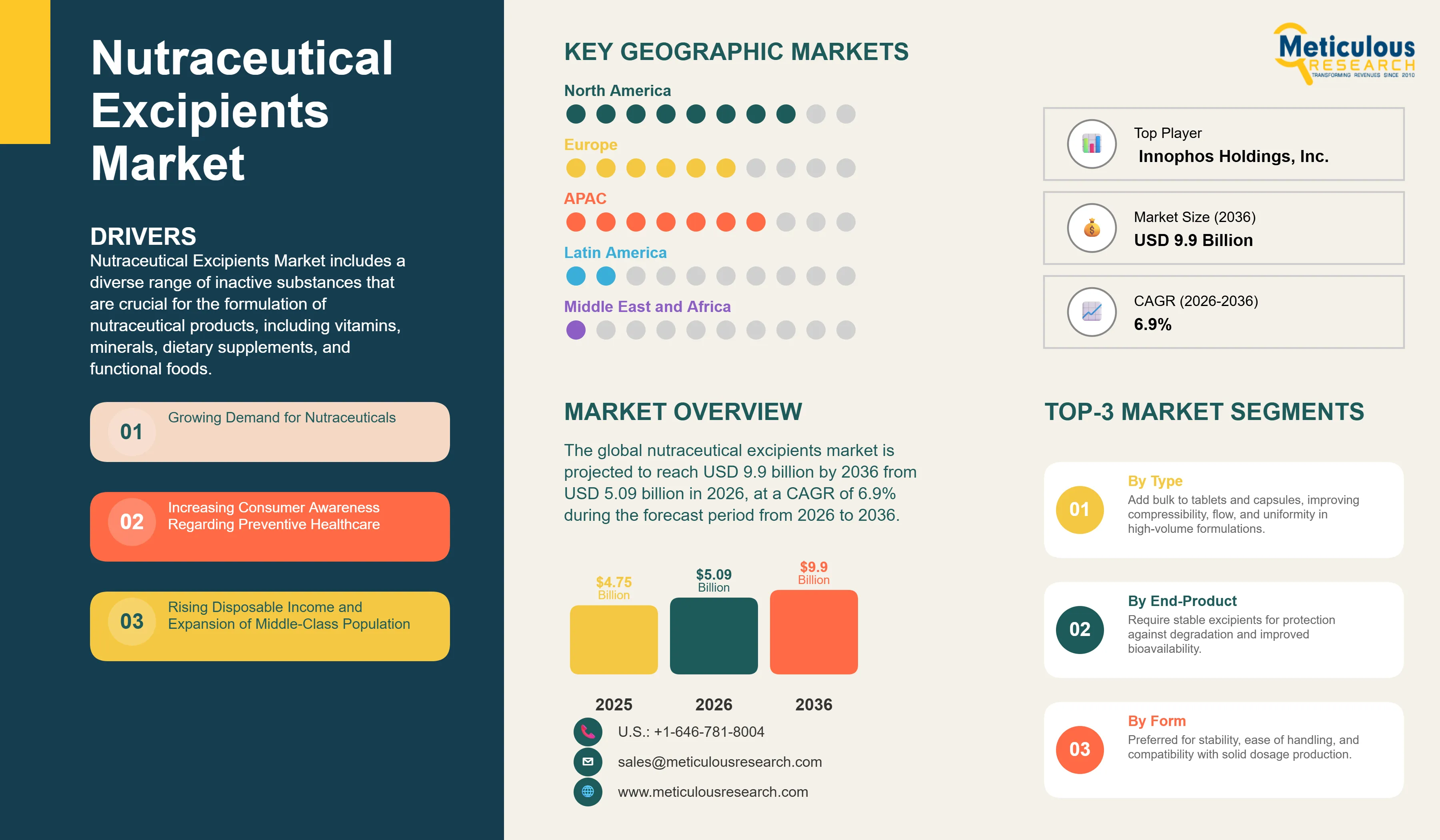
The global nutraceutical excipients market was valued at USD 4.75 billion in 2025. This market is projected to reach USD 9.9 billion by 2036 from USD 5.09 billion in 2026, at a CAGR of 6.9% during the forecast period from 2026 to 2036.
This nutraceutical excipients market includes a diverse range of inactive substances that are crucial for the formulation of nutraceutical products, including vitamins, minerals, dietary supplements, and functional foods. The primary function of these excipients is to act as carriers for active ingredients, ensure product stability, improve manufacturing efficiency, and enhance patient compliance through better taste and appearance. The robust growth of this market is primarily driven by the expansion of the overall nutraceutical industry, which is being propelled by a global shift towards preventive healthcare, increasing consumer awareness about the benefits of dietary supplements, a growing aging population, and the rising incidence of lifestyle-associated diseases. The continuous innovation in excipient technology, particularly the development of multifunctional and clean-label excipients, is further expected to create significant growth avenues for market players.
Key Highlights
- The global nutraceutical excipients market is projected to reach USD 9.9 billion by 2036.
- The market is expected to grow at a CAGR of 6.9% from 2026 to 2036.
- In 2026, the fillers & diluents are expected to hold the largest share of the market by type, owing to their extensive use in solid dosage forms.
- The proteins & amino acids segment is projected to be the largest end-product category, driven by the booming sports nutrition and weight management markets.
- The dry form of excipients, including powders and granules, is expected to dominate the market due to its stability and ease of handling.
- North America is expected to command the largest share of the global market in 2026, supported by a mature nutraceutical market and high consumer awareness.
- The Asia-Pacific region is projected to witness the fastest growth during the forecast period, driven by rising disposable incomes and increasing health consciousness.
- Key market players are increasingly focusing on strategic collaborations and new product launches, particularly in the area of natural and multifunctional excipients.
Executive Summary
Click here to: Get Free Sample Pages of this ReportThe nutraceutical excipients are no longer just inert fillers; they are functional components that can significantly impact the bioavailability, stability, and sensory profile of the final nutraceutical product. The market landscape is composed of large, multinational corporations such as Kerry Group plc, DuPont, and Cargill, Incorporated, which provide a vast portfolio of excipients, alongside smaller, specialized firms that are carving out niches by focusing on innovative areas like clean-label, organic, and non-GMO excipients. This competitive environment fosters continuous innovation and pushes manufacturers to develop solutions that meet the increasingly complex demands of the nutraceutical industry.
A pivotal factor shaping the market is the clean-label movement, a consumer-driven trend demanding transparency and simplicity in product ingredients. This has catalyzed a significant shift away from synthetic excipients towards natural, plant-based alternatives. Ingredients derived from sources such as starch, cellulose, seaweed, and natural gums are experiencing a surge in demand. This trend is further supported by the growing popularity of personalized nutrition, which requires versatile excipients suitable for a wide array of customized formulations, from tablets and capsules to functional beverages and powders. Advanced manufacturing technologies, such as spray drying and microencapsulation, are also playing a crucial role, enabling the creation of excipients with superior properties, such as enhanced flowability, controlled release, and effective taste-masking, thereby addressing key challenges in nutraceutical formulation.
Emerging markets, particularly in the Asia-Pacific region, are expected to offer significant growth opportunities for the nutraceutical excipients market, driven by expanding supplement manufacturing capacity and increasing digital retail penetration. Online platforms now account for a substantial share of supplement sales across Southeast Asia, enhancing accessibility to nutraceutical products.
In addition, growing demand for novel excipients with enhanced functionalities is creating opportunities for manufacturers to invest in R&D. Technologies such as cyclodextrin-based complexes (e.g., Roquette’s KLEPTOSE®) and multifunctional carbohydrate excipients (e.g., JRS Pharma’s EMDEX®) are increasingly used to improve bioavailability, enable taste masking, and support controlled-release delivery. The development of application-specific excipients for segments such as sports nutrition, infant nutrition, and personalized supplements is expected to further drive the growth of nutraceutical excipients market.
Market Insights
Why Do Proteins & Amino Acids Dominate the Market?
The proteins and amino acids segment accounts for the largest share of the nutraceutical excipients market in 2026, primarily driven by the growth of the global sports nutrition and wellness supplements industry, where protein formulations captured over 45% of new product launches in 2025 across powders, bars, and RTD shakes.
The widespread adoption of protein-based products, including powders like whey isolates and vegan blends, nutrition bars with 20g+ protein profiles, and ready-to-drink formulations for applications such as muscle recovery (e.g., post-workout BCAAs), weight management (high-protein meal replacements), and general health support, has increased the demand for excipients such as binders like microcrystalline cellulose for compressibility, fillers such as maltodextrins for bulk density, flavoring agents including natural vanillin extracts, and sweeteners like stevia-rebaudioside blends to balance bitterness.
Which Type Segment Holds the Largest Share in the Nutraceutical Excipients Market?
Based on type, the fillers & diluents account for the largest share of the overall nutraceutical excipients market in 2026, owing to their widespread use in tablet and capsule formulations. These excipients play a critical role in improving the bulk properties and manufacturability of nutraceutical products, particularly in high-volume supplement applications such as vitamins (e.g., mannitol-dicalcium phosphate blends for chewables), minerals (magnesium stearate-lubricated calcium blends), and protein-based formulations where lactose monohydrate fillers enable 30% higher tablet weights without capping.
However, binders and disintegrants are expected to witness steady growth due to their increasing application in solid dosage forms such as chewable tablets and effervescent supplements. These excipients are essential for maintaining structural integrity via hydroxypropyl cellulose films while enabling effective disintegration and release of active ingredients during consumption, as seen in Roquette's Lycoperl DIS for 20% faster probiotic tablet breakdown in gastric simulation tests.
Key Companies
The key players profiled in the global nutraceutical excipients market report include Kerry Group plc, Innophos Holdings, Inc., JRS PHARMA, Sensient Colors LLC, Hilmar Ingredients, Ingredion Incorporated, Cargill, Incorporated, Roquette Frères S.A., DuPont de Nemours, Inc., Meggle Group Wasserburg, and ABF Ingredients, among others.
Frequently Asked Questions
Related Tags
How We Built This Intelligence
Table of Contents
Expand allAccess & Licensing
Choose how you access this intelligence — from a standalone data pack to organization-wide access. Every option is delivered within 24–48 hours and backed by analyst support.
Related Statistics & Insights
Need something more specific?
A custom-scoped study can target a single segment, geography, or competitor set — or answer a board-level question this syndicated report doesn't. Tell an analyst what decision you're making and we'll scope it.