Information and Communications TechnologyReport ID: MR-867Feb 2025119 PagesNorth America
Verified by the Meticulous Standard·Last verified: May 2026 by Rajdeep Bhawal

North America Online Language Learning Market Size, Share, Forecast, & Trends Analysis By Learning Mode (Self-learning Apps & Applications, Tutoring), Age Group, Language (English, Mandarin, Spanish), End User (Individual Learners, Educational Institutions), and CountryΓÇöGlobal Forecast to 2031

Published Date: Feb 2025
Format: PDF + Excel + Cloud Portal
Pages / Size: 119 Pages
Analyst: Rajdeep Bhawal
Secure checkout · Full methodology disclosure · Underwritten by lead analyst Rajdeep Bhawal
North America Online Language Learning Market Size
North America Online Language Learning Market Sizing & Sourcing
Base year: 2025 · CAGR: 7.2%
$5.86B
Market size 2025
$6.42B
Market size 2026
$12.84B
Forecast by 2036
7.2%
CAGR 2026–2036

Market Overview

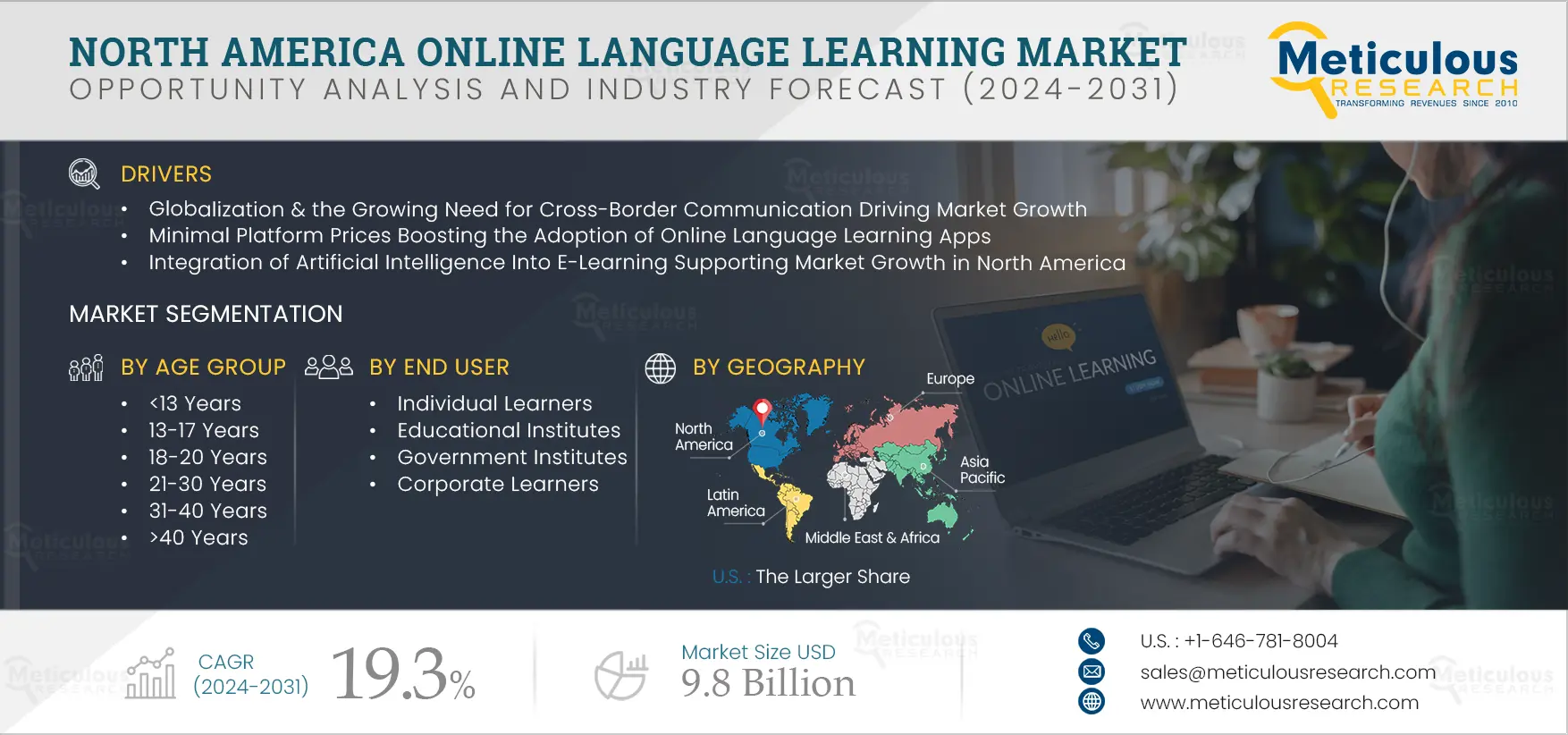
Key factors driving the growth of this market include globalization & the growing need for cross-border communication, the minimal platform prices of online language learning apps, and the integration of artificial intelligence into E-learning. Furthermore, multinational companies’ increasing preference for multilingual employees and the increasing investments in start-ups & small companies engaged in language teaching are expected to generate market growth opportunities.

Key Findings

  • By Learning Mode: In 2024, the Self-learning Apps and Applications Segment is Expected to Dominate the North America Online Language Learning Market
  • By Age Group: In 2024, the 13-17 Years Segment is Expected to Dominate the North America Online Language Learning Market
  • By Language: In 2024, the English Segment is Expected to Dominate the North America Online Language Learning Market
  • By End User: In 2024, the Individual Learners Segment is Expected to Dominate the North America Online Language Learning Market
  • By Country: theΓÇ»U.S. Dominates North America Online Language Learning Market in 2024

Market Trends

Flexible Pricing Structure

Flexible pricing structures have emerged as a key trend driving the growth of the online language learning market in North America. As more individuals seek affordable and accessible ways to acquire new language skills, language learning platforms are adapting by offering a variety of pricing options. These structures range from subscription models and pay-as-you-go plans to tiered pricing based on features or lesson types, allowing learners to choose plans that fit their budgets and learning needs. This flexibility has broadened the market’s appeal, making high-quality language education more attainable for people across diverse income levels and backgrounds.

Subscription-based models, such as monthly or annual memberships, have become particularly popular, offering users unlimited access to a range of language courses or content. This model provides affordability and convenience, giving learners the freedom to progress at their own pace without committing to long-term contracts. Some platforms also offer free or freemium versions, which give learners a chance to explore basic language content before deciding to upgrade to paid plans. Such flexibility allows platforms to attract a wider audience, including casual learners who might otherwise not invest in traditional language classes. Several Players offer flexible pricing based on learners’ preferences. Subscription-based services are available for users based on their long-term and short-term requirements. For instance, Rosetta Stone LLC (U.S.) provides language learning for one language at USD 48.06 for three months, for one language at USD 130.99 for a 12-month subscription, and for a lifetime subscription of USD 181.68 for 25 languages. Hence, the availability of flexible subscription models has become a key trend in North America’s online language learning market.
Introduction of Wearable Technologies

Over the last decade, technological innovations such as mobile phones and smartphones have become increasingly popular in educational environments. Wearable devices have emerged as an innovation that people can wear to communicate and track vitals, among other parameters. VR headsets are the most widely used wearable technology in eLearning. By providing a multisensory experience, VR solutions can enhance students’ understanding of concepts and improve their ability to recall key information.

Smartwatches are a popular wearable technology globally. They function as small smartphones and allow users to read messages and other information, and set reminders, making them an excellent choice for use in the education sector. Their use in eLearning, while limited, is centered around their convenience and portability.

Wearable technologies can be an asset in classroom teaching and language learning by enhancing learning and student engagement. They can assist students with a variety of physical limitations. The data collected from wearable devices can help educators build student profiles and enable them to design customized assessments and instruction sets. Additionally, these devices are easy to operate for students as well as children. Hence, the introduction of wearable technology in eLearning has elevated the language learning experience.

Market Opportunities

Increasing Investments in Start-ups & Small Companies Engaged in Language Teaching Generating Growth Opportunities For Market Players

In recent years, investments in start-ups and small companies engaged in language teaching have been on the rise. This surge in funding is driven by the growing recognition of the importance of language proficiency in a globalized world and the increasing demand for innovative language learning solutions. With globalization, the demand for bilingual or multilingual individuals is on the rise, driving both individuals and businesses to seek effective online language learning solutions. Language teaching start-ups and small companies have recognized this growing need and are developing innovative technologies and approaches to make language acquisition more accessible and engaging. These companies are increasingly receiving funding from venture capitalists, private equity firms, and even government initiatives aimed at fostering education technology, boosting their ability to reach broader markets.

With North America's diverse population, the demand for bilingual education has extended beyond traditional foreign language instruction to include a broader range of languages, including indigenous and heritage languages. Start-ups focusing on niche languages or specialized learning objectives are gaining attention, especially as they fill the gaps left by larger, more generalized platforms. This scenario presents a unique opportunity for educational start-ups to expand their product portfolios and cater to the language learning needs in the market. Recognizing the immense potential, several companies, including start-ups, have attracted investments for accelerating their language learning platforms. For instance, in March 2023, Speakeasy Labs, Inc. (U.S.), a leading language learning platform that uses artificial intelligence, announced raising ~USD 27 million in Series B funding led by OpenAI Start-up Fund (U.S.). The funds will be used to propel Speakeasy Labs' efforts to expedite the development of new conversational language experiences through generative AI, enable faster expansion to new regions and languages, and further enhance the company’s offerings. The ongoing development of language learning platforms to meet the growing demand reflects the commitment of start-ups and companies to revolutionizing language education, which is expected to generate growth opportunities for the players operating in this market.

By Learning Mode: In 2024, the Self-learning Apps and Applications Segment is Expected to Dominate the North America Online Language Learning Market

Based on Learning Mode, the North America online language learning market is segmented into self-learning apps and applications and tutoring. In 2024, the self-learning apps and applications segment is expected to account for the larger share of the North America online language learning market. Language learning through apps is gaining popularity and usage in North America through mobile phones, tablets, and computer users. Most language learning apps can be downloaded free of cost, while some are required to be purchased. Self-learning apps have eliminated the geographical barriers that once hindered language learning. These apps use interactive multimedia content, such as videos, audio clips, quizzes, and exercises, to engage learners actively. They offer personalized learning paths based on learners' proficiency levels, goals, and preferences. The rapid development of technologies has enabled language learning apps to integrate different media, such as texts, pictures, animation, audio, and video, to create multimedia instructional materials and increase students’ interest in studying.

Movement restrictions, lockdowns, and social distancing norms by various countries significantly increased the use of mobile language learning apps. Companies in the market are focusing on offering learners access to lessons, resources, and practice materials at their convenience and the opportunity to engage with language content on their terms, anytime and anywhere. For instance, in September 2022, Skilldora (U.S.) partnered with D-ID (U.S.) to launch the first e-learning platform & app using Instructed Courses to deliver consistently structured, high-quality courses across the U.S. Such growing development helps to increase the demand for self-learning apps and applications in North America.

Country Analysis

The U.S. Dominates the North America Online Language Learning Market in 2024

In 2024, the U.S. is estimated to account for the largest share of the North America online language learning market. The large share of the U.S. in the North America online language learning market is primarily attributed to the growing number of international travelers, the rising disposable incomes, steady immigration levels, consumers' high inclination toward the adoption of new technologies, the growing emphasis on bilingual & multilingual education, and the high education spending.

Also, this country is expected to register the highest CAGR during the forecast period.

Key Companies

The report includes a competitive landscape based on an extensive assessment of the key strategic developments that led market participants to adopt over the past three years (2021-2024).

The key players profiled in the North America online language learning market report are Babbel GmbH (Germany), Duolingo, Inc. (U.S.), ELSA Corp. (U.S.), Enux Education Limited (FluentU) (China), Mango Languages (U.S.), Rosetta Stone LLC (U.S.), Open Education LLC (U.S.), New Oriental Education & Technology Group Inc. (China), Berlitz Corporation (U.S.), McGraw Hill LLC (U.S.), Cambly Inc. (U.S.), Houghton Mifflin Harcourt Publishing Company (U.S.), Cambridge University Press & Assessment (U.K.), Busuu Limited (U.K), inlingua International Ltd. (Switzerland), Transparent Language, Inc. (U.S.), The British Council (U.K), ATI STUDIOS A.P.P.S. S.R.L(Mondly) (Romania), and Memrise Limited (U.K.).

North America Online Language Learning Overview: Latest Developments from Key Industry Players

  • In April 2024, Rosetta Stone LLC (U.S.) partnered with Lynn Public Schools (LPS) in Massachusetts to utilize Rosetta Stone for Schools' comprehensive curriculum and immersive activities. This collaboration aims to enhance language skills and address equity gaps for English Language Learners (ELLs) within the district.

  • In June 2023, Open English, a part of Open Education LLC (U.S.), launched Open Mundo, a 24/7 platform for taking live online classes with native-speaking teachers in French, Italian, Spanish, and Portuguese.
  • In October 2022, ELSA Corp. (U.S.) launched Speech Analyzer. This assessment platform integrates with online communication tools to help with test prep, classroom studies, presentations, and interviews and provides a full analysis of conversational speech skills and progress.

Market Research Summary

Particulars

Details

Number of Pages

119

Format

PDF

Forecast Period

2024–2031

Base Year

2023

CAGR (Value)

19.3%

Market Size (Value)

USD 9.8 Billion by 2031

Segments Covered

By Learning Mode

  • Self-Learning Apps And Applications
  • Tutoring
    • One-On-One Learning
    • Group Learning

By Age Group

  • <13 Years
  • 13-17 Years
  • 18-20 Years
  • 21-30 Years
  • 31-40 Years
  • >40 Years

By Language

  • English
  • Spanish
  • French
  • Mandarin
  • Japanese
  • German
  • Arabic
  • Italian
  • Korean
  • Other Languages            

By End User

  • Individual Learners
  • Educational Institutes
    • K-12
    • Higher Education
  • Government Institutes
  • Corporate Learners

Countries Covered

U.S. and Canada

Key Companies

Babbel GmbH (Germany), Duolingo, Inc. (U.S.), ELSA Corp. (U.S.), Enux Education Limited (FluentU) (China), Mango Languages (U.S.), Rosetta Stone LLC (U.S.), Open Education LLC (U.S.), New Oriental Education & Technology Group Inc. (China), Berlitz Corporation (U.S.), McGraw Hill LLC (U.S.), Cambly Inc. (U.S.), Houghton Mifflin Harcourt Publishing Company (U.S.), Cambridge University Press & Assessment (U.K.), Busuu Limited (U.K), inlingua International Ltd. (Switzerland), Transparent Language, Inc. (U.S.), The British Council (U.K), ATI STUDIOS A.P.P.S. S.R.L(Mondly) (Romania), and Memrise Limited (U.K.)

Frequently Asked Questions

How We Built This Intelligence

Table of Contents

Expand all

Access & Licensing

Choose how you access this intelligence — from a standalone data pack to organization-wide access. Every option is delivered within 24–48 hours and backed by analyst support.

Single User License
Instant access to full PDF report + Excel dataset.
$4,175
1–5 User Access
Full PDF Report + Excel Datasheets
1-Hour Analyst Call included
Free 10% Customization
POPULAR
Multi-User License
Instant access to full PDF report + Excel dataset.
$5,875
1–5 User Access
Full PDF Report + Excel Datasheets
1-Hour Analyst Call included
Free 10% Customization
Enterprise License
Instant access to full PDF report + Excel dataset.
$7,875
1–5 User Access
Full PDF Report + Excel Datasheets
1-Hour Analyst Call included
Free 10% Customization
Flexible Purchase Options
Buy the complete report, individual chapters, or only the data you need. Starting from $1,500.
Analyst-reviewed intelligence
Multi-source validation
Transparent methodology
Citation-ready data
Analyst assistance

Related Statistics & Insights

$2.5B
market value in 2023
$9.8B
projected market value by 2031
19.3%
compound annual growth rate
$27million
in Series B funding led by OpenAI Start-up Fund (U.S.)
Cite this report
Meticulous Research. (2025). North America Online Language Learning Market - Opportunity Analysis and Industry Forecast (2024-2031) (Report No. MR-867). Meticulous Market Research Pvt. Ltd. https://meticulousresearch.com/reports/north-america-online-language-learning-market-5550
Custom Research

Need something more specific?

A custom-scoped study can target a single segment, geography, or competitor set — or answer a board-level question this syndicated report doesn't. Tell an analyst what decision you're making and we'll scope it.

Search Market Intelligence

Search across reports, blogs, press releases, and industries