- Home
- Reports
- Food and Beverages
- Meat Processing Equipment Market
Meat Processing Equipment Market by Type (Cutters, Mixers and Blenders, Massagers, Tumblers, Tenderizers, Slicers), Mode of Operation (Semi-automatic, Automatic), Category (Processed Meat, Fresh Meat), Meat Type (Beef, Chicken) - Global Forecast to 2032
Market Overview
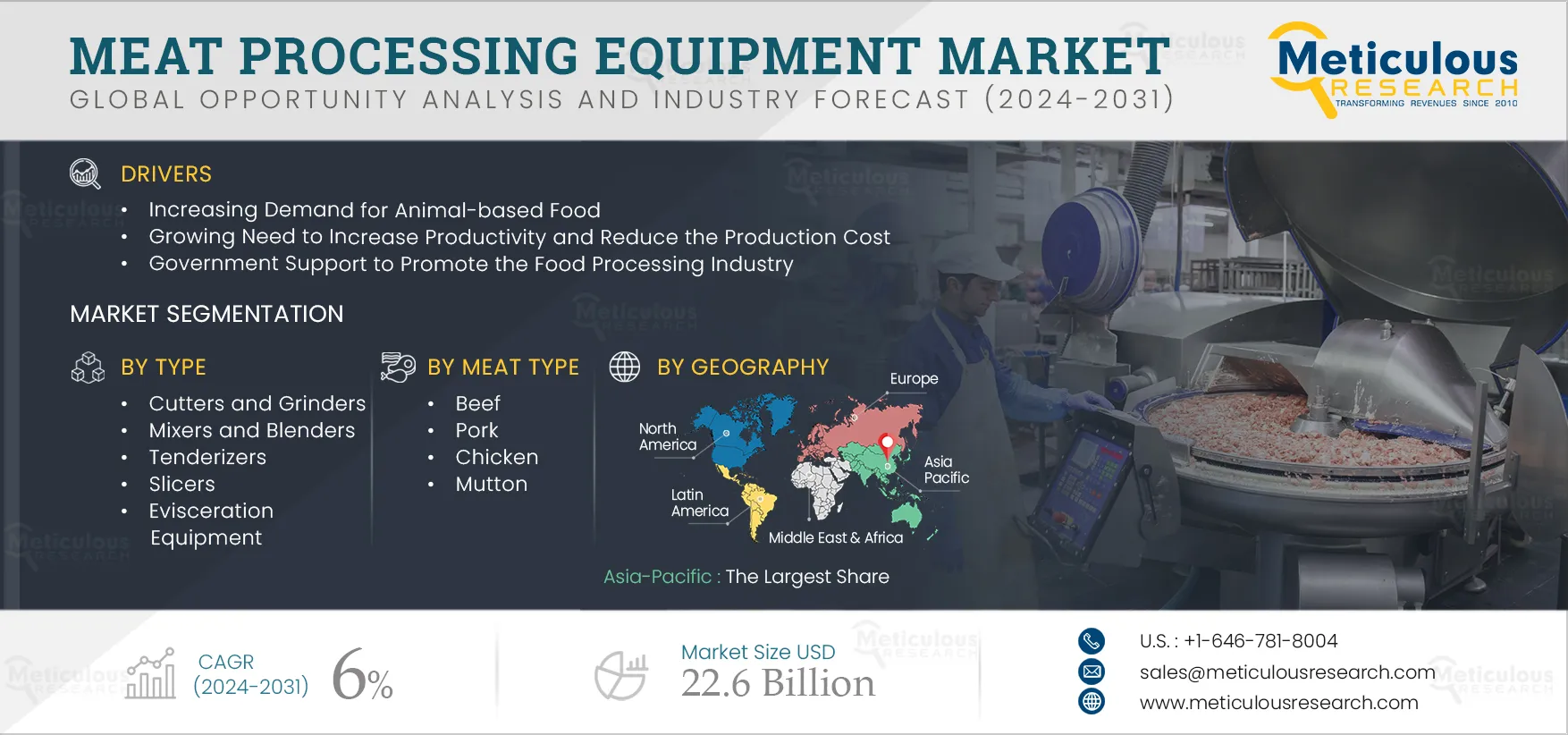
Increasing demand for animal-based food, the growing need to increase productivity and reduce production costs, and government support to promote the food processing industry are the key factors driving the growth of the meat processing equipment market. However, the high cost of equipment is expected to restrain the growth of this market. In addition, emerging economies such as Latin America, Southeast Asia, and Africa are expected to generate growth opportunities for the players operating in this market. However, the lack of trained labor is a major challenge for market growth.
Increasing Demand for Animal-bas...
According to the Department of Economic and Social Affairs (UN), the global population is expected to reach 8.6 billion by 2032, 9.8 billion by 2050, and 11.2 billion by 2100. A growing global population places increased pressure on the world’s resources to provide not only more but also different types of food. In addition to increased demand arising from population growth, there is a growing demand for protein due to socio-economic changes, including increased income and rapid urbanization. These factors have forced the livestock industry to expand and fulfill the growing need for protein sources. Animal-based food products are the key source of dietary protein and a proportion of calories. According to the World Health Organization (WHO), the annual meat production is projected to increase from 218.0 million metric tons in 1997–1999 to 376.0 million metric tons by 2032.
Further, according to the Organisation for Economic Co-operation and Development and Food and Agriculture Organization (OECD-FAO), the global demand for meat will be 371.68 million tons by 2032. Also, the global per capita meat consumption is expected to increase to 35.4 kg r.w.e. by 2027, an increase of 1.1 kg r.w.e. compared to the base period. This increase in the demand for protein-rich food, accompanied by the growing consumer preference for a low-fat and high-protein diet, has led to a significant rise in the consumption of animal-sourced protein across the globe.
Hence, to meet the growing need for animal-sourced protein, there is a strong demand for meat processing equipment.
Click here to: Get Free Sample Pages of this Report
Key Findings in the Meat Process...
Cutters and Grinders Segment to Dominate the Meat Processing Equipment Market in 2025
Based on type, the meat processing equipment market is segmented into cutters and grinders; smokers, massagers, and tumblers; mixers and blenders; tenderizers; killing and defeathering equipment; slicers; evisceration equipment; cookers, roasters, and grillers; de-heading and gutting equipment; and other meat processing equipment. In 2025, the cutters and grinders segment is expected to account for the largest share of the meat processing equipment market. The segment’s large market share is attributed to increasing global meat production and consumption and the application of cutters and grinders in a wide range of meat products.
In 2025, the Semi-automatic Segment is Expected to Dominate the Food Processing Equipment Market
Based on mode of operation, the global meat processing equipment market is segmented into semi-automatic and automatic. In 2025, the semi-automatic segment is expected to account for the largest share of the global meat processing equipment market. The segment’s large share is attributed to the benefits of semi-automatic food processing equipment, such as greatly improved labor productivity, flexibility in production processes, and technical & economic feasibility.
The Processed Meat Segment to Dominate the Meat Processing Equipment Market in 2025
Based on category, the meat processing equipment market is segmented into processed meat and fresh meat. In 2025, the processed meat segment is expected to account for the larger share of the meat processing equipment market. The large market share of this segment is attributed to increasing demand for ready-to-cook food products and growing innovation and technological advancement in the equipment for meat processing. Also, the growing urbanization and increasing per capita income among millennials is further expected to boost the growth of processed meat, which ultimately supports the dominant position of this segment.
The Beef Segment to Dominate the Meat Processing Equipment Market in 2025
Based on meat type, the meat processing equipment market is segmented into beef, pork, chicken, mutton, and other types of meat. In 2025, the beef segment is expected to account for the largest share of the meat processing equipment market. The large market share of this segment is attributed to the growing demand for beef, as it is a major source of protein. Usually, cattle and buffalo meat have a higher protein content as compared to other meat types, including chicken, pork, turkey, and lamb. Awareness associated with the consumption of protein through high nutritional food and growing preference for beef over other meats owing to various diseases associated with poultry and pork is further expected to drive the growth of this market.
Asia-Pacific to Dominate the Meat Processing Equipment Market in 2025
The meat processing equipment market is segmented into five major regions—North America, Europe, Asia-Pacific, Latin America, and the Middle East & Africa. In 2025, the Asia-Pacific region is expected to account for the largest share of the meat processing equipment market. The large share of this segment is mainly attributed to increasing awareness regarding the importance of protein-rich diets, the rising technological advancement and new product innovations in the food & beverages industry, the fast-growing economy, and the strong demand for meat and meat products in developing countries, including China and India. Moreover, rapid urbanization, rising income, and changing lifestyles in the Asia-Pacific region have resulted in consumers opting for convenient, ready-to-cook meat products.
Key Companies
The report includes a competitive landscape based on an extensive assessment of the key strategic developments of leading market players. Some of the key players operating in the meat processing equipment market are GEA Group Aktiengesellschaft (Germany), Marel HF (Iceland), John Bean Technologies Corporation (U.S.), The Middleby Corporation (U.S.), Mepaco Group (U.S.), Minerva Omega Group s.r.l (Italy), Heat and Control Inc. (U.S.), Alfa Laval AB (Sweden), Equipamientos Cárnicos, S.L (MAINCA) (Spain), Biro Manufacturing Co (U.S.), and Nordischer Maschinenbau Rudolf Baader GmbH & Co. KG (Germany).
Market Research Summary
|
Particular |
Details |
|
Page No. |
210 |
|
Format |
|
|
Forecast Period |
2025–2032 |
|
Base Year |
2024 |
|
CAGR |
6% |
|
Market Size (Value) |
$22.6 Billion |
|
Market Size (Volume) |
Unit |
|
Segments Covered |
By Type
By Mode of Operation
By Category
By Meat Type
|
|
Countries Covered |
North America (U.S., Canada), Europe (Germany, France, U.K., Italy, Spain, Netherlands, Rest of Europe), Asia-Pacific (China, Japan, India, Australia, Rest of Asia-Pacific), Latin America (Brazil, Mexico, Argentina, Rest of Latin America), and the Middle East & Africa |
|
Key Companies |
GEA Group Aktiengesellschaft (Germany), Marel HF (Iceland), John Bean Technologies Corporation (U.S.), The Middleby Corporation (U.S.), Mepaco Group (U.S.), Minerva Omega Group s.r.l (Italy), Heat and Control Inc. (U.S.), Alfa Laval AB (Sweden), Equipamientos Cárnicos, S.L (MAINCA) (Spain), Biro Manufacturing Co (U.S.), and Nordischer Maschinenbau Rudolf Baader GmbH & Co. KG (Germany). |
Frequently Asked Questions
Related Tags
How We Built This Intelligence
Table of Contents
Expand allAccess & Licensing
Choose how you access this intelligence — from a standalone data pack to organization-wide access. Every option is delivered within 24–48 hours and backed by analyst support.
Related Statistics & Insights
Need something more specific?
A custom-scoped study can target a single segment, geography, or competitor set — or answer a board-level question this syndicated report doesn't. Tell an analyst what decision you're making and we'll scope it.