Managed Services Market Size, Share, Forecast, & Trends Analysis by Type (Security, Network, Communication & Collaboration, Others), Deployment Mode (Cloud, On-premises), Organization Size, End-use Industry (BFSI, IT & Telecom, Healthcare, Others)ΓÇöGlobal Forecast to 2032
Market Overview
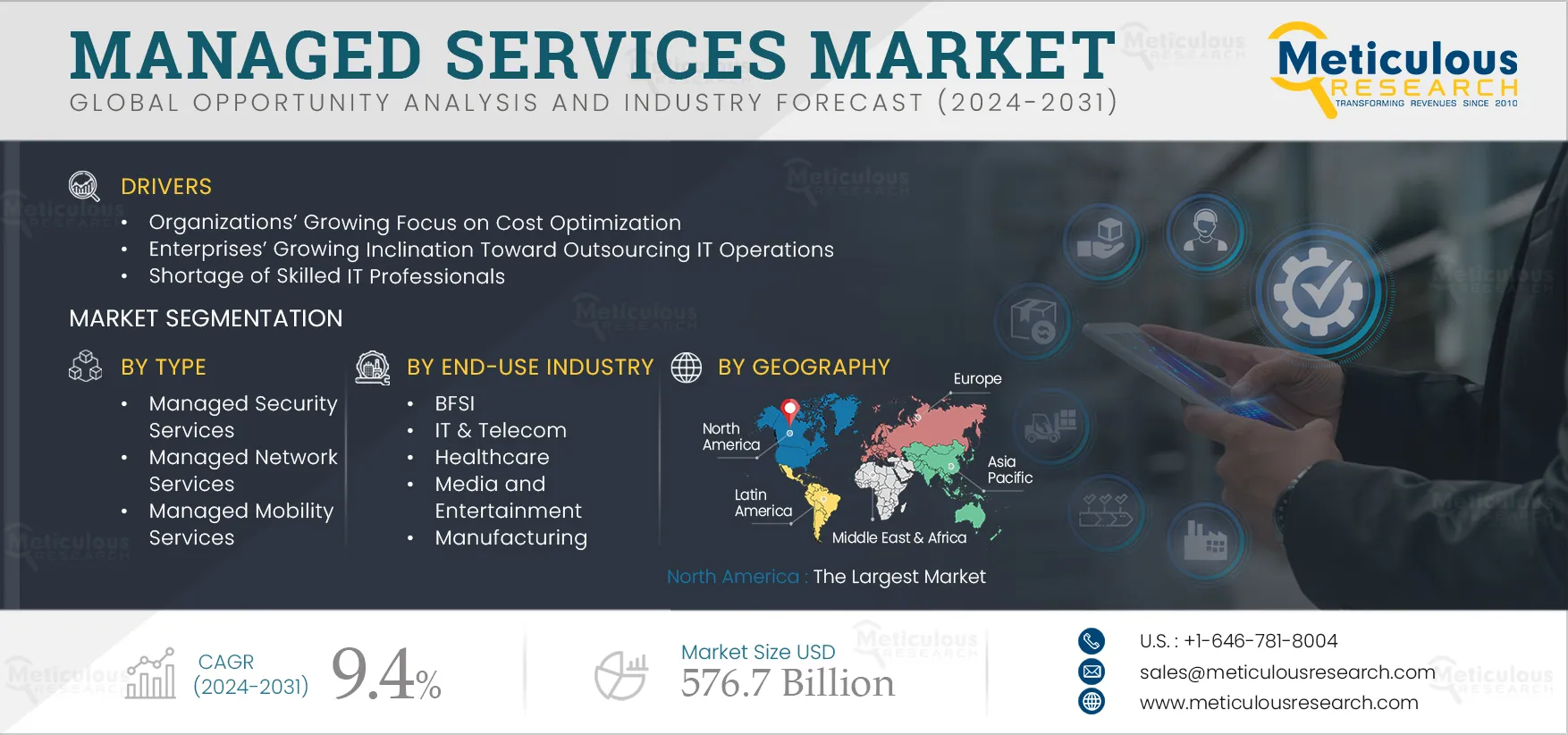
The growth of the managed services market is driven by organizations’ growing focus on cost optimization, enterprises’ growing inclination toward outsourcing IT operations, the shortage of skilled IT professionals, increasing cyber threats & ransomware attacks, and increasing investments in digital transformation. However, enterprises’ reluctance to give third-party vendors control over their systems restrains the growth of this market.
The growing adoption of advanced technologies and the rising demand for cloud-based solutions are expected to create market growth opportunities. However, the low adoption of managed services among Small & Medium-sized Enterprises (SMEs) is a major challenge for the players operating in this market.
Click here to: Get Free Sample Pages of this Report
Market Growth Drivers
Enterprises’ Growing Inclination Toward Outsourcing IT Operations Driving Market Growth
In recent years, there has been a massive shift in how businesses operate, irrespective of the industry. Businesses have recognized the cost benefits of outsourcing IT operations. Managed services help organizations focus on innovation and core business objectives, as Managed Service Providers (MSPs) take care of the IT aspects. MSPs provide businesses access to comprehensive IT technology and management & consultancy services, helping them strengthen their IT foundation, manage risks & compliance, and enhance their competitive position.
In addition, businesses are outsourcing entire IT operations or select aspects such as security and infrastructure and relying on managed services, where a third-party vendor or managed service provider takes on the responsibility of technology implementation, risk mitigation, talent shortages, and regulatory pressures. For instance, in July 2025, Unitywater (Australia) announced a 5-year collaboration with Cognizant Technology Solutions Corporation (U.S.) for Information and Communications Technology (ICT) Support Managed Services. This collaboration aims to support Unitywater's digital infrastructure, enhancing operational efficiency and productivity in alignment with its strategic ambition of healthy and thriving communities. Thus, organizations’ growing inclination toward outsourcing IT operations is driving the growth of the managed services market.
Increasing Investments in Digital Transformation Driving the Managed Services Market
Digital transformation is imperative for all businesses. Current competitive pressures have encouraged companies to invest in their digital transformation. Managed service providers fulfill enterprises’ digital transformation needs by providing cloud and other managed services. Managed service provider offers a cost-effective route to digital transformation, promoting agility and enabling IT staff to design and improve new IT systems specific to company needs.
Additionally, businesses are collaborating with technology players to transform their operations. For instance, in March 2025, Etihad Etisalat (Mobily) (Saudi Arabia) extended its managed services agreement with Telefonaktiebolaget LM Ericsson (Ericsson) (Sweden) by three years to leverage next-generation Artificial Intelligence (AI) and Machine Learning (ML) for autonomous operations and boost Mobily's digital transformation journey. Thus, businesses’ increasing focus on digital transformation initiatives for optimizing processes, improving service metrics, reducing time-to-market, and enhancing efficiency & customer experiences is driving the growth of this market.
Managed Services Market Opportun...
Growing Adoption of Advanced Technologies Expected to Generate Opportunities for Market Stakeholders
The adoption of advanced technologies is another area where managed services play an important role. The adoption of advanced technologies such as AI, big data, and IoT is on the rise due to their substantial benefits, including improved efficiency, flexibility, automation, and data-driven decision-making. Businesses are becoming more aware of the importance of adopting new technologies, such as artificial intelligence, IoT, and big data, in surviving the market competition. However, businesses need more resources and in-house expertise to manage new technologies. Managed service providers help businesses improve efficiency and control costs by bringing advanced technologies and capabilities. Managed services leverage many emerging technologies, such as automation, artificial intelligence, and machine learning to optimize business processes.
In addition, several MSPs are focusing on integrating AI capabilities into their offering. For instance, in February 2025, Telefonaktiebolaget LM Ericsson (Ericsson) (Sweden) launched AI-powered intent-based operations within its managed services Ericsson Operations Engine to offer differentiated premium 5G services to consumers and enterprise businesses. Therefore, the growing adoption of advanced technologies and MSPs’ increased focus on incorporating advanced technologies into their offerings are expected to generate market growth opportunities during the forecast period.
Managed Services Market Analysis
By Type: The Managed Security Services Segment to Dominate the Managed Services Market in 2025
Based on type, the managed services market is segmented into managed security services, managed IT infrastructure, information, and data center services; managed network services; managed mobility services; and managed communication & collaboration services. In 2025, the managed security services segment is expected to account for the largest share of over 39% of the managed services market. The segment’s large market share is attributed to businesses increasing need to protect critical assets from evolving cyber threats, the increased adoption of security services for identity management, application security, and threat detection & response, and the high adoption of cybersecurity services in the BFSI sector to protect systems and networks from cyberattacks.
However, the managed IT infrastructure, information, and data center services segment is projected to record the highest CAGR during the forecast period. The growth of this segment is driven by businesses’ increasing investments in digital transformation, the growing adoption of Software-as-a-Service (SaaS) solutions, the rising adoption of cloud-based and digital technologies, and the growing need for IT infrastructure among SMEs. Managed IT infrastructure services continuously monitor infrastructure components to proactively identify and resolve issues. These factors contribute to the growth of this segment.
By Deployment Mode: The Cloud-based Segment to Dominate the Managed Services Market in 2025
Based on deployment mode, the managed services market is segmented into cloud-based and on-premises managed services. In 2025, the cloud-based segment is expected to account for the larger share of over 62% of the managed services market. The segment’s large market share is attributed to the significant advantages of cloud-based services for businesses, such as on-demand access to skilled and experienced personnel, high levels of business agility, automated updates, and cybersecurity support.
Moreover, the cloud-based segment is also projected to record the higher CAGR during the forecast period. The growth of this segment is driven by the rising adoption of cloud-based solutions, enterprises increasing reliance on cloud-based services and data storage, and the growing demand for robust and scalable infrastructure.
By Organization Size: The Large Enterprises Segment to Dominate the Managed Services Market in 2025
Based on organization size, the managed services market is segmented into large enterprises and Small & Medium-sized Enterprises (SMEs). In 2025, the large enterprises segment is expected to account for the larger share of over 67.0% of the managed services market. The segment’s large market share is attributed to large organizations’ increased need to manage complex IT infrastructures requiring significant resources, expertise, and ongoing management; the fluctuating IT needs of large organizations, including access to advanced security measures and expertise, and the rising focus on risk mitigation and regulatory compliance.
However, the Small & Medium-sized Enterprises (SMEs) segment is projected to record the higher CAGR during the forecast period. The growth of this segment is driven by the rising adoption of managed services among SMEs due to their limited resources and expertise and the advantages of managed services, such as advanced security measures against cyber threats, access to advanced technologies, and eliminating the need to hire and maintain in-house IT teams.
By End-use Industry: The BFSI Segment to Dominate the Managed Services Market in 2025
Based on end-use industry, the managed services market is segmented into BFSI, IT & telecom, government & public sector, healthcare, media & entertainment, e-commerce & retail, manufacturing, educational institutes, and other end-use industries. In 2025, the BFSI segment is expected to account for the largest share of over 34% of the managed services market. The segment’s large market share is attributed to the expertise of managed service providers in compliance and risk management, helping financial institutions organize and safeguard their operations effectively, increased digitization in the BFSI sector, BFSI organizations’ growing focus on providing uninterpreted and enhanced customer service, and the increasing integration of AI/ML capabilities into various functions, such as risk assessment, fraud detection, customer service, and process automation.
However, the IT & telecom segment is projected to record the highest CAGR during the forecast period. The growth of this segment is driven by IT companies' growing focus on developing cutting-edge solutions and the ability of managed services to scale business operations quickly to meet increased demand. IT & telecom businesses get access to a pool of skilled IT professionals by procuring managed services. These qualified and trained IT professionals can ensure high-quality management while guaranteeing the highest service levels.
Geographical Analysis
North America Dominates the Managed Services Market
Based on geography, the managed services market is segmented into North America, Europe, Asia-Pacific, Latin America, and the Middle East & Africa. In 2025, North America is expected to account for the largest share of over 40% of the managed services market, followed by Europe, Asia-Pacific, Latin America, and the Middle East & Africa. North America’s large market share is attributed to the presence of prominent Managed Services Providers (MSPs) in the region, the growing adoption of managed security services for privileged access management, the rising need to protect connected network infrastructure, increased IT spending, key players’ growing focus on integrating new technologies such as automation and artificial intelligence in their offerings, the increased deployment of managed services and the increased collaborative efforts of key players on enhancing their managed services.
However, Asia-Pacific is expected to record the highest CAGR of 10.5% during the forecast period due to the rapid economic growth, increasing cybercrimes and ransomware attacks, rising demand for cybersecurity services and expertise, growing focus on improving business processes, and growing number of small & medium-sized enterprises in the region.
Key Companies
The report offers a competitive analysis based on an extensive assessment of the leading players’ product portfolios, geographic presence, and key growth strategies adopted in the last three to four years. Some of the key players operating in the managed services market are Accenture (Ireland), Tata Consultancy Services Limited (India), HCL Technologies (India), Cognizant (U.S.), IBM Corporation (U.S.), Fujitsu Limited (Japan), Kyndryl Holdings, Inc. (U.S.), Verizon Communications Inc. (U.S.), Google LLC (U.S.), Hughes Network Systems, LLC (U.S.), AT&T Inc. (U.S.), Microsoft Corporation (U.S), Cloudflare, Inc. (U.S.), Wipro Limited (India), HP Inc. (U.S.), SecureWorks Corp. (U.S.), Hitachi Vantara LLC (U.S.), Cisco Systems, Inc. (U.S.), DXC Technology Company (U.S.), and Infosys Limited (India).
Managed Services Industry Overview: Latest Developments from Key Industry Players
- In January 2025, Hitachi Vantara LLC (U.S.) partnered with Cisco Systems, Inc. (U.S.) to introduce an innovative suite of hybrid cloud services designed to address ongoing data management challenges faced by modern enterprises. By combining Hitachi Vantara's proficiency in storage, infrastructure, managed services, and hybrid cloud management with Cisco's expertise in networking and computing, the comprehensive offering provides a consistent experience, whether used on-premises or in the cloud.
- In August 2024, DXC Technology Company (U.S.) signed an agreement with AT&T Inc. (U.S.) to provide end-to-end support for a portion of its IT infrastructure operations. Under the agreement, DXC will manage AT&T’s midrange IT infrastructure, which spans AT&T’s enterprise compute, storage, backup and recovery environments.
Market Research Summary
|
Particulars |
Details |
|
Number of Pages |
300 |
|
Format |
|
|
Forecast Period |
2025–2032 |
|
Base Year |
2024 |
|
CAGR |
9.4% |
|
Market Size |
$576.7 Billion by 2032 |
|
Segments Covered |
By Type
By Deployment Mode
By Organization Size
By End-use Industry
|
|
Countries Covered |
North America (U.S. and Canada), Europe (U.K., Germany, France, Italy, Spain, Sweden, Belgium, and Rest of Europe), Asia-Pacific (China, Japan, India, South Korea, Singapore, Taiwan, Indonesia, and Rest of Asia-Pacific), Latin America (Mexico, Brazil, and Rest of Latin America), and the Middle East & Africa (UAE, Israel, and Rest of Middle East & Africa) |
|
Key Companies Profiled |
Accenture (Ireland), Tata Consultancy Services Limited (India), HCL Technologies (India), Cognizant (U.S.), IBM Corporation (U.S.), Fujitsu Limited (Japan), Kyndryl Holdings, Inc. (U.S.), Verizon Communications Inc. (U.S.), Google LLC (U.S.), Hughes Network Systems, LLC (U.S.), AT&T Inc. (U.S.), Microsoft Corporation (U.S), Cloudflare, Inc. (U.S.), Wipro Limited (India), HP Inc. (U.S.), SecureWorks Corp. (U.S.), Hitachi Vantara LLC (U.S.), Cisco Systems, Inc. (U.S.), DXC Technology Company (U.S.), and Infosys Limited (India) |
Frequently Asked Questions
Related Tags
How We Built This Intelligence
Table of Contents
Expand allAccess & Licensing
Choose how you access this intelligence — from a standalone data pack to organization-wide access. Every option is delivered within 24–48 hours and backed by analyst support.
Related Statistics & Insights
Need something more specific?
A custom-scoped study can target a single segment, geography, or competitor set — or answer a board-level question this syndicated report doesn't. Tell an analyst what decision you're making and we'll scope it.