OthersReport ID: MR-1472Apr 2025298 PagesGlobal
Verified by the Meticulous Standard·Last verified: May 2026 by Specialist Analyst

Low/Zero Waste Household Products Market by Product Type (Kitchen, Bathroom, Laundry, Storage, Disposable Alternatives), Material (Bamboo, Glass, Bioplastics), Distribution Channel, End User, and Geography - Global Forecast to 2032

Published Date: Apr 2025
Format: PDF + Excel + Cloud Portal
Pages / Size: 298 Pages
Analyst: Specialist Analyst
Secure checkout · Full methodology disclosure · Underwritten by lead analyst Specialist Analyst
Low/Zero Waste Household Products Market Size
Low/Zero Waste Household Products Market Sizing & Sourcing
Base year: 2025 · CAGR: 7.2%
$5.86B
Market size 2025
$6.42B
Market size 2026
$12.84B
Forecast by 2036
7.2%
CAGR 2026–2036

Market Overview

Report Overview

This comprehensive market research report analyzes the rapidly expanding low waste household products market, evaluating how sustainable alternatives are transforming traditional household goods to reduce environmental impact while meeting consumer needs. The report provides a strategic analysis of market dynamics, growth projections till 2032, and competitive positioning across global and regional/country-level markets.

Market Dynamics Overview

Key Market Drivers & Trends and Insights
Click here to: Get Free Sample Pages of this Report

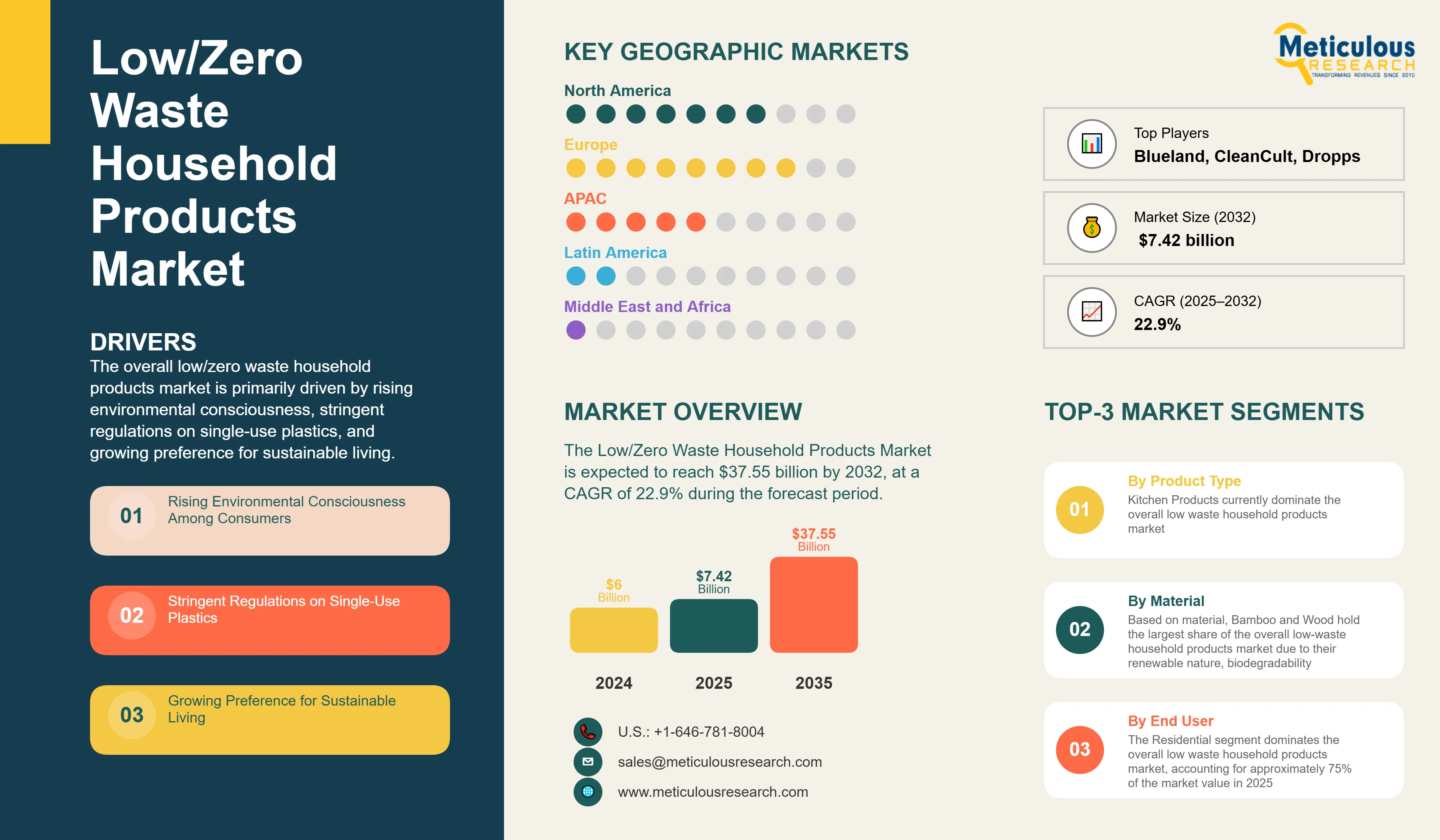
The overall low/zero waste household products market is primarily driven by rising environmental consciousness, stringent regulations on single-use plastics, and growing preference for sustainable living. The increasing adoption of refill stations and package-free stores is transforming retail models, while compostable packaging solutions are gaining significant traction. Social media influence has accelerated zero-waste lifestyle adoption, particularly among younger demographics, while corporate sustainability commitments are pushing manufacturers to develop more environmentally responsible alternatives.

Key Challenges

Despite growth prospects, the overall low waste household products market faces challenges including higher price points limiting mass adoption, limited availability in mainstream retail channels, consumer convenience preferences favoring disposable options, supply chain optimization difficulties for sustainable packaging, and balancing product performance with sustainability objectives.

Growth Opportunities

The low waste household products market offers several high-growth opportunities. Subscription-based business models are gaining traction by providing regular delivery of sustainable products while minimizing packaging waste. Innovation in biodegradable materials presents significant potential for product development, while expansion into emerging markets represents a vast untapped consumer base. Circular economy initiatives that reuse and repurpose materials are creating new business models, and the DIY product movement is empowering consumers to create their low-waste alternatives.

Key Highlights

By Product Type

Kitchen Products currently dominate the overall low waste household products market, with reusable food storage solutions and compostable cleaning tools being fundamental products driving consumer adoption. Key items include silicone food storage bags, beeswax wraps, bamboo utensils, and biodegradable dish brushes. However, the Bathroom Products segment, particularly solid toiletries and reusable menstrual products, is projected to grow at the highest CAGR of 28.9% through 2032 as consumers increasingly prioritize personal care sustainability. The Laundry and Cleaning segment, including concentrated detergents and biodegradable cleaning tools, is also witnessing significant growth during the forecast period.

By Material

Based on material, Bamboo and Wood hold the largest share of the overall low-waste household products market due to their renewable nature, biodegradability, and aesthetic appeal. Glass products form a substantial segment due to durability and recyclability benefits, while Stainless Steel applications in food containers and reusable bottles represent significant market value. However, Biodegradable Plastics and Organic Textiles segments are expected to experience the highest growth rates through 2032 as manufacturers develop more advanced materials that maintain convenience while reducing environmental impact.

By Distribution Channel

Online Retail currently represents the largest market segment by value, benefiting from direct-to-consumer models that align with sustainability messaging and allow brands to control packaging practices. Specialized Zero Waste Stores have seen rapid expansion in urban centers, while Mainstream Retail Chains are gradually increasing shelf space for sustainable alternatives. However, Subscription Services are anticipated to show the highest growth rate during the forecast period due to the recurring revenue model and convenience factor for consumers seeking to maintain sustainable practices.

By End User

The Residential segment dominates the overall low waste household products market, accounting for approximately 75% of the market value in 2025, driven by individual consumer adoption of sustainable lifestyle choices. However, the Commercial segment—particularly in hospitality and educational institutions—is expected to grow at a faster pace through 2032 as businesses incorporate sustainability into their operational practices and brand positioning. Within commercial applications, hospitality leads the market as hotels implement plastic-free amenities to enhance their environmental credentials.

By Geography

Europe leads the global low waste household products market followed by North America due to stringent regulations, advanced consumer awareness, and established sustainability infrastructure. Germany represents the largest market in Europe, while the U.S. leads North American adoption. However, the Asia-Pacific region, particularly Japan, South Korea, and Australia is projected to witness the highest CAGR during the forecast period of 2025-2032, driven by rapidly growing environmental awareness, government initiatives to reduce plastic waste, and increasing disposable incomes. Latin America shows promising growth potential, particularly in sustainability-focused markets like Chile and Brazil.

Competitive Landscape

The global low/zero waste household products market features a diverse competitive landscape with established multinational consumer goods companies expanding sustainable offerings and independent sustainability-focused manufacturers gaining significant market share.

Established Consumer Goods Companies

Unilever PLC, through its subsidiary Seventh Generation, Inc., leads established players with its comprehensive sustainable product portfolio spanning cleaning products, paper goods, and personal care. S.C. Johnson & Son, Inc. has strengthened its position through strategic acquisitions of pioneering eco-brands including Ecover and Method Products, PBC, leveraging their established formulations and consumer trust. Venus Laboratories, Inc. (operating as ECOS/Earth Friendly Products) has maintained its position as one of the longest-operating plant-based cleaning product manufacturers in the market. These companies compete primarily on manufacturing scale, R&D capabilities for performance parity with conventional products, and extensive distribution networks.

Independent Sustainable Manufacturers

Cot'n Wash, Inc. (Dropps) has disrupted the laundry and dishwasher detergent categories with its plastic-free pod delivery system, while Who Gives A Crap, Inc. has established strong brand recognition in sustainable paper products with its direct-to-consumer model. Blueland Co. has pioneered the tablet-based refill system for cleaning products, significantly reducing plastic packaging and transportation emissions. Ethique Limited has differentiated itself through completely solid product formulations eliminating water and packaging waste. These independent manufacturers compete primarily on sustainability innovation, minimalist packaging approaches, and authentic mission-driven positioning.

The manufacturing landscape is characterized by increasing acquisition interest from traditional consumer goods conglomerates seeking to expand sustainable portfolios, while material science partnerships between ingredient suppliers and product manufacturers accelerate sustainable formulation development. Leading manufacturers are increasingly adopting circular economy principles through concentrated formulations, packaging innovations, and ingredient sourcing transparency.

As the market matures, key manufacturers will need to address scale challenges through production efficiency, develop formulations that maintain efficacy while reducing environmental impact, and implement verifiable sustainability metrics to counter greenwashing concerns. Successful manufacturers will balance environmental benefits with product performance and price accessibility to drive mainstream adoption beyond environmentally-conscious early adopters.

Market Research Summary

Particulars

Details

Number of Pages

298

Format

PDF & Excel

Forecast Period

2025–2032

Base Year

2024

CAGR (Value)

22.9%

Market Size (Value)in 2025

USD 7.42 Billion

Market Size (Value) in 2032

USD 37.55 Billion

Segments Covered

By Product Type

  • Kitchen Products
  • Bathroom Products
  • Laundry and Cleaning
  • Home Organization and Storage
  • Disposable Alternatives

By Material

  • Bamboo and Wood
  • Glass
  • Stainless Steel
  • Organic Textiles
  • Biodegradable Plastics
  • Silicone
  • Other Materials

By Distribution Channel

  • Online Retail
  • Specialized Zero Waste Stores
  • Mainstream Retail Chains
  • Direct Sales
  • Subscription Services

Market by End User

  • Residential
  • Commercial

Countries Covered

North America (U.S., Canada)
Europe (Germany, France, U.K., Netherlands, Sweden, Denmark, Rest of Europe)
Asia-Pacific (Japan, South Korea, Australia, China, India, Singapore, Rest of Asia-Pacific)
Latin America (Brazil, Mexico, Chile, Rest of Latin America)
Middle East & Africa (United Arab Emirates, Israel, South Africa, Rest of Middle East & Africa)

Key

Companies

Seventh Generation, Inc. (subsidiary of Unilever PLC), Ecover (subsidiary of S.C. Johnson & Son, Inc.), Blueland Co., CleanCult, Inc., Ethique Limited, Dropps (Cot'n Wash, Inc.), Meliora Cleaning Products, LLC, Who Gives A Crap, Inc., Method Products, PBC (subsidiary of S.C. Johnson & Son, Inc.), Mrs. Meyer's Clean Day (subsidiary of S.C. Johnson & Son, Inc.), Bio-Kleen Products, Inc., Venus Laboratories, Inc. (dba ECOS/Earth Friendly Products), Nellie's Clean, Inc., Aunt Fannie's, Inc., Better Life, LLC

Frequently Asked Questions

How We Built This Intelligence

Table of Contents

Expand all

Access & Licensing

Choose how you access this intelligence — from a standalone data pack to organization-wide access. Every option is delivered within 24–48 hours and backed by analyst support.

Single User License
Instant access to full PDF report + Excel dataset.
$4,175
1–5 User Access
Full PDF Report + Excel Datasheets
1-Hour Analyst Call included
Free 10% Customization
POPULAR
Multi-User License
Instant access to full PDF report + Excel dataset.
$5,875
1–5 User Access
Full PDF Report + Excel Datasheets
1-Hour Analyst Call included
Free 10% Customization
Enterprise License
Instant access to full PDF report + Excel dataset.
$7,875
1–5 User Access
Full PDF Report + Excel Datasheets
1-Hour Analyst Call included
Free 10% Customization
Flexible Purchase Options
Buy the complete report, individual chapters, or only the data you need. Starting from $1,500.
Analyst-reviewed intelligence
Multi-source validation
Transparent methodology
Citation-ready data
Analyst assistance

Related Statistics & Insights

$6B
market value in 2024
$37.55B
projected market value by 2032
22.9%
compound annual growth rate
75%
of the market value in 2025
Cite this report
Meticulous Research. (2025). Low/Zero Waste Household Products Market - Global Opportunity Analysis and Industry Forecast (2025-2032) (Report No. MR-1472). Meticulous Market Research Pvt. Ltd. https://meticulousresearch.com/reports/low-waste-household-products-market-6155
Custom Research

Need something more specific?

A custom-scoped study can target a single segment, geography, or competitor set — or answer a board-level question this syndicated report doesn't. Tell an analyst what decision you're making and we'll scope it.

Search Market Intelligence

Search across reports, blogs, press releases, and industries