- Home
- Reports
- Semiconductor and Electronics
- Latin America Water and Wastewater Treatment Market
Latin America Water and Wastewater Treatment Market by Type, Offering (Treatment Technologies, Treatment Chemicals, Process Control, and Automation), Application (Municipal Applications, Industrial Applications {Mining}), and Country - Forecast to 2032
Latin America Water and Wastewat...
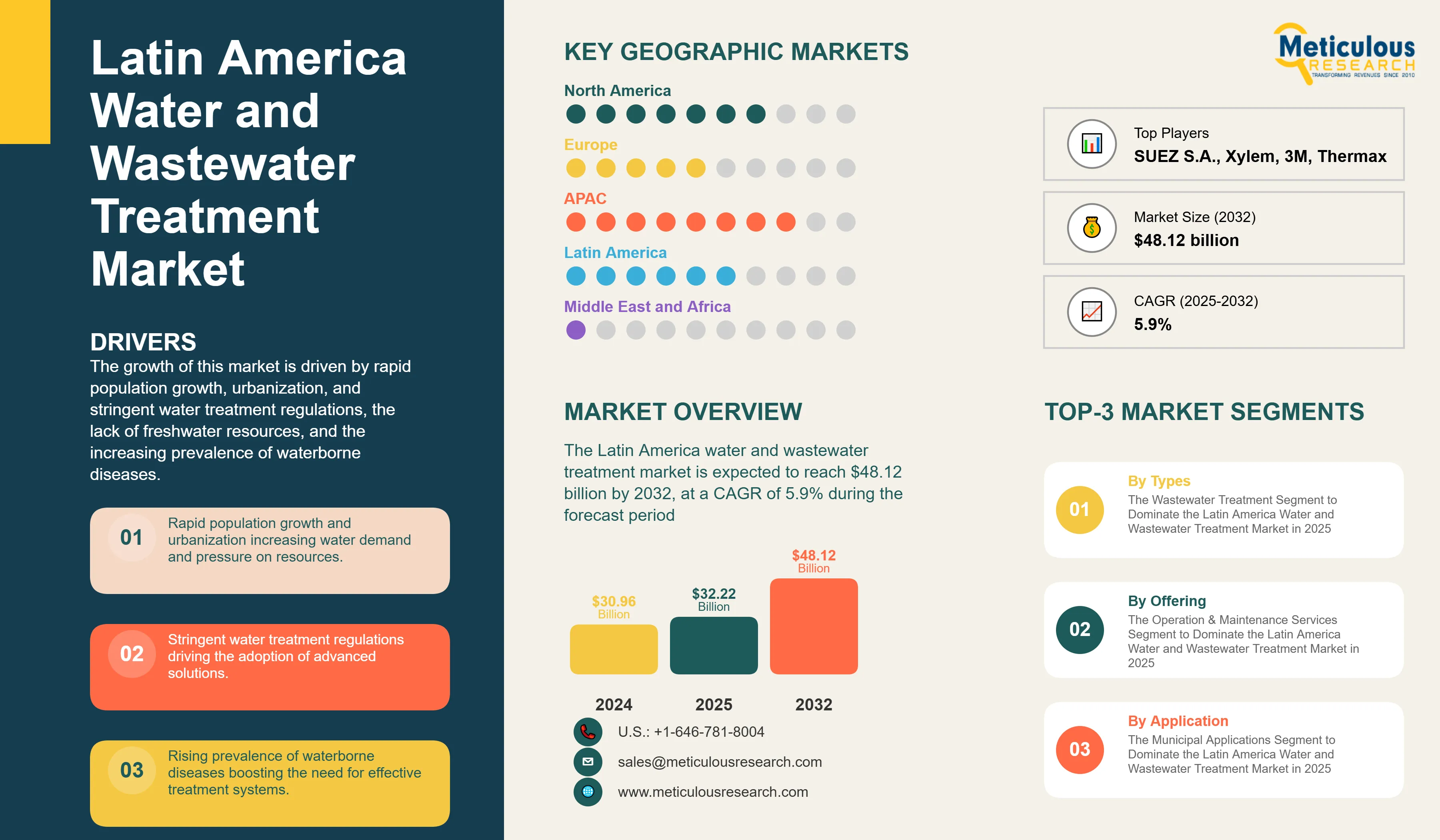
The growth of this market is driven by rapid population growth, urbanization, and stringent water treatment regulations, the lack of freshwater resources, and the increasing prevalence of waterborne diseases. However, the high costs of installing, maintaining, and operating water and wastewater treatment infrastructure restrain the growth of this market. Furthermore, the rising demand for energy-efficient and advanced water treatment technologies is expected to generate growth opportunities for market players. However, upgrading and repairing aging water infrastructure is a major challenge in the water and wastewater treatment market.
Key Findings
- By Type: In 2025, the Wastewater Treatment Segment Is Expected to Dominate the Latin America Water and Wastewater Treatment Market.
- By Offering: In 2025, the Operation & Maintenance Services Segment Is Expected to Dominate the Latin America Water and Wastewater Treatment Market.
- By Application: In 2025, the Municipal Applications Segment Is Expected to Dominate the Latin America Water and Wastewater Treatment Market.
- By Country: In 2025, Brazil Is Expected to Dominate the Latin America Water and Wastewater Treatment Market.
Market Growth Drivers

Click here to: Get Free Sample Pages of this Report
Rapid Growth in Population and Urbanization Boosts the Demand for Latin America Water and Wastewater Treatment
The increasing regional population, particularly the urban population, remains a central factor driving industrial expansion. Latin America's population is steadily increasing, with urban areas experiencing the most significant growth. According to the United Nations, the region's population is projected to reach 748 million by 2030, up from 652 million in 2021. Also, as of recent data, approximately 80% of Latin America's population resides in urban areas, making it one of the most urbanized regions globally. This urban population is concentrated in cities with over 20,000 inhabitants, highlighting the rapid urban expansion in the region. A larger population and rapid urbanization strain existing water infrastructure, leading to increased demand for modern water and wastewater treatment systems to ensure sustainable water supply and sanitation.
The surge in urban populations has led to increased demand for reliable water supply and efficient wastewater management systems. However, the existing infrastructure has struggled to keep pace with this rapid growth. Currently, only about 50% of the population in Latin America is connected to sewerage systems, and merely 30% of collected wastewater undergoes treatment. This shortfall poses significant public health risks and environmental challenges. To address these challenges, substantial investments are being made in water and wastewater treatment infrastructure. According to the Development Bank of Latin America (CAF), between 2010 and 2030, an estimated US$80 billion is expected to be invested in sewerage infrastructure, with an additional US$33 billion allocated for wastewater treatment facilities. These investments aim to enhance service coverage, improve water quality, and mitigate environmental pollution.
Thus, growing population and urbanization are driving the adoption of water and wastewater treatment solutions, supporting market growth
Stringent Water Treatment Regulations Support the Growth of Latin America Water and Wastewater Treatment Market
Governments across the region are implementing stricter environmental and public health standards to address water pollution, ensure access to clean water, and promote sustainable water management. These regulations compel industries, municipalities, and utilities to invest in modern treatment technologies, creating significant growth opportunities for the water treatment sector.
Countries like Brazil, Mexico, and Chile have established comprehensive water quality standards and wastewater discharge limits. For example, Brazil's National Water Agency (ANA) enforces regulations under the National Water Resources Policy, which mandates industries and municipalities to treat wastewater before discharge. Mexico's National Water Commission (CONAGUA) has implemented the Mexican Official Standards (NOMs) for water quality, requiring industries to adopt advanced treatment technologies to comply with effluent standards.
Industries such as mining, oil and gas, and food and beverage are major water consumers and polluters. Regulations require these sectors to adopt zero-liquid discharge (ZLD) systems, membrane filtration, and other advanced technologies to minimize water usage and ensure compliance. For instance, Chile's Superintendence of the Environment (SMA) imposes heavy fines on mining companies for non-compliance with water discharge standards, driving investments in water and wastewater treatment infrastructure.
Moreover, in 2021, Chile implemented a long-term mining policy mandating a reduction in freshwater use to 10% by 2030 and 5% by 2050, promoting the adoption of desalination and water reuse technologies in the mining sector. Also, Brazil's Basin Restoration Program (PRODES) exemplifies innovative regulatory approaches by providing financial incentives for wastewater treatment plants that meet specific discharge standards, thereby encouraging proper operation and maintenance.
Thus, stringent government regulations is driving the growth of the water and wastewater treatment market in Latin America
Market Opportunities
By Type: The Wastewater Treatment Segment to Dominate the Latin America Water and Wastewater Treatment Market in 2025
Based on type, the Latin America water and wastewater treatment market is segmented into wastewater treatment and water treatment. In 2025, the wastewater treatment segment is expected to account for a larger share of 61.1% of the Latin America water and wastewater treatment market. The large market share of this segment is attributed to the rising focus on water quality and public health, the growing prevalence of water-borne diseases and stringent governmental regulations, and the rising industrialization and urbanization. Also, this segment is expected to register a higher CAGR during the forecast period.
By Offering: The Operation & Maintenance Services Segment to Dominate the Latin America Water and Wastewater Treatment Market in 2025
Based on offering, the Latin America water and wastewater treatment market is segmented into treatment technologies, treatment chemicals, process control and automation, design, engineering, and construction services, and operation & maintenance services. In 2025, the operation & maintenance services segment is expected to account for the largest share of the Latin America water and wastewater treatment market. The segment’s large market share is attributed to the growing need to ensure the production of the desired quality and quantity of treated water, the increasing complexities of water and wastewater treatment facilities, the adoption of innovative solutions, and stringent regulatory standards.
However, the process control & automation segment is projected to register the highest CAGR during the forecast period. The rapid growth of this segment is attributed to growing need for efficiency, reliability, and sustainability in water management systems. Process control and automation technologies enable water treatment plants to optimize operations, reduce costs, and comply with stringent environmental regulations.
By Application: The Municipal Applications Segment to Dominate the Latin America Water and Wastewater Treatment Market in 2025
Based on applications, the Latin America water and wastewater treatment market is segmented into municipal applications and industrial applications. In 2025, the municipal applications segment is expected to account for the larger share of the Latin America water and wastewater treatment market. The segment’s large share is mainly attributed to factors such as the rising regional population and urbanization, growing need to ensure access to safe drinking water and proper sanitation to communities, growing government investments for infrastructure development, stringent government regulations, and advancements in treatment processes.
However, the industrial applications segment is expected to register a higher CAGR during the forecast period. The growth of this segment is mainly driven by factors such as increasing industrialization and urbanization, declining freshwater resources, adoption of advanced treatment technologies, stringent governmental regulations on treating industrial wastewater, growing emphasis on sustainable practices, and a rising focus on water quality and public health.
Geographical Analysis
Brazil Dominates the Latin America Water and Wastewater Treatment Market in 2025
Based on country, the Latin America water and wastewater treatment market is segmented into Brazil, Mexico, Chile, Argentina, Colombia, Peru, Ecuador, Venezuela, The Caribbean, and the rest of Latin America. In 2025, Brazil is expected to account for the largest share of 36.7% of the Latin America water and wastewater treatment market, followed by Mexico, Chile, Argentina, Colombia, Peru, Ecuador, Venezuela, The Caribbean, and the rest of Latin America. The large share of this country is mainly attributed to the growing awareness about environmental pollution, stringent waste and wastewater management regulations, and the growing adoption of advanced technologies such as membrane filtration and activated sludge treatment. Furthermore, the rapid industrialization and growing adoption of treatment technologies in various industrial applications are also contributing to the growth of the water and wastewater treatment market in Brazil. Moreover, this country is projected to record the highest CAGR during the forecast period.
Key Companies
The report offers a competitive analysis based on an extensive assessment of the leading players’ product portfolios, country presence, and key growth strategies adopted in the last three to four years. Some of the key players operating in the Latin America water and wastewater treatment market are Veolia Environnement (France), SUEZ S.A. (France), Xylem Inc. (U.S.), DuPont de Nemours, Inc. (U.S.), 3M Company (U.S.), Pentair plc (U.K.), Thermax Limited (India), WOG Technologies (Singapore), Burns & McDonnell (U.S.), and The Dow Chemical Company (U.S.).
Latin America Water and Wastewater Treatment Industry Overview: Latest Developments from Key Industry Players
- In May 2024, DuPont de Nemours, Inc. (U.S.) launched the newest version of WAVE Design Software – version 1.83, database 63. WAVE is DuPont Water Solutions' integrated expert modeling software, which includes the broadest multi-tech product portfolio – Ultrafiltration (UF), Nanofiltration (NF), Reverse Osmosis (RO), Ion Exchange Resins (IX), and Closed-Circuit Reverse Osmosis (CCRO).
- In March 2023, Veolia Environment (France) launched GreenPath Zero Carbon, offering a portfolio of 100 solutions identified in Veolia’s areas of expertise in water, energy, and waste, making it possible to reduce emissions by up to 80% in the areas covered by Veolia's technologies.
Market Research Summary
|
Particulars |
Details |
|
Number of Pages |
162 |
|
Format |
|
|
Forecast Period |
2025–2032 |
|
Base Year |
2024 |
|
CAGR (Value) |
5.9% |
|
Market Size in 2025 |
$32.22 Billion |
|
Market Size in 2032 |
$48.12 Billion |
|
Segments Covered |
By Type
By Offering
By Application
|
|
Countries Covered |
Brazil, Mexico, Chile, Argentina, Colombia, Peru, Ecuador, Venezuela, The Caribbean, and the Rest of Latin America. |
|
Key Companies |
SUEZ S.A. (France), Veolia Environnement (France), Xylem Inc. (U.S.), DuPont de Nemours, Inc. (U.S.), 3M Company (U.S.), Pentair plc (U.K.), Thermax Limited (India), WOG Technologies (Singapore), Burns & McDonnell (U.S.), and The Dow Chemical Company (U.S.). |
Frequently Asked Questions
Related Tags
How We Built This Intelligence
Table of Contents
Expand allAccess & Licensing
Choose how you access this intelligence — from a standalone data pack to organization-wide access. Every option is delivered within 24–48 hours and backed by analyst support.
Related Statistics & Insights
Need something more specific?
A custom-scoped study can target a single segment, geography, or competitor set — or answer a board-level question this syndicated report doesn't. Tell an analyst what decision you're making and we'll scope it.