Information and Communications TechnologyReport ID: MR-878May 2025410 PagesGlobal
Verified by the Meticulous Standard·Last verified: May 2026 by Rajdeep Bhawal

Language Learning Market Size, Share, Forecast, & Trends Analysis by Age Group (<18 years, 18-20 years, 21-30 years, 31-40 years, >40 years), Language (English, Mandarin, Spanish, French, German, Italian, Japanese) End User (B2C, B2B)ΓÇöGlobal Forecast to 2035

Published Date: May 2025
Format: PDF + Excel + Cloud Portal
Pages / Size: 410 Pages
Analyst: Rajdeep Bhawal
Secure checkout · Full methodology disclosure · Underwritten by lead analyst Rajdeep Bhawal
Language Learning Market Size
Language Learning Market Sizing & Sourcing
Base year: 2025 · CAGR: 7.2%
$5.86B
Market size 2025
$6.42B
Market size 2026
$12.84B
Forecast by 2036
7.2%
CAGR 2026–2036

Market Overview

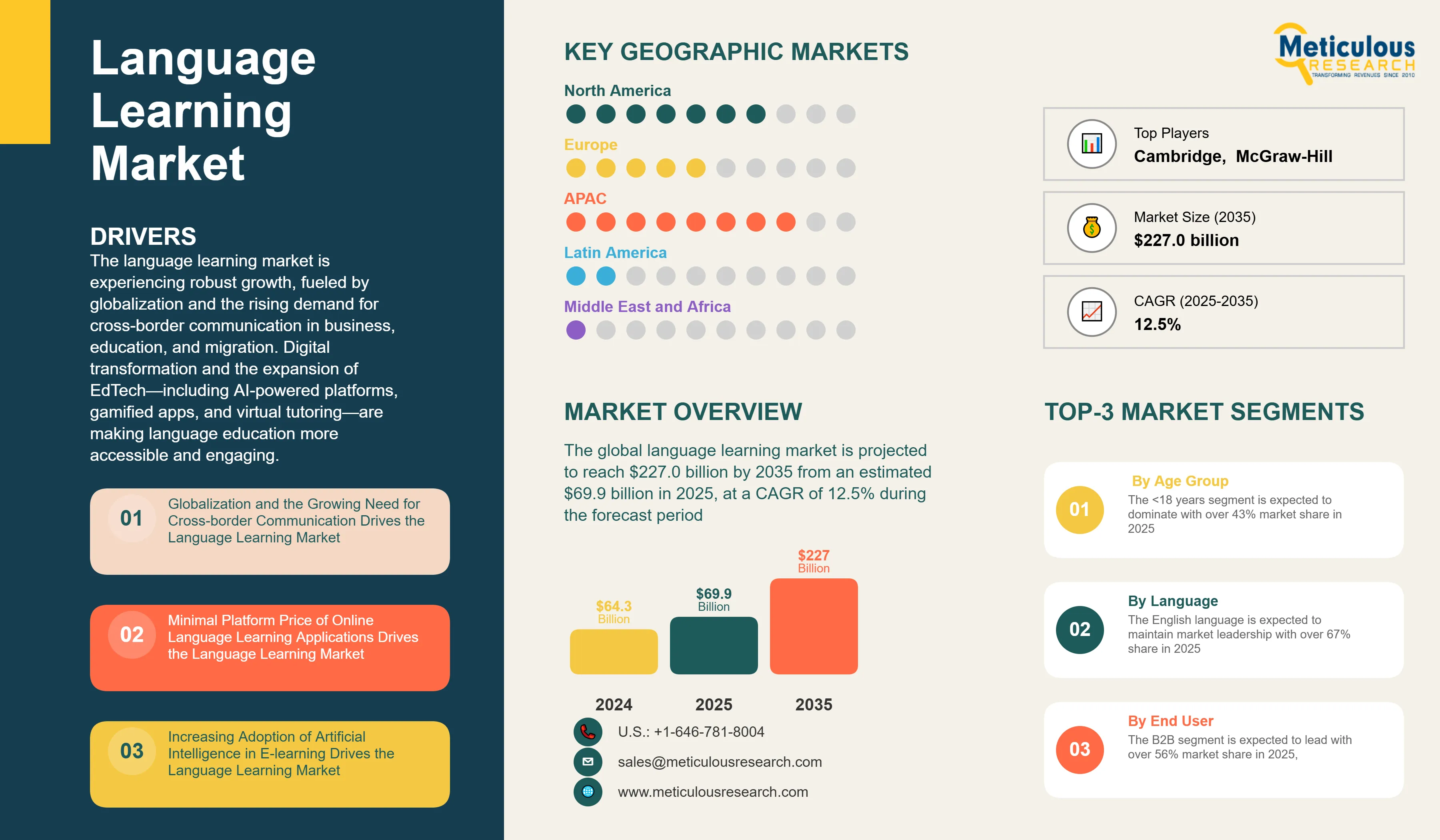
The language learning market is experiencing robust growth, fueled by globalization and the rising demand for cross-border communication in business, education, and migration. Digital transformation and the expansion of EdTech—including AI-powered platforms, gamified apps, and virtual tutoring—are making language education more accessible and engaging. Low-cost subscription models (e.g., Duolingo, Babbel) and government-led multilingualism initiatives (e.g., EU language policies, China’s English education push) further accelerate adoption. Additionally, AI-driven personalization (e.g., ChatGPT tutors, speech recognition) is revolutionizing e-learning efficiency.

Beyond individual learners, multinational corporations increasingly seek multilingual talent, driving demand for corporate language training programs. Startups in the sector are also attracting significant investments, particularly those leveraging immersive tech (VR/AR), adaptive learning algorithms, and niche language specialization. These trends collectively position the market for sustained expansion, with emerging economies (India, Africa, LATAM) offering untapped potential.

Market Growth Drivers

Digital Transformation & EdTech Growth

Technology is revolutionizing language learning through AI-powered apps, gamification, and virtual classrooms. Platforms like Duolingo and Babbel use adaptive algorithms to personalize lessons, while speech recognition enhances pronunciation practice. Gamified elements, such as rewards and leaderboards, boost engagement and retention. Virtual tutoring services like iTalki connect learners with native speakers worldwide, making education accessible. The rise of mobile learning allows users to study anytime, anywhere. EdTech innovations also include chatbots for conversational practice and AI-driven feedback systems. This digital shift caters to modern learners who prefer flexible, interactive, and cost-effective solutions over traditional classroom-based methods.

Government & Educational Policies

Governments worldwide are mandating language education to foster multilingualism and global competitiveness. Countries like China emphasize English proficiency, while the EU promotes regional language diversity. Standardized tests (TOEFL, IELTS) are integral for academic and professional opportunities, driving demand for test prep services. Public schools are incorporating bilingual programs, and national initiatives support adult language training. Policymakers recognize language skills as vital for economic growth, diplomacy, and social integration. Subsidies and partnerships with private educators further expand access. These policies create a structured demand for language learning, ensuring sustained market growth across age groups and socioeconomic backgrounds.

Immigration & Travel Trends  and Insights
Click here to: Get Free Sample Pages of this Report

Migration and tourism are key drivers of language learning. Immigrants learn host-country languages to improve employability and social integration, with programs targeting Spanish in the U.S. or German in Europe. Post-pandemic travel resurgence fuels demand for conversational skills in popular tourist destinations. Language apps now offer travel-specific courses, teaching phrases for dining, transportation, and emergencies. Governments and NGOs also provide free language resources to aid newcomers. This trend highlights the practical necessity of language acquisition for mobility, cultural adaptation, and global connectivity, making it a persistent growth sector.

Language Learning Market Opportu...

AI & Gamified Learning Apps

The convergence of artificial intelligence and gamification presents unprecedented opportunities in language learning. AI-powered platforms can now deliver hyper-personalized experiences through adaptive algorithms that adjust difficulty, content, and pacing based on individual learning patterns. Companies like Duolingo have demonstrated the market potential, but significant gaps remain in specialized areas like business English, technical vocabulary, and cultural context training. Gamification elements including achievement systems, social competitions, and immersive storylines increase engagement rates by up to 70% compared to traditional methods. The integration of advanced AI features such as real-time pronunciation coaching, conversational chatbots powered by large language models, and predictive analytics for learning optimization creates compelling value propositions. Mobile-first platforms capture the growing demand for flexible, on-demand learning solutions that fit busy lifestyles and leverage microlearning principles.

Emerging Markets (Asia, Africa, Latin America)

Emerging markets represent the fastest-growing segment of the global language learning industry, driven by economic development, urbanization, and digital connectivity expansion. In Asia, countries like India, Indonesia, and Vietnam show enormous demand for English proficiency to access global job markets and educational opportunities. Africa's young, mobile-first population creates opportunities for affordable, accessible language learning solutions that address limited internet infrastructure through offline capabilities and SMS-based learning modules. Latin America's growing middle class and business ties with North America fuel demand for professional English skills. These markets require localized approaches including culturally relevant content, regional payment methods, and partnerships with local educational institutions. Mobile-optimized platforms are essential given smartphone penetration rates often exceed computer access. Freemium models work well in price-sensitive markets, while government partnerships for educational initiatives can provide scale and legitimacy for expanding language learning companies.

Language Learning Market Analysis

Market By Age Group

The <18 years segment is expected to dominate with over 43% market share in 2025, driven by rising preference for interactive and engaging learning experiences, increasing demand for cross-border collaboration skills, and expanding higher education opportunities. This segment benefits from language learning's cognitive advantages including enhanced verbal and spatial reasoning, improved memory, and strengthened problem-solving abilities.

However, the 18-20 years segment shows the highest growth rate, fueled by growing needs to enhance employability and job market competitiveness, deeper cultural engagement requirements, and study abroad enrichment opportunities. This demographic comprises dedicated high school students strongly committed to academic excellence and cognitive growth, exhibiting enthusiastic approaches to embracing diverse languages and cultures through internet-based learning platforms.

Market By Language

The English language is expected to maintain market leadership with over 67% share in 2025, supported by rising demand for English learning programs, accelerating globalization and urbanization trends, growing worldwide English learner populations, increasing popularity of English proficiency tests, and expanding emphasis on English education in schools and institutions.

Mandarin exhibits the fastest growth trajectory, leveraging its status as the world's second most spoken language with 1.117 billion speakers globally according to Busuu Online S.L. data from May 2022. As a group of Sinitic languages natively spoken across northern and southwestern China, Mandarin holds official status in China, Taiwan, and Singapore, with over 70% of China's population speaking the language.

Market By End User

The B2B segment is expected to lead with over 56% market share in 2025, driven by increasing corporate demand for industry-specific language skills to communicate effectively with international clients, partners, and markets. Growth factors include enhanced business communication needs and rising language training demand across government, education, and private sector organizations.

B2C segment demonstrates higher growth potential during the forecast period, supported by similar drivers including industry-specific communication requirements, business communication enhancement needs, and expanding language training demand across various organizational sectors.

Geographical Analysis

Asia-Pacific to Dominate the Language Learning Market in 2025

In 2025, Asia-Pacific is expected to account for the largest share of over 49.2% of the language learning market. The growth of this market is attributed to the influx of multinational companies, government initiatives to strengthen national education networks, growing government focus on the education sector, rapidly developing economies, and increasing disposable incomes leading to increased Internet penetration. Asia-Pacific holds tremendous growth opportunities for the language learning market. Market players in this region are adopting various strategies to broaden their product portfolios, advance the capabilities of their existing products, cater to the changing needs of the users, and ensure a competitive edge in the language learning market. Various key players in this market launch various initiatives in the development of the market.

Moreover, the Asia-Pacific region is projected to register the highest CAGR during the forecast period.

Key Companies

The report offers a competitive analysis based on an extensive assessment of the product portfolios and geographic presence of leading market players and the key growth strategies adopted by them over the past three to four years. The key players operating in the language learning market include Cambridge University Press (U.K.), New Oriental Education & Technology Group Inc. (China), Houghton Mifflin Harcourt Company (U.S.), McGraw-Hill Education, Inc. (U.S.), Duolingo Inc. (U.S.), Berlitz Corporation (U.S.), Busuu Online S.L. (Spain), Babble GMBH (Germany), Linguistica 360, Inc. (U.S.), Mondly (Romania), ELSA Corp. (U.S.), FluentU (China), Memrise Inc. (U.K.), Mango Languages (U.S.), Rosetta Stone Ltd. (U.S.), Inlingua International Ltd. (Switzerland), Sanako Corporation (Finland), Transparent Language, Inc. (U.S.), and Open Education LLC (U.S.).

Executive Summary

  • In April 2025, Duolingo launched its largest-ever course expansion, leveraging AI to add 10+ new languages (including Zulu and Xhosa) and enhance personalized learning. This update also introduced adaptive exercises and real-time feedback, reinforcing Duolingo’s edge in scalable, tech-driven language education.

  • In February 2025, Babel, a Spanish multinational specializing in digital transformation, announced a strategic collaboration with OpenAI to enhance its capabilities in Generative Artificial Intelligence.

Market Research Summary

Particulars

Details

Number of Pages

410

Format

PDF

Forecast Period

2025–2035

Base Year

2024

CAGR

12.5%

Market Size (2031)

$69.9 Billion

Market Size (2035)

$227.0 Billion

Segments Covered

Language Learning Market Assessment—by Age Group                    

  • <18 Years
  • 18-20 Years
  • 21-30 Years
  • 31-40 Years
  • >40 Years

Language Learning Market Assessment—by Language

  • English
  • French
  • Spanish
  • Mandarin
  • Japanese
  • German
  • Italian
  • Arabic
  • Korean
  • Portuguese
  • Other Languages

Language Learning Market Assessment—by Learning Objective

  • Academic Learning (K-12, Higher Ed)
  • Test Preparation (TOEFL, IELTS, PTE, etc.)
  • Business/Workplace Communication
  • Travel & Cultural Immersion
  • Migration/Relocation

Language Learning Market Assessment—by End User       

  • B2B
    • Live
      • Offline
        • Group Learning
        • 1:1 Tutoring
      • Online
        • 1:1 Tutoring
        • Group Learning
    • Web & Mobile Apps
  • B2C
    • Live
      • Offline
        • Group Learning
        • 1:1 Tutoring
      • Online
        • 1:1 Tutoring
        • Group Learning
    • Web & Mobile Apps    

Countries Covered

Europe (Germany, France, Italy, U.K., Spain, Russia, Poland, Netherlands, Sweden, Belgium, Austria, Switzerland, Finland, Norway, Turkey, Ireland, Luxembourg, and Rest of Europe), Asia-Pacific (China, Japan, India, South Korea, Indonesia, Australia & New Zealand, Taiwan, Hong Kong, Singapore, Malaysia, Vietnam, and Rest of Asia-Pacific), North America (U.S. and Canada), Latin America (Brazil, Mexico, and Rest of Latin America), and the Middle East & Africa (UAE, Saudi Arabia, and Rest of Middle East & Africa)

Key Companies Profiles

Cambridge University Press (U.K.), New Oriental Education & Technology Group Inc. (China), Houghton Mifflin Harcourt Company (U.S.), McGraw-Hill Education, Inc. (U.S.), Duolingo Inc. (U.S.), Berlitz Corporation (U.S.), Busuu Online S.L. (Spain), Babble GMBH (Germany), Linguistica 360, Inc. (U.S.), Mondly (Romania), ELSA Corp. (U.S.), FluentU (China), Memrise Inc. (U.K.), Mango Languages (U.S.), Rosetta Stone Ltd. (U.S.), Inlingua International Ltd. (Switzerland), Sanako Corporation (Finland), Transparent Language, Inc. (U.S.), and Open Education LLC (U.S.).

Frequently Asked Questions

How We Built This Intelligence

Table of Contents

Expand all

Access & Licensing

Choose how you access this intelligence — from a standalone data pack to organization-wide access. Every option is delivered within 24–48 hours and backed by analyst support.

Single User License
Instant access to full PDF report + Excel dataset.
$4,175
1–5 User Access
Full PDF Report + Excel Datasheets
1-Hour Analyst Call included
Free 10% Customization
POPULAR
Multi-User License
Instant access to full PDF report + Excel dataset.
$5,875
1–5 User Access
Full PDF Report + Excel Datasheets
1-Hour Analyst Call included
Free 10% Customization
Enterprise License
Instant access to full PDF report + Excel dataset.
$7,875
1–5 User Access
Full PDF Report + Excel Datasheets
1-Hour Analyst Call included
Free 10% Customization
Flexible Purchase Options
Buy the complete report, individual chapters, or only the data you need. Starting from $1,500.
Analyst-reviewed intelligence
Multi-source validation
Transparent methodology
Citation-ready data
Analyst assistance

Related Statistics & Insights

$64.3B
market value in 2024
$227.0B
projected market value by 2035
12.5%
compound annual growth rate
70%
compared to traditional methods
Cite this report
Meticulous Research. (2025). Language Learning Market - Global Opportunity Analysis and Industry Forecast (2025-2035) (Report No. MR-878). Meticulous Market Research Pvt. Ltd. https://meticulousresearch.com/reports/language-learning-market-5561
Custom Research

Need something more specific?

A custom-scoped study can target a single segment, geography, or competitor set — or answer a board-level question this syndicated report doesn't. Tell an analyst what decision you're making and we'll scope it.

Search Market Intelligence

Search across reports, blogs, press releases, and industries