India Rubber Products Market for Civil Construction Industry by Product (Adhesive, Sealant, Flooring, Matting, Gasket, Bellows & Connectors, Bridge Expansion Joint, Clamp), Rubber Type (Natural, Styrene Butadiene, Chloroprene, EPDM) - Forecast to 2029
Market Overview
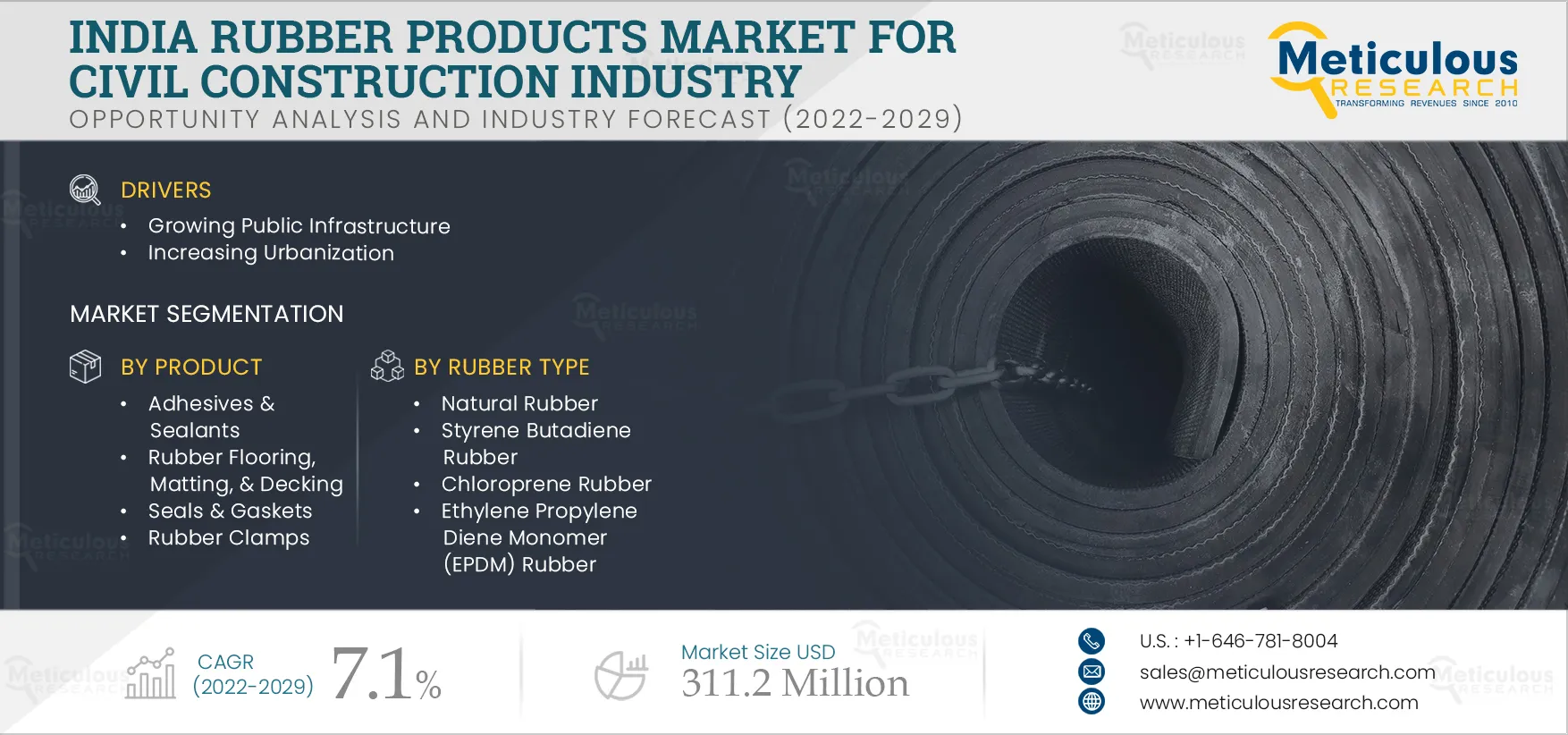
The India Rubber Products Market for Civil Construction Industry is expected to grow at a CAGR of 7.1% from 2022 to 2029 to reach $311.2 million by 2029. Rubber is highly elastic and flexible in nature. Rubber has various properties, such as water resistance, tear resistance, elongation, abrasion resistance, and thermal and electronic resolution. Rubber is used in different industries such as agriculture, aerospace, chemical, healthcare, mining, petroleum, printing and paper, textile, and civil and construction.
In the civil construction industry, rubber is used for making various products such as gaskets & seals, safety surfacing, rubber matting, flooring, decking, rubber sheeting, rubber moldings, rubber clamps, bellows & connectors, safety surfacing, and traffic management. Different types of rubbers are used for making civil construction products, including natural rubber, chloroprene rubber, ethylene propylene rubber, and styrene-butadiene rubber.
The growing construction industry and increasing urbanization mainly drive the growth of this market in India. Implementing smart technology in manufacturing rubber products and developing rubber industry in India are expected to create market growth opportunities. However, the shortage of labor for natural rubber tapping and problems faced by the rubber industry are major challenges to market growth.
Growing Public Infrastructure
Rubber is highly elastic and durable, remaining flexible even when exposed to a wide range of temperatures. Rubber also exhibits water resistance, thermal and electrical insulation, movement and vibration absorption properties leading to its adoption in construction and civil industry. Several products, such as joints, seals, gaskets, sealants, adhesives, and bonding agents, are used in the construction to provide extra strength and support to structures.
One of the major goals of the Indian government is to achieve a GDP of USD 5 trillion by the year 2024–2025. India needs to spend USD 1.4 trillion on infrastructure to achieve this goal. To complete this objective, the government launched a National Infrastructure Pipeline (NIP) for 2020–2025 to provide and develop transport, logistics, energy, water and sanitization, and social and commercial infrastructures for the people across the country. The investment for NIP is projected to be around USD 1.5 trillion.
Additionally, in March 2021, the parliament passed a bill to create a USD 2.5 billion development finance institution called National Bank for Financing Infrastructure and Development (NaBFID) to fund infrastructure projects in India. Such initiatives by the government to develop infrastructure at a massive scale across the country are expected to lead to the adoption of rubber products for the civil construction industry
Need something more specific?
A custom-scoped study can target a single segment, geography, or competitor set — or answer a board-level question this syndicated report doesn't. Tell an analyst what decision you're making and we'll scope it.