eSports Market Size, Share, Forecast, & Trends Analysis by Revenue Model (Sponsorships, Media & Broadcasting Rights), Streaming (Live, On-demand), Genre (Real-time Strategy, Multiplayer Online Battle Arena, Others), Platform (PCs, Mobile Platforms) & Geography - Global Forecast to 2032
Market Overview
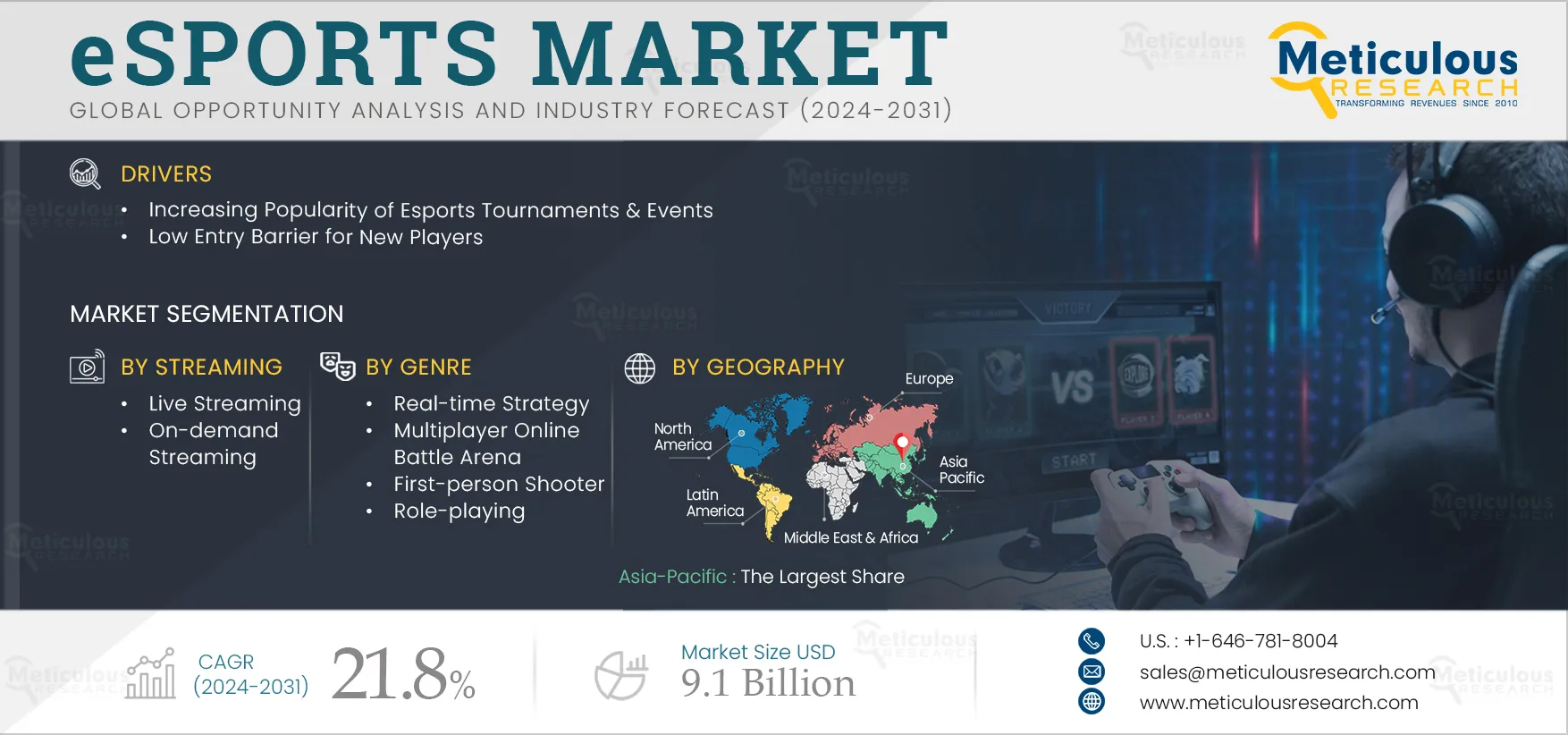
Key factors driving the growth of this market include the increasing popularity of eSports tournaments & events and a low entry barrier for new players. However, the lack of awareness about eSports among potential audiences restrains the market’s growth.
Additionally, the availability of lucrative sponsorship & partnership deals for eSports organizations and initiatives by stakeholders to professionalize eSports are anticipated to offer market growth opportunities. However, limited professional opportunities for eSports teams in emerging regions remain a major challenge for market growth.
Furthermore, the growing popularity of mobile gaming and the increasing number of eSports professionals streaming their gameplay on platforms like Twitch and YouTube are prominent trends in this market.
Click here to: Get a Free Sample Copy of this report
Market Growth Drivers
Increasing Popularity of eSports Tournaments & Events
The growing popularity of eSports tournaments and events is attracting both players and viewers. Tournaments such as IEM Cologne (CS: GO), ESL One (DOTA 2), League of Legends World Championship, and The International (DOTA 2) have gained significant recognition globally, gaining millions of fans. This growing popularity of eSports tournaments is encouraging game developers and eSports organizations to host their own events to enhance global reach and mainstream acceptance.
Moreover, several countries are actively supporting the eSports market by organizing national tournaments and events. For instance, in July 2025, Saudi Arabia announced the Esports World Cup, set to take place in Riyadh. This tournament is expected to feature the largest prize pool in eSports history and will showcase teams competing across various game genres. The Esports World Cup is part of Saudi Arabia’s National Gaming and eSports Strategy, which aims to increase the sector's contribution to the country's GDP by over 50 billion SAR (approximately USD 13.3 billion) and create more than 39,000 jobs by 2032. Such initiatives are anticipated to drive the market’s growth during the forecast period.
Low Entry Barrier for New Players
In recent years, eSports has emerged as a rapidly growing industry with low barriers to entry for aspiring gamers and new players. Competitive gaming tournaments offer attractive prizes and opportunities for global recognition. To participate in eSports competitions, individuals primarily need skill, dedication, access to gaming consoles, computers, or mobile devices, and a reliable internet connection. Some events even provide the necessary setup for players to compete.
The eSports ecosystem is accessible to both new players and viewers, as many games and platforms are free, and the required equipment tends to be relatively affordable. Anyone with an internet connection can participate in or watch eSports games and events. This low barrier to entry encourages both amateur and professional gamers, as well as an increase in viewership. These factors are anticipated to drive the growth of the eSports market.
Market Opportunities
Initiatives by Stakeholders to Professionalize eSports
In recent years, there has been a significant transformation in the eSports market, where entities have evolved from teams to clubs and are now becoming full-fledged eSports organizations. As eSports increasingly offers viable career paths, there has been a significant increase in the number of professional eSports athletes. The establishment of eSports arenas, training facilities, and support staff is creating a professional environment for players and teams. Additionally, various stakeholders are making efforts to professionalize the eSports industry.
Moreover, several countries have launched initiatives to promote the eSports sector, which is a significant step toward its professionalization. For instance, in January 2024, the French government announced plans for a National Esports Strategy, which includes initiatives for eSports visas for players and talent, support for grassroots eSports, and the development of a more structured eSports ecosystem. Similarly, Denmark is among the few countries where the government actively supports eSports. Many educational institutions across various countries have integrated eSports into their curricula and extracurricular activities, including at the middle and high school levels. Furthermore, China’s General Administration of Sports officially recognized eSports as a sport in 2003. This recognition and support from stakeholders are expected to create opportunities for the growth of the eSports market.
eSports Market Analysis
By Revenue Model: In 2025, the Sponsorships Segment to Dominate the eSports Market
By revenue model, the global eSports market is segmented into sponsorships, advertisements, merchandise & ticket sales, media & broadcasting rights, game publisher fees, and digital money. In 2025, the sponsorships segment is expected to account for the largest share of over 35.0% of the global eSports market. The significant market share of this segment is attributed to several factors, including the heavy reliance of eSports events on sponsorship, substantial contributions from apparel brands, banking and financial services institutions, and technology companies, as well as an increased focus by businesses to target consumers on global platforms to engage a highly active audience.
Numerous companies are forming partnerships to sponsor eSports events. For instance, in September 2025, BLAST ApS (Denmark) announced a partnership with NASCAR Digital Media, LLC (U.S.) to sponsor the FNCS Global Championship and the Rocket League World Championship 2025. Both competitions are set to take place at Dickies Arena, with a combined total prize pool of over $3 million for the two events.
However, the media & broadcasting rights segment is projected to record the highest CAGR during the forecast period. This segment’s growth is attributed to the emergence of game-specific streaming platforms, a rising interest among traditional media companies in eSports events, and the growing popularity of on-demand streaming services.
By Streaming Type: in 2025, the Live Segment to Dominate the eSports Market
By streaming type, the global eSports market is segmented into live streaming and on-demand streaming. In 2025, the live streaming segment is expected to account for a larger share of over 64.0% of the global eSports market. This segment’s significant market share is attributed to the rising popularity of eSports competitions, the increasing number of smartphone & Internet users, and the rising demand for live-streamed content.
However, the on-demand streaming segment is projected to record the highest CAGR during the forecast period. This segment’s growth is fueled by the rising consumption of online media, a shift toward digital entertainment, and the flexibility that on-demand services provide, enabling users to view pre-recorded content whenever they choose.
By Genre: in 2025, the Multiplayer Online Battle Arena Segment to Dominate the eSports Market
By genre, the global eSports market is segmented into real-time strategy, multiplayer online battle arena, first-person shooter, role-playing, and other genres. In 2025, the multiplayer online battle arena segment is expected to account for the largest share of over 31.0% of the global eSports market. This segment’s significant market share is attributed to the increasing number of tournaments and prize pools specifically for MOBA games, a rising demand for free-to-play games, and the increase in sponsorships targeting MOBA events and teams.
However, the real-time strategy segment is projected to record the highest CAGR during the forecast period. This segment’s growth is fueled by the increasing demand for real-time strategy (RTS) games on mobile platforms and the growing popularity of competitive RTS games.
By Platform: In 2025, the PCs Segment to Dominate the eSports Market
By platform, the global eSports market is segmented into PCs, mobile platforms, and consoles. In 2025, the PCs segment is expected to account for the larger share of over 47.0% of the global eSports market. This segment’s significant market share is attributed to the enhanced accessibility of PC games and ongoing advancements in graphics technology and system performance. Additionally, key market players are actively collaborating to strengthen eSports teams and communities. For instance, in January 2025, Revenant Esports Private Limited (India) collaborated with Advanced Micro Devices, Inc. (U.S.). This collaboration aims to foster eSports communities and enhance PC gaming teams, particularly in India.
However, the mobile platforms segment is projected to record the highest CAGR during the forecast period. This segment’s growth is fueled by the emergence of new high-quality mobile games, the increasing interest in competitive gaming formats, and the growing interest in mobile gaming among younger demographics. Several companies are collaborating to create platforms for mobile gamers. For instance, in February 2024, Vodafone Idea Limited (India) partnered with Gamerji E-Sports Private Limited (India) to launch an eSports platform on the Vi App, attracting mobile gamers to participate in eSports tournaments.
Geographical Analysis
In 2025, Asia-Pacific Region to Dominate the eSports Market
Based on geography, the eSports market is segmented into five regions: Europe, Asia-Pacific, North America, Latin America, and the Middle East & Africa. In 2025, Asia-Pacific is expected to account for the largest share of over 42.0% of the global eSports market. This significant share is attributed to factors such as the increasing number of eSports tournaments and leagues, a growing base of enthusiastic gamers and viewers, advancements in internet infrastructure, and support from governments and local organizations for eSports development. Additionally, various market players are collaborating to enhance the eSports ecosystem in the region. For instance, in January 2024, Vodafone Idea Limited (India) partnered with Team Vitality (France) to strengthen the eSports ecosystem in India. This partnership enables Vi customers to participate in eSports and offers exclusive access to Team Vitality's most popular tournaments and teams.
However, the market in North America is projected to record the highest CAGR of 23.0% during the forecast period. The growth of this regional market is primarily driven by substantial investments in the eSports industry and the presence of prominent eSports organizations. Various key players are also creating platforms to educate audiences about eSports. For instance, in June 2025, SidePrize LLC, operating as PrizePicks (Georgia), the largest daily fantasy sports operator in North America, launched the eSports Lab to educate new audiences about the world of eSports. The eSports Lab is a digital platform that features statistics, live matches, and educational resources related to global championships across the eSports ecosystem.
Key Companies
The report offers a competitive analysis based on an extensive assessment of the leading players’ product portfolios and geographic presence and the key growth strategies adopted by them over the past 3–4 years. Some of the prominent companies operating in the eSports market are TaKeTV GmbH (Germany), Activision Blizzard, Inc. (U.S.), Nintendo of America Inc. (U.S.), Sony Interactive Entertainment Inc. (U.S.), Take-Two Interactive Software, Inc. (U.S.), Gfinity PLC (U.K), Tencent Holdings Limited (China), Electronic Arts Inc. (U.S.), ESL Gaming GmbH (Germany), NODWIN Gaming Pvt Ltd. (India), Garena Online Private Limited (Singapore), Kafu Games (Saudi Arabia), HUYA Inc. (China), Gameloft SE (France), and Red Bull GmbH (Germany).
eSports Industry Overview: Latest Developments from Key Industry Players
- In April 2024, the Singapore subsidiary of NODWIN Gaming Pvt Ltd. (India) acquired a 51% stake in Branded, a full-service live media company. This acquisition allows NODWIN Gaming to gain access to all of Branded’s existing event intellectual properties (IPs) and to onboard a skilled international team focused on enhancing international sponsorship revenue for all of NODWIN Gaming’s IPs in India and globally.
- In January 2022, ESL Gaming GmbH and FACEIT (U.K.) merged to form the ESL FACEIT Group. This new entity seeks to create a comprehensive platform for competitive gaming, offering unparalleled opportunities for players, fans, teams, publishers, developers, and partners.
- In July 2022, Sony Corporation (Japan) acquired Repeat Technologies, Inc. (U.S.) as part of its ongoing expansion into eSports focused on PlayStation. This acquisition is designed to broaden its eSports offerings and enhance gamer engagement with competitive play.
Market Research Summary
|
Particulars |
Details |
|
Number of Pages |
250 |
|
Format |
|
|
Forecast Period |
2025–2032 |
|
Base Year |
2024 |
|
CAGR (Value) |
21.8% |
|
Market Size (Value) |
USD 9.1 Billion by 2032 |
|
Segments Covered |
By Revenue Model
By Streaming
By Genre
By Platform
|
|
Countries Covered |
Europe (Germany, U.K., France, Italy, Spain, Netherlands, Denmark, Rest of Europe), Asia-Pacific (China, Japan, South Korea, India, Philippines, Thailand, Taiwan, Singapore, Vietnam, Malaysia, Rest of Asia-Pacific), North America (U.S., Canada), Latin America (Brazil, Mexico, Rest of Latin America), and the Middle East & Africa (Israel, UAE, Rest of Middle East & Africa) |
|
Key Companies |
TaKeTV GmbH (Germany), Activision Blizzard, Inc. (U.S.), Nintendo of America Inc. (U.S.), Sony Interactive Entertainment Inc. (U.S.), Take-Two Interactive Software, Inc. (U.S.), Gfinity PLC (U.K), Tencent Holdings Limited (China), Electronic Arts Inc. (U.S.), ESL Gaming GmbH (Germany), NODWIN Gaming Pvt Ltd. (India), Garena Online Private Limited (Singapore), Kafu Games (Saudi Arabia), HUYA Inc. (China), Gameloft SE (France), and Red Bull GmbH (Germany) |
Frequently Asked Questions
How We Built This Intelligence
Table of Contents
Expand allAccess & Licensing
Choose how you access this intelligence — from a standalone data pack to organization-wide access. Every option is delivered within 24–48 hours and backed by analyst support.
Related Statistics & Insights
Need something more specific?
A custom-scoped study can target a single segment, geography, or competitor set — or answer a board-level question this syndicated report doesn't. Tell an analyst what decision you're making and we'll scope it.