English Language Learning Market Size, Share, Forecast, & Trends Analysis by Methodology (Blended, Offline, Online), Learning Mode, Age Group, End User (Individual Learners, Educational Institutes, Government Bodies, Corporate Learners) - Forecast to 2035
Market Overview
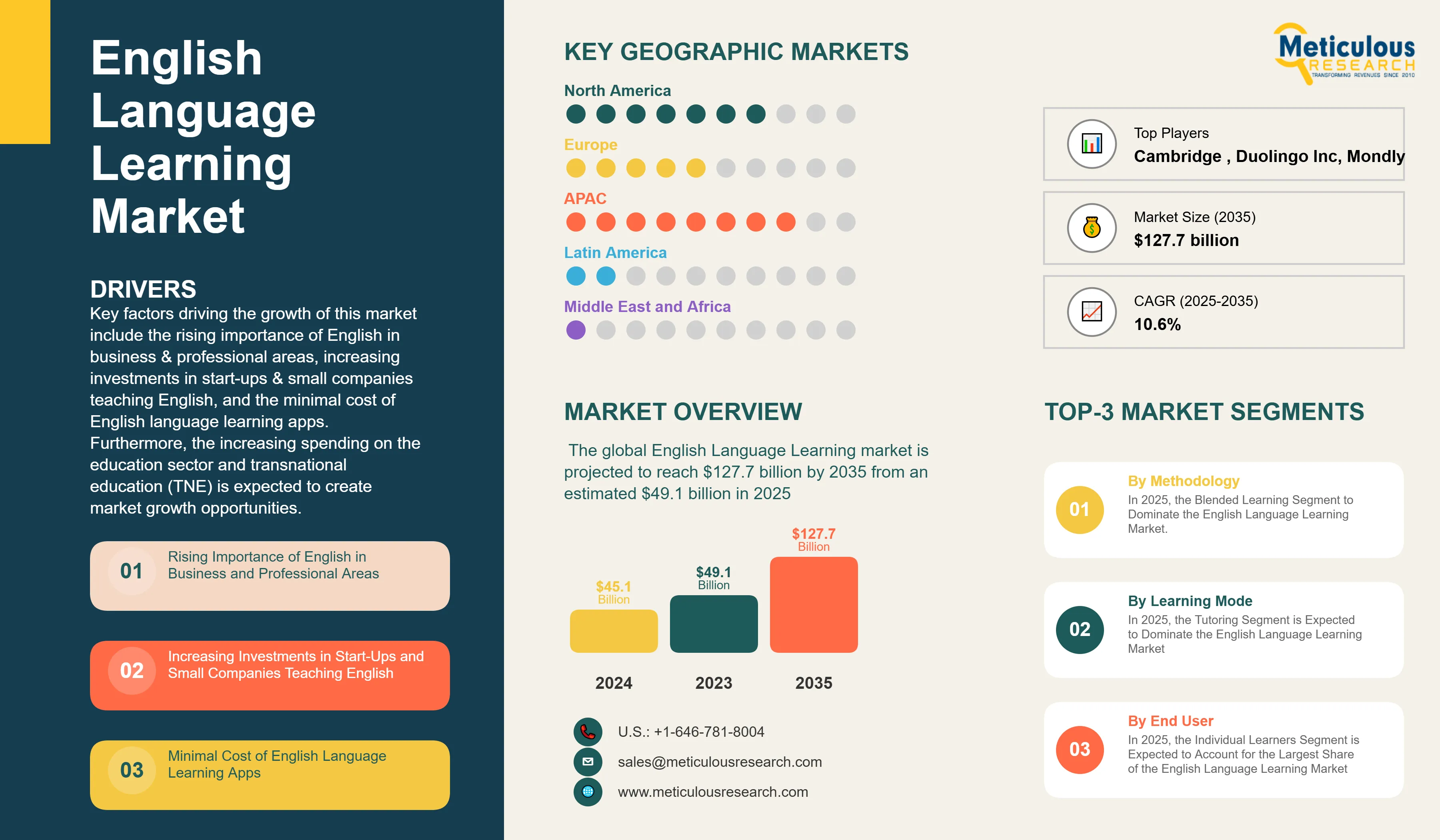
Key factors driving the growth of this market include the rising importance of English in business & professional areas, increasing investments in start-ups & small companies teaching English, and the minimal cost of English language learning apps. Furthermore, the increasing spending on the education sector and transnational education (TNE) is expected to create market growth opportunities.
The rapid digital transformation in education, accelerated by the COVID-19 pandemic, has significantly expanded access to online learning platforms, making English education more accessible to populations in emerging markets where traditional classroom-based instruction was previously limited. Technological advancements, particularly in artificial intelligence and machine learning, are revolutionizing language acquisition through personalized adaptive learning systems, speech recognition tools, and AI-powered tutors that provide instant feedback and customized lesson plans.
Government initiatives in many non-English speaking countries to improve English proficiency among their workforce are further stimulating market growth, as seen in national education reforms across the Middle East and Southeast Asia. The rise of digital nomadism and remote work arrangements has created additional demand for business English and communication skills training. Furthermore, the proliferation of smartphones and improving internet infrastructure in emerging economies has enabled mobile-first learning solutions to reach previously underserved populations, while gamification techniques are enhancing learner engagement and retention rates.
Market Insights
Click here to: Get Free Sample Pages of this Report
- By Methodology: In 2025, the Blended Learning Segment to Dominate the English Language Learning Market.
- By Learning Mode: In 2025, the Tutoring Segment is Expected to Dominate the English Language Learning Market
- By Age Group: In 2025, the 13-17 Years Segment is Expected to Account for the Largest Share of the English Language Learning Market
- By End User: In 2025, the Individual Learners Segment is Expected to Account for the Largest Share of the English Language Learning Market
- By Geography: Asia-Pacific Dominates the English Language Learning Market in 2025
Market Growth Drivers
Increasing Investments in Start-Ups and Small Companies Teaching English
Education start-ups are evolving rapidly to cater to the needs of hundreds of millions of non-English medium students and individual learners for English language training. The global demand for higher education is expected to increase, and nearly 600 million students will be enrolled in universities worldwide by 2040. Many students present a unique opportunity for education start-ups to expand their product portfolio for English language learning platforms. Since the advent of the COVID-19 pandemic, English language learning apps have seen a boom in interest by investors as traditional classroom learning models have been flipped upside down. Alternative language learning companies are attracting investors and reaching “unicorn” status, a term used in the venture capital industry to describe a privately held startup company with a valuation of over USD 1 billion, more frequently than ever before. Several companies, including start-ups, have received investments for accelerating the English language learning platforms. For instance:
- Stimuler (2025) - The AI-powered language learning platform, has secured $3.75Mn in Pre-Series A funding, with participation led by Lightspeed and SWC Global
- Speak (2025)- The AI-powered language learning platform backed by OpenAI, has raised $78 million in a Series C funding round, reaching a valuation of $1 billion.
- ELSA (English Language Speech Assistant) (2024) - This AI-powered pronunciation coach secured $15 million in Series B funding in early 2024 to expand their English pronunciation and fluency platform globally.
- Lingokids (2024) - This educational technology platform focused on English language learning for children secured $40 million in Series C funding in 2024 to enhance their interactive learning content.
- Preply (2024) - This language tutoring marketplace raised $70 million in Series C funding in early 2024 to expand their AI-powered English learning tools and personalized teaching approaches.
- Novakid (2023) - This online English learning platform for children received $35 million in Series B funding in mid-2023 to expand their immersive learning experiences using AI and gamification techniques.
- Cambly (2023) - This platform connecting English learners with native speakers raised $60 million in early 2023 to expand their on-demand tutoring services globally.
- iTutorGroup (2023) - This Asian education technology company received substantial investment from VIPKid in late 2023 to strengthen their online English teaching platform.
Market Trends
Artificial Intelligence & Robot Technology
AI and robot technology are transforming the English language learning market by enabling personalized, efficient, and scalable education. Platforms like Duolingo and ELSA Speak use AI for real-time feedback and adaptive lessons. Robot-assisted tools like Elias offer immersive, teacher-like interaction, especially in regions with limited native instructors. AI chatbots, VR classrooms, and automated assessments are reducing costs and improving access. Despite challenges like privacy concerns and development costs, AI-driven learning continues to gain traction globally across education and corporate training.
E-LEARNING
E-learning is accelerating language learning through flexible, low-cost, and accessible digital platforms. With the rise of internet users and mobile technology, animated and interactive content is enhancing learner engagement. Platforms like the British Council’s myClass Online offer live and self-paced courses with expert guidance. Customized modules, available on-demand, help users manage learning alongside work or personal responsibilities. Distance learning’s adaptability and growing investment in digital education continue to drive e-learning’s expansion across age groups and global markets.
English Language Learning Market...
Emerging Markets & Mobile-First Solutions
Emerging markets like India, Brazil, and Nigeria show rising demand for English skills driven by globalization and digital jobs. Mobile-first learning apps are bridging access gaps caused by limited infrastructure and teacher shortages. With high smartphone adoption, platforms like Hello English and Cake offer gamified, offline-capable learning on low-end devices. Governments and NGOs are also driving growth via digital education partnerships. Voice-based and vernacular tools are gaining popularity, while localized freemium and ad-supported models make learning affordable. These trends are unlocking vast opportunities for scalable, inclusive English education in underserved regions.
Transnational Education (TNE)
Transnational education (TNE) allows students to earn foreign degrees from their home country through partnerships, branch campuses, or virtual programs. Post-pandemic, TNE gained momentum as international mobility declined and institutions sought alternative revenue streams. TNE supports skill development, reduces brain drain, and increases access to quality education without relocation. It benefits professionals seeking flexible upskilling and fosters competition between local and foreign providers. As demand for globally recognized education grows—especially in developing regions—TNE fuels the adoption of English language learning (ELL) tools, creating new opportunities for digital platforms and international academic partnerships.
Market Opportunities
By Methodology: In 2025, the Blended Learning Segment is Expected to Dominate the English Language Learning Market
Based on offering, the global English language learning market is segmented into blended learning, offline learning, and online learning. In 2025, the blended learning segment is estimated to account for the largest share of the global English language learning market. Traditional and digital learning methods offer a complex and diverse learning environment, significantly increasing students’ motivation to learn. Technology advancements and internet access have changed the teaching process for all languages. Blended learning is also known as hybrid learning or mixed learning process. It comprises two or more learning methods: face-to-face teaching and online learning. Additionally, this learning methodology offers many advantages, including learning from independent locations and offering learners the same training opportunities at all locations.
However, the online learning segment is projected to register the highest CAGR during the forecast period. The rapid growth of this segment is driven by the increasing user base for mobile phones, the growing digitalization in the education sector, the increasing budget allocations and investments for E-learning programs, and the emergence of new online learning platforms after the COVID-19 pandemic. With the emergence of new technologies and improved digital tools and techniques online, English learning is gaining significant traction.
By Age Group: The 13-17 Years Segment Is Expected to Dominate the English Language Learning Market
Based on age group, the global English language learning market is segmented into 40 years. In 2025, the 13-17 years segment is expected to account for the largest share of of the global English language learning market. The large market share of this segment is attributed to the increasing digitization of public schools, the rising number of English learners, the significant increase in smartphone users, the increasing demand for kids' learning apps, the rising preference for interactive and engaging learning experiences, and increasing need for immersive and practical language practice.
By End User: The Individual Learners Segment is Expected to Dominate the English Language Learning Market
Based on end user, the global English language learning market is segmented into individual learners, educational institutes, government bodies, and corporate learners. The educational institutes is further segmented into K-12, and higher education. In 2025, the individual learners segment is expected to account for the largest share of the global English language learning market. Also, this segment is expected to register the highest CAGR during the forecast period. The large share of this market is attributed to the increasing adoption of smart devices coupled with faster internet penetration, the growing need for transmission of live content on the internet for better brand engagement and student reach, and the high number of established language learning sites.
Geographical Analysis
Asia-Pacific Dominates the English Language Learning Market in 2025
In 2025, Asia-Pacific is estimated to account for the largest share of the global English language learning market. The large market share of this market is attributed to the increasing digitalization of educational content, increasing demand for language skills to work and collaborate across borders, wide availability of E-learning courses, and growing popularity of English learning programs in the region, growing Internet penetration, increasing government focus on education through various initiatives, and the growing need to enhance employability and competitiveness in the future job opportunities.
Moreover, the market in Asia-Pacific is also projected to register the highest CAGR during the forecast period.
Key Companies
The report includes a competitive landscape based on an extensive assessment of the key growth strategies adopted by key market players over the past three years (2022-2025). The key players profiled in the global English language learning market report are Cambridge University Press (U.K.), New Oriental Education & Technology Group Inc. (China), Houghton Mifflin Harcourt Company (U.S.), McGraw-Hill Education, Inc. (U.S.), Duolingo Inc. (U.S.), Berlitz Corporation (U.S.), Busuu Online S.L. (Spain), Babble GMBH (Germany), Linguistica 360, Inc. (U.S.), Mondly (Romania), ELSA Corp. (U.S.), FluentU (A part of Enux Education Limited) (China), Memrise Inc. (U.K.), Mango Languages (U.S.), Rosetta Stone Ltd. (A part of IXL Learning, Inc.) (U.S.), Inlingua International Ltd. (Switzerland), Sanako Corporation (Finland), Transparent Language, Inc. (U.S.), and Open Education LLC (U.S.).
Market Research Summary
|
Particulars |
Details |
|
Number of Pages |
295 |
|
Format |
|
|
Forecast Period |
2025–2035 |
|
Base Year |
2024 |
|
CAGR (Value) |
10.0% |
|
Market Size (Value) |
USD 127.7 Billion by 2035 |
|
Segments Covered |
Global English Language Learning Market, by Methodology
Global English Language Learning Market, by Learning Mode
Global English Language Learning Market, by Age Group
Global English Language Learning Market, by End User
|
|
Countries Covered |
North America (U.S., Canada), Europe (Germany, U.K., France, Italy, Spain, Russia, Poland, Netherlands, Belgium, Sweden, Austria, Switzerland, Finland, Norway, Turkey, Ireland, Luxembourg, and Rest of Europe), Asia-Pacific (China, Japan, South Korea, India, Indonesia, Australia & New Zealand, Taiwan, Hongkong, Singapore, Malaysia, Vietnam, Rest of Asia-Pacific), Latin America (Brazil, Mexico, Rest of Latin America), and the Middle East & Africa (UAE, Saudi Arabia, Rest of Middle East & Africa) |
|
Key Companies |
Cambridge University Press (U.K.), New Oriental Education & Technology Group Inc. (China), Houghton Mifflin Harcourt Company (U.S.), McGraw-Hill Education, Inc. (U.S.), Duolingo Inc. (U.S.), Berlitz Corporation (U.S.), Busuu Online S.L. (Spain), Babble GMBH (Germany), Linguistica 360, Inc. (U.S.), Mondly (Romania), ELSA Corp. (U.S.), FluentU (A part of Enux Education Limited) (China), Memrise Inc. (U.K.), Mango Languages (U.S.), Rosetta Stone Ltd. (A part of IXL Learning, Inc.) (U.S.), Inlingua International Ltd. (Switzerland), Sanako Corporation (Finland), Transparent Language, Inc. (U.S.), and Open Education LLC (U.S.). |
Frequently Asked Questions
Related Tags
How We Built This Intelligence
Table of Contents
Expand allAccess & Licensing
Choose how you access this intelligence — from a standalone data pack to organization-wide access. Every option is delivered within 24–48 hours and backed by analyst support.
Related Statistics & Insights
Need something more specific?
A custom-scoped study can target a single segment, geography, or competitor set — or answer a board-level question this syndicated report doesn't. Tell an analyst what decision you're making and we'll scope it.