- Home
- Reports
- Food and Beverages
- Dietary Supplements Market
Dietary Supplements Market Size, Share, Forecast, & Trends Analysis by Type (Botanicals, Minerals, Enzymes), Form (Tablets, Capsules, Liquid), Function (Medical, Sport Nutrition), End User (Infants, Adults), Distribution Channel - Global Forecast to 2032
Market Overview
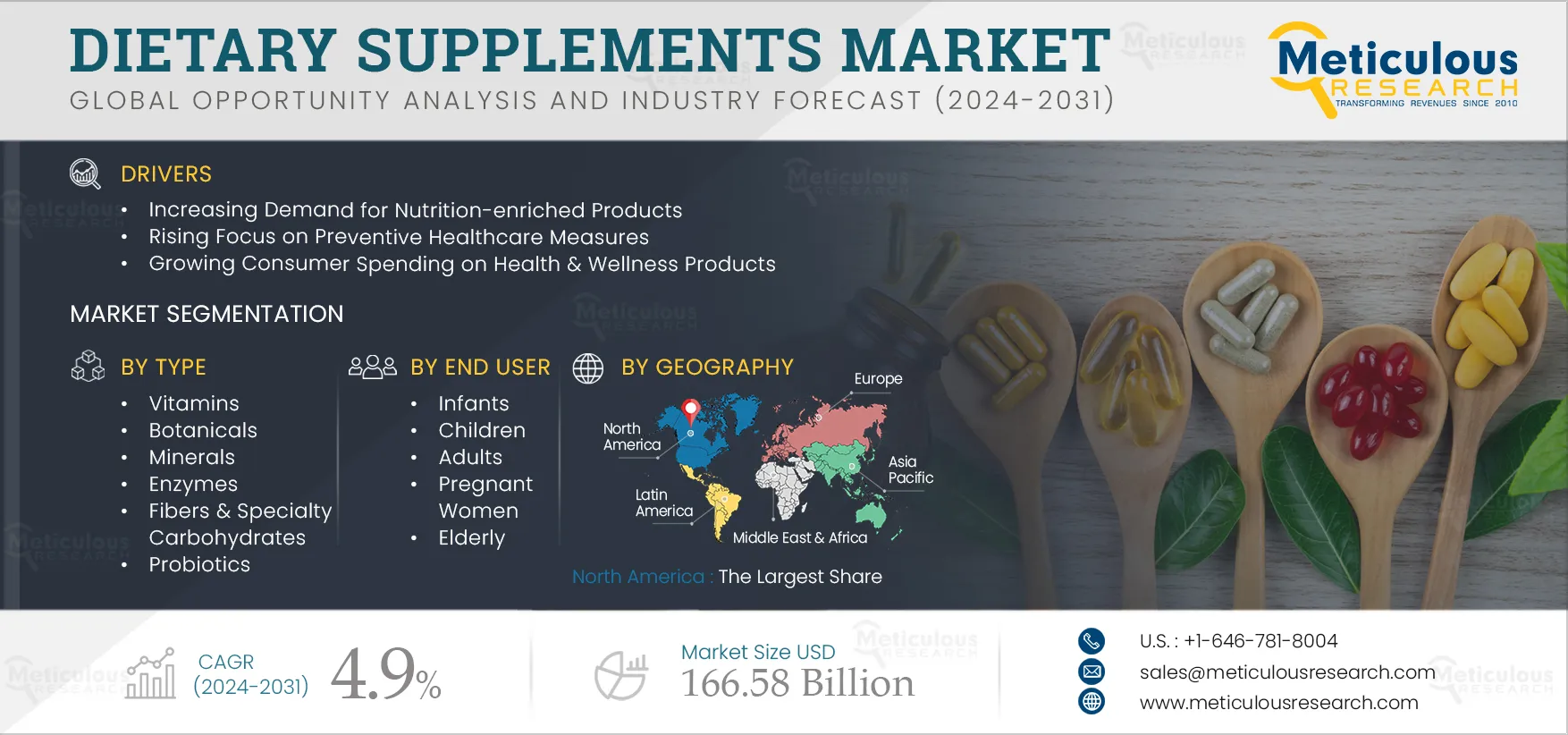
The growth of this market is driven by the escalating demand for nutrition-enhanced products, an increased emphasis on preventive healthcare strategies, rising consumer expenditure on health and wellness items, and a growing geriatric population alongside a higher incidence of chronic diseases. Furthermore, technological innovations in dietary supplements and a rising preference for plant-based alternatives are anticipated to generate growth opportunities within the market.
Key Findings
- By Type: In 2025, the Vitamins Segment is Anticipated to Dominate the Dietary Supplements Market
- By Form: In 2025, the Tablets Segment is Anticipated to Dominate the Dietary Supplements Market
- By Function: In 2025, the Additional Supplements Anticipated is Expected to Dominate the Dietary Supplements Market
- By End User: In 2025, the Adults Segment is Anticipated to Account for the Largest Share of the Dietary Supplements Market
- By Distribution Channel: In 2025, the Pharmacies & Drug Stores Segment is Anticipated to Account for the Largest Share of the Dietary Supplements Market
- By Geography: North America to Dominate the Dietary Supplements Market in 2025
Market Trends
Rising Focus on Preventive Healthcare Measures
Preventive healthcare measures are significantly driving the demand for dietary supplements. As the focus on preventing chronic diseases and sustaining long-term health intensifies, consumers are increasingly adopting supplements as a proactive strategy to enhance their immune systems, support cardiovascular health, and address various wellness concerns. With a growing awareness of the importance of maintaining optimal nutrient levels, more individuals are integrating vitamins, minerals, probiotics, and other nutrients into their daily routines to mitigate illness risks and promote overall well-being.
Moreover, this shift toward preventive healthcare is boosted by increasing awareness of lifestyle-related diseases such as obesity, diabetes, and cardiovascular conditions, which are frequently associated with inadequate nutrition and sedentary lifestyles. As a result, individuals are seeking convenient and effective solutions to manage their health proactively. Dietary supplements provide targeted approaches for addressing specific deficiencies and supporting particular health objectives, making them an attractive option for those focused on long-term preventive health strategies. This rising demand for supplements that align with preventive care is significantly contributing to the growth of the dietary supplements market.
Increasing Demand for Sports Nutrition Supplements
Sports nutrition supplements are formulated to enhance the physical performance and recovery of athletes and active individuals. These products typically include a range of ingredients such as carbohydrates, electrolytes, and amino acids, which work together to replenish energy levels and support muscle recovery.
Additionally, the demand for sports nutrition supplements is rapidly growing, driven by their ability to enhance performance and endurance, enabling athletes to engage in vigorous training. The increasing number of athletes and sports participants, particularly in developing countries, is a significant factor contributing to market growth during the forecast period. For example, the National Collegiate Athletic Association (NCAA) reported a substantial rise in participation, with approximately 532,000 students competing in NCAA championship sports in the 2022–2024 season—an increase of over 25,000 since the 2017–2018 period.
Moreover, the increasing interest of the millennial population in fitness and physical activities, coupled with their rising purchasing power, is significantly driving the demand for sports nutrition supplements. The emergence of direct-to-consumer (D2C) brands and the growth of sales through various distribution channels, including supermarkets, hypermarkets, and e-commerce platforms, are further contributing to market expansion. Consequently, these factors are expected to enhance the sports nutrition supplements market, which is poised to elevate the overall demand for dietary supplements in the coming years.
Click here to: Get Free Sample Pages of this Report
Dietary Supplements Market Oppor...
Technological Advancements in the Dietary Supplements Industry
Technological advancements in the dietary supplements industry are transforming product formulation, manufacturing, and delivery methods. Innovations such as nanotechnology and microencapsulation are improving the bioavailability of nutrients, ensuring that vitamins, minerals, and other active ingredients are absorbed more effectively by the body. These technologies facilitate controlled-release formulas that provide sustained nutrient delivery, enhancing the efficacy of supplements. Furthermore, advanced extraction techniques allow manufacturers to obtain high-purity ingredients from natural sources, significantly boosting the quality and potency of dietary supplements.
Moreover, digitalization and artificial intelligence (AI) are transforming the production and personalization of dietary supplements. AI-driven algorithms analyze individual health data, including genetic information and lifestyle factors, to recommend tailored supplement regimens that address specific health needs. This move toward personalized nutrition reflects the growing consumer demand for products aligned with their unique health objectives. At the manufacturing level, technologies such as blockchain are being utilized to enhance transparency in ingredient sourcing and quality control, thereby building greater consumer trust. Consequently, these technological advancements in the dietary supplements sector are anticipated to create substantial growth opportunities for market participants.
Market Opportunities
The Vitamins Segment is Expected to Dominate the Dietary Supplements Market in 2025
Based on type, the dietary supplements market is segmented into vitamins, botanicals, minerals, proteins & amino acids, enzymes, fibers & specialty carbohydrates, omega-3 fatty acids, probiotics, and other types. In 2025, the vitamins segment is expected to account for the largest share of the dietary supplements market. The significant market share of this segment is largely attributed to the crucial role vitamins play in maintaining overall health and well-being. Consumers are increasingly incorporating vitamin products into their daily routines to ensure they meet their nutritional needs. Vitamins offer a convenient solution for individuals to obtain essential nutrients that support immune function, energy levels, and overall wellness.
Additionally, vitamins in dietary supplements address specific health concerns and play a key role in long-term health maintenance. For example, B-complex vitamins are vital for energy production and cognitive function, making them especially beneficial for individuals dealing with fatigue or mental fog. Antioxidant vitamins such as A, C, and E help protect the body from oxidative stress and support skin health, promoting a youthful appearance and reducing the risk of chronic diseases. The versatility of vitamins, their capacity to address both general wellness and specific deficiencies, and their availability in various forms make them a valuable component of dietary supplements.
However, the botanicals segment is slated to register the highest CAGR during the forecast period. This trend is driven by the natural health benefits of botanical supplements and the growing consumer interest in plant-based remedies. These supplements provide a variety of health advantages, including antioxidant properties, immune support, and stress relief, attracting consumers who seek holistic and alternative healthcare solutions. Additionally, the increasing prevalence of chronic diseases, combined with the advantages of botanical remedies over synthetic drugs—such as a lower risk of adverse side effects—are further supporting the growth of this market segment.
Geographical Analysis
North America Dominates the Dietary Supplements Market in 2025
In 2025, North America is estimated to account for the largest share of the global dietary supplements market. This substantial market share is largely attributed to increased awareness of the health benefits of dietary supplements, rising demand for clean-label products, the growing trend toward veganism, and an increase in health-conscious consumers. Additionally, advancements in nutrition and technology, along with the rising prevalence of lifestyle diseases such as diabetes and obesity, are significant factors driving this market growth.
However, Asia-Pacific is slated to register the highest CAGR during the forecast period. This growth can be attributed to the rising demand for dietary supplements, increased awareness of the health benefits associated with nutritional products, growing disposable incomes, rapid urbanization, and heightened health and wellness trends. Additionally, countries like China, Japan, and India, which have a high prevalence of chronic diseases, are expected to further drive market growth during the forecast period.
Key Companies
The report features a competitive landscape derived from a comprehensive analysis of the key strategic developments that market participants have implemented over the past three years (2021-2025).
The key players profiled in the dietary supplements market report are Amway Corporation (U.S.), Glanbia plc (Ireland), Abbott Laboratories (U.S.), Pfizer Inc. (U.S.), Nestlé S.A. (Switzerland), Archer-Daniels-Midland Company (U.S.), Bayer AG (Germany), Otsuka Holdings Co., Ltd. (Japan), Nu Skin Enterprises, Inc. (U.S.), GSK plc (U.K.), Herbalife International of America Inc. (U.S.), Nature's Bounty (U.S.), RBK Nutraceuticals Pty Ltd (Australia), Suntory Holdings Limited (Japan), and Pharmavite LLC (U.S.).
Dietary Supplements Industry Overview: Latest Developments from Key Industry Players
- In April 2025, Nestlé India and Dr. Reddy’s Laboratories Ltd. entered into a definitive agreement to establish a joint venture aimed at introducing innovative nutraceutical brands to consumers in India and other designated regions. This partnership will leverage the strengths of both companies to expand their complementary nutraceutical portfolios across categories, including metabolic health, hospital nutrition, general wellness, women’s health, and child nutrition for consumers throughout India.
- In January 2025, Abbott launched its new PROTALITY brand. The PROTALITY brand provides nutritional support for adults pursuing weight loss in the form of a high-protein nutrition shake featuring a blend of fast- and slow-digesting protein designed to feed muscles for up to seven hours.
- In December 2022, Amway launched its Singapore Business Innovation Hub in the Central Business District in collaboration with the Singapore Economic Development Board (EDB), marking a strategic expansion in the region. This new hub will enable Amway to leverage Singapore’s robust talent pool to enhance product innovation globally, addressing the evolving wellness needs of both global and regional consumers. It will serve as a springboard for the company’s next phase of strategic growth in Asia.
- In May 2022, Nestlé Health Science acquired Puravida, a premium Brazilian nutrition and health lifestyle brand. The acquisition will enable NHSc to expand its consumer health portfolio in Brazil.
- In February 2022, Amway India launched nutrition supplements in gummies and jelly strips. This new range of on-the-go nutrition supplements strengthens Amway’s nutrition portfolio.
- In November 2021, Archer-Daniels-Midland Company acquired Deerland Probiotics & Enzymes (U.S.). With this acquisition, the company strengthened its position in dietary supplements and functional foods.
Market Research Summary
|
Particulars |
Details |
|
Number of Pages |
~250 |
|
Format |
|
|
Forecast Period |
2025–2032 |
|
Base Year |
2025 |
|
CAGR (Value) |
4.9% |
|
Market Size (Value) |
USD 166.58 Billion by 2032 |
|
Segments Covered |
By Type
By Form
By Function
By End User
By Distribution Channel
|
|
Countries Covered |
North America (U.S., Canada), Europe (Germany, France, U.K., Italy, Spain, Poland, Netherlands, Belgium, and Rest of Europe), Asia-Pacific (China, Japan, India, South Korea, Australia, Indonesia, Malaysia, Thailand, Singapore, and Rest of Asia-Pacific), Latin America (Brazil, Mexico, Argentina, and Rest of Latin America), and the Middle East & Africa (Saudi Arabia, South Africa, UAE, and Rest of Middle East & Africa) |
|
Key Companies |
Amway Corporation (U.S.), Glanbia plc (Ireland), Abbott Laboratories (U.S.), Pfizer Inc. (U.S.), Nestlé S.A. (Switzerland), Archer-Daniels-Midland Company (U.S.), Bayer AG (Germany), Otsuka Holdings Co., Ltd. (Japan), Nu Skin Enterprises, Inc. (U.S.), GSK plc (U.K.), Herbalife International of America Inc. (U.S.), Nature's Bounty (U.S.), RBK Nutraceuticals Pty Ltd (Australia), Suntory Holdings Limited (Japan), and Pharmavite LLC (U.S.) |
Frequently Asked Questions
Related Tags
How We Built This Intelligence
Table of Contents
Expand allAccess & Licensing
Choose how you access this intelligence — from a standalone data pack to organization-wide access. Every option is delivered within 24–48 hours and backed by analyst support.
Related Statistics & Insights
Need something more specific?
A custom-scoped study can target a single segment, geography, or competitor set — or answer a board-level question this syndicated report doesn't. Tell an analyst what decision you're making and we'll scope it.