- Home
- Reports
- Chemicals and Materials
- Cleaning Products Market
Cleaning Products Market Size, Share, Forecast, & Trends Analysis by Type (Laundry Care Products, Household Cleaners, Dishwashing Products), Distribution Channel (Supermarkets & Hypermarkets, Convenience Stores, E-commerce) - Global Forecast to 2032
Market Overview
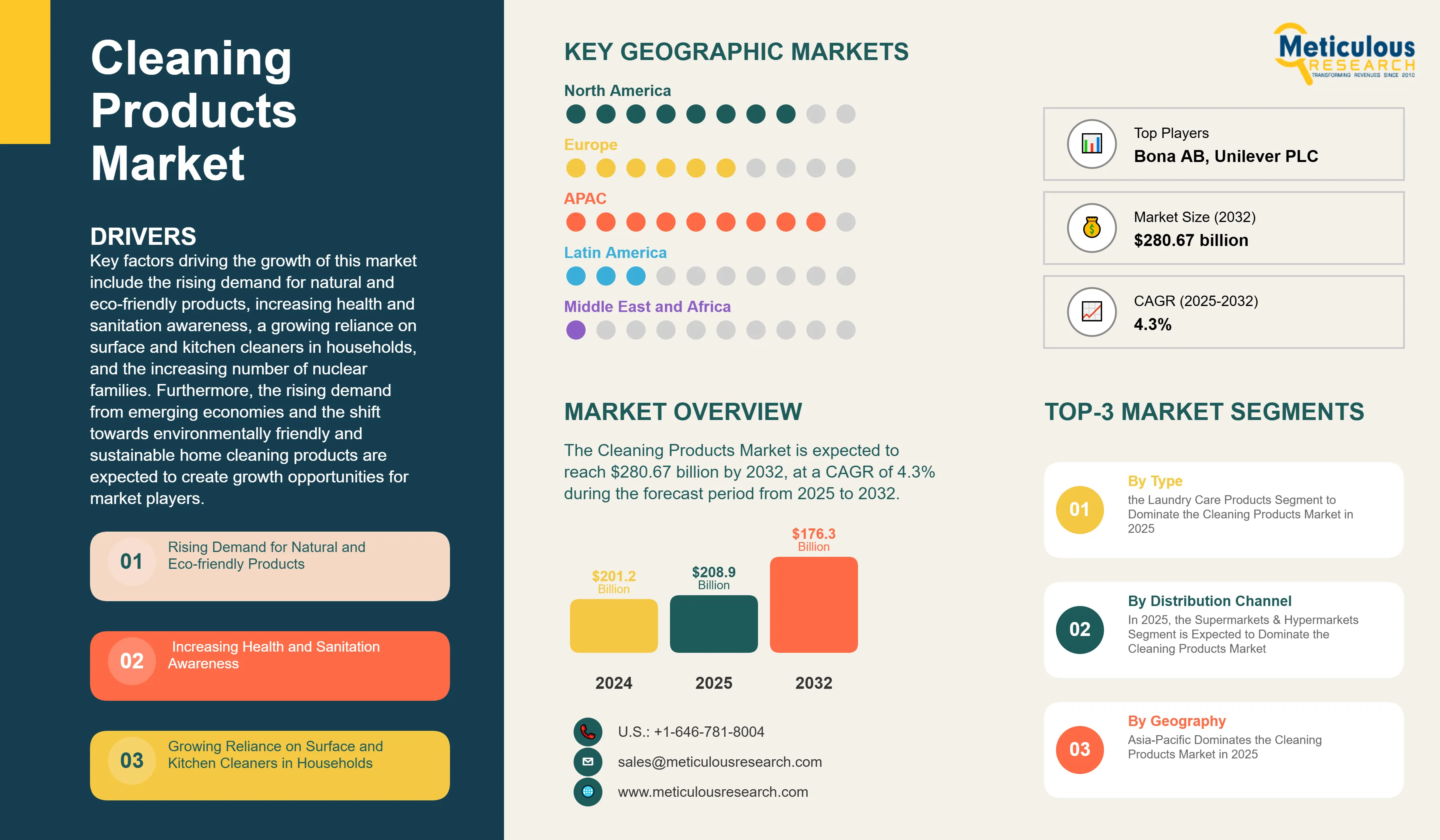
Key factors driving the growth of this market include the rising demand for natural and eco-friendly products, increasing health and sanitation awareness, a growing reliance on surface and kitchen cleaners in households, and the increasing number of nuclear families. Furthermore, the rising demand from emerging economies and the shift towards environmentally friendly and sustainable home cleaning products are expected to create growth opportunities for market players.
Key Findings
- By Type: the Laundry Care Products Segment to Dominate the Cleaning Products Market in 2025
- By Distribution Channel: In 2025, the Supermarkets & Hypermarkets Segment is Expected to Dominate the Cleaning Products Market
- By Geography: Asia-Pacific Dominates the Cleaning Products Market in 2025
Market Growth Drivers

Click here to: Get Free Sample Pages of this Report
Rising Demand for Natural and Eco-friendly Products
Consumers are increasingly prioritizing eco-friendly and non-toxic alternatives due to both health and environmental concerns. As awareness grows about the harmful effects of synthetic chemicals commonly found in cleaning products, many consumers are shifting toward natural and organic formulations that are free from harsh chemicals, parabens, and synthetic fragrances. These natural products, often made with ingredients like plant-based extracts, essential oils, and biodegradable compounds, appeal to health-conscious consumers concerned about the potential risks of conventional cleaning products. This trend is particularly strong among families with young children, pets, or individuals with sensitive skin or allergies who seek cleaning solutions that are both gentle and effective without compromising safety.
In addition to health considerations, environmental concerns are driving the growing preference for natural cleaning products. Many consumers are opting for biodegradable cleaning agents that break down without harming the environment, as well as products packaged in recyclable or eco-friendly materials. This shift toward sustainability is fostering the growth of green cleaning brands and encouraging innovation in environmentally responsible product development. Moreover, major cleaning product manufacturers are increasingly introducing plant-based and eco-friendly alternatives to meet rising demand, further expanding the market for natural cleaning products and contributing to the overall growth of the cleaning products market.
Cleaning Products Market Opportu...
Rising Demand from Emerging Economies
Emerging economies are experiencing rapid urbanization, rising disposable incomes, and improved standards of living. As populations in countries like China, India, Brazil, and parts of Southeast Asia continue to grow, the demand for household cleaning products is increasing, driven by consumers' desire to maintain cleaner and healthier living environments. In many of these emerging markets, the importance of hygiene and cleanliness is becoming more ingrained, fueled by changing lifestyles, greater exposure to global media, and a growing emphasis on health and wellness. This heightened awareness of hygiene, coupled with the demand for convenience, especially in urban areas, is leading to a surge in the consumption of both basic and specialized cleaning products, such as disinfectants, surface cleaners, laundry detergents, and air fresheners.
Furthermore, as the middle class in these economies expands, there is a noticeable shift toward premium and branded cleaning products. Consumers in emerging markets are increasingly willing to invest in products that offer superior effectiveness, ease of use, and advanced cleaning capabilities. This creates significant opportunities for international cleaning brands to expand their presence by introducing products tailored to local preferences and needs. Additionally, as these economies continue to grow, the demand for commercial cleaning products is also increasing, particularly with the expansion of sectors like retail, hospitality, and healthcare.
For companies in the cleaning products industry, entering these emerging markets presents a lucrative growth opportunity. By tapping into a large, underserved market, companies can meet the unique needs of consumers in these regions while benefiting from the ongoing economic growth and changing consumption behaviors.
Market Opportunities
By Type: In 2025, the Laundry Care Products Segment is Expected to Dominate the Cleaning Products Market
Based on type, the cleaning products market is segmented into laundry care products, household cleaners, dishwashing products, and other cleaning products. In 2025, the laundry care products segment is expected to account for the largest share of the cleaning products market. This segment's large market share is attributed to rising consumer preference for convenience, product effectiveness, and an increasing focus on hygiene. Consumers are seeking laundry solutions that save time and effort, such as highly efficient detergents, stain removers, and fabric softeners. The growing popularity of multi-functional products, like detergent pods and all-in-one laundry solutions, further boosts this demand, as these products offer added convenience and performance in a single item.
However, the household cleaners segment is expected to register the highest CAGR during the forecast period. This growth is primarily driven by increasing consumer awareness about the importance of maintaining sanitized and germ-free living spaces, which has accelerated the adoption of household cleaning products. Consumers are increasingly seeking disinfectants, sanitizers, and surface cleaners that can effectively eliminate viruses, bacteria, and allergens. This demand is further fueled by heightened health concerns, particularly in households with young children, elderly members, or individuals with respiratory conditions, who may be more vulnerable to illness.
Geographical Analysis
Asia-Pacific Dominates the Cleaning Products Market in 2025
In 2025, Asia-Pacific is expected to account for the largest share of the global cleaning products market. Asia-Pacific’s large market share can be attributed to the increasing demand for household cleaning products, rising investment in R&D for eco-friendly products, and supportive initiatives and incentives for foreign businesses entering the market. Additionally, factors such as a large and rapidly growing population, rising disposable incomes, and evolving consumer lifestyles are further contributing to market growth.
Despite the region’s large market share, there is a growing preference for natural cleaning products, driven by increased awareness of the environmental and health risks associated with hazardous chemicals. As a result, local manufacturers are introducing more bio-friendly products to tap into the emerging demand for sustainable and eco-friendly cleaning solutions.
However, North America is expected to record the highest CAGR during the forecast period. This growth is driven by the development of high-quality cleaning products, increasing sanitary requirements, and the high standard of living among consumers. Additionally, growing consumer awareness regarding the benefits of advanced cleaning technologies and formulations—such as those with antimicrobial properties or eco-friendly credentials—further supports this demand.
Key Companies
The report includes a competitive landscape based on an extensive assessment of the key growth strategies adopted by leading market players over the past three years (2021-2025).
The key players profiled in the global cleaning products market report are Church & Dwight Co., Inc. (U.S.), Colgate-Palmolive Company (U.S.), Henkel AG & Co. KGaA (Germany), Kao Corporation (Japan), The Procter & Gamble Company (U.S.), Reckitt Benckiser Group plc (U.K.), Unilever PLC (U.K.), The Clorox Company (U.S.), McBride plc (U.K.), Kimberly-Clark Corporation (U.S.), Freudenberg Group (Germany), S.C. Johnson & Son Inc. (U.S.), Saraya Goodmaid Sdn. Bhd. (Malaysia), and Bona AB (Sweden).
Cleaning Products Industry Overview: Latest Developments from Key Industry Players
- In August 2025, Unilever launched a new Sunlight dishwashing liquid that delivers superior performance while using 100% plant-based, renewable, and biodegradable cleaning ingredients.
- In May 2025, Procter & Gamble expanded its Laundry Care lineup with Tide Professional Commercial Laundry Detergent and Downy Professional Fabric Softener. The launch of Tide Professional and Downy Professional will help businesses across industries manage their laundry more efficiently, saving time while ensuring a quality clean.
- In January 2024, Henkel and Shell Chemical LP (U.S.) signed a five-year collaboration agreement to replace up to 200,000 tonnes of fossil feedstocks used in the manufacture of surfactants with renewable raw materials. The renewable-based surfactants will be incorporated into Henkel’s laundry product brands, including Persil, Purex, and all related brands.
- In March 2022, Henkel and BASF SE (Germany) committed to replacing fossil carbon feedstock with renewable feedstock for most products in Henkel’s European Laundry & Home Care and Beauty Care businesses over the next four years. This follows a successful pilot program with Henkel’s cleaning and detergent brand, Love Nature, in 2021.
Market Research Summary
|
Particulars |
Details |
|
Number of Pages |
~300 |
|
Format |
|
|
Forecast Period |
2025–2032 |
|
Base Year |
2024 |
|
CAGR (Value) |
4.3% |
|
Market Size (Value) |
USD 280.67 Billion by 2032 |
|
Segments Covered |
By Type
By Distribution Channel
|
|
Countries Covered |
North America (U.S., Canada), Europe (Germany, U.K., France, Italy, Spain, Poland, Austria, Switzerland, Netherlands, Belgium, Rest of Europe), Asia-Pacific (China, Japan, India, Australia, South Korea, Indonesia, Malaysia, Thailand, Vietnam, Singapore, Philippines, Rest of Asia-Pacific), Latin America (Brazil, Mexico, Argentina, Rest of Latin America), and the Middle East & Africa (Saudi Arabia, South Africa, UAE, Rest of Middle East & Africa) |
|
Key Companies |
Church & Dwight Co., Inc. (U.S.), Colgate-Palmolive Company (U.S.), Henkel AG & Co. KGaA (Germany), Kao Corporation (Japan), The Procter & Gamble Company (U.S.), Reckitt Benckiser Group plc (U.K.), Unilever PLC (U.K.), The Clorox Company (U.S.), McBride plc (U.K.), Kimberly-Clark Corporation (U.S.), Freudenberg Group (Germany), S.C. Johnson & Son Inc. (U.S.), Saraya Goodmaid Sdn. Bhd. (Malaysia), and Bona AB (Sweden). |
Frequently Asked Questions
Related Tags
How We Built This Intelligence
Table of Contents
Expand allAccess & Licensing
Choose how you access this intelligence — from a standalone data pack to organization-wide access. Every option is delivered within 24–48 hours and backed by analyst support.
Related Statistics & Insights
Need something more specific?
A custom-scoped study can target a single segment, geography, or competitor set — or answer a board-level question this syndicated report doesn't. Tell an analyst what decision you're making and we'll scope it.