Information and Communications TechnologyReport ID: MR-937Jan 2025300 PagesGlobal
Verified by the Meticulous Standard·Last verified: May 2026 by Aniket Hade

Asia-Pacific Smart Home Market by Type (Smart Lightning Systems, Smart Speakers, Smart Home Healthcare Systems, Smart Furniture, Smart Kitchen Appliances, Smart Entertainment Systems), Protocols (Wireless, Wired, Hybrid), and Geography - Forecast to 2032

Published Date: Jan 2025
Format: PDF + Excel + Cloud Portal
Pages / Size: 300 Pages
Analyst: Aniket Hade
Secure checkout · Full methodology disclosure · Underwritten by lead analyst Aniket Hade
Asia-Pacific Smart Home Market Size
Asia-Pacific Smart Home Market Sizing & Sourcing
Base year: 2025 · CAGR: 7.2%
$5.86B
Market size 2025
$6.42B
Market size 2026
$12.84B
Forecast by 2036
7.2%
CAGR 2026–2036

The Asia-Pacific Smart Home Mark...

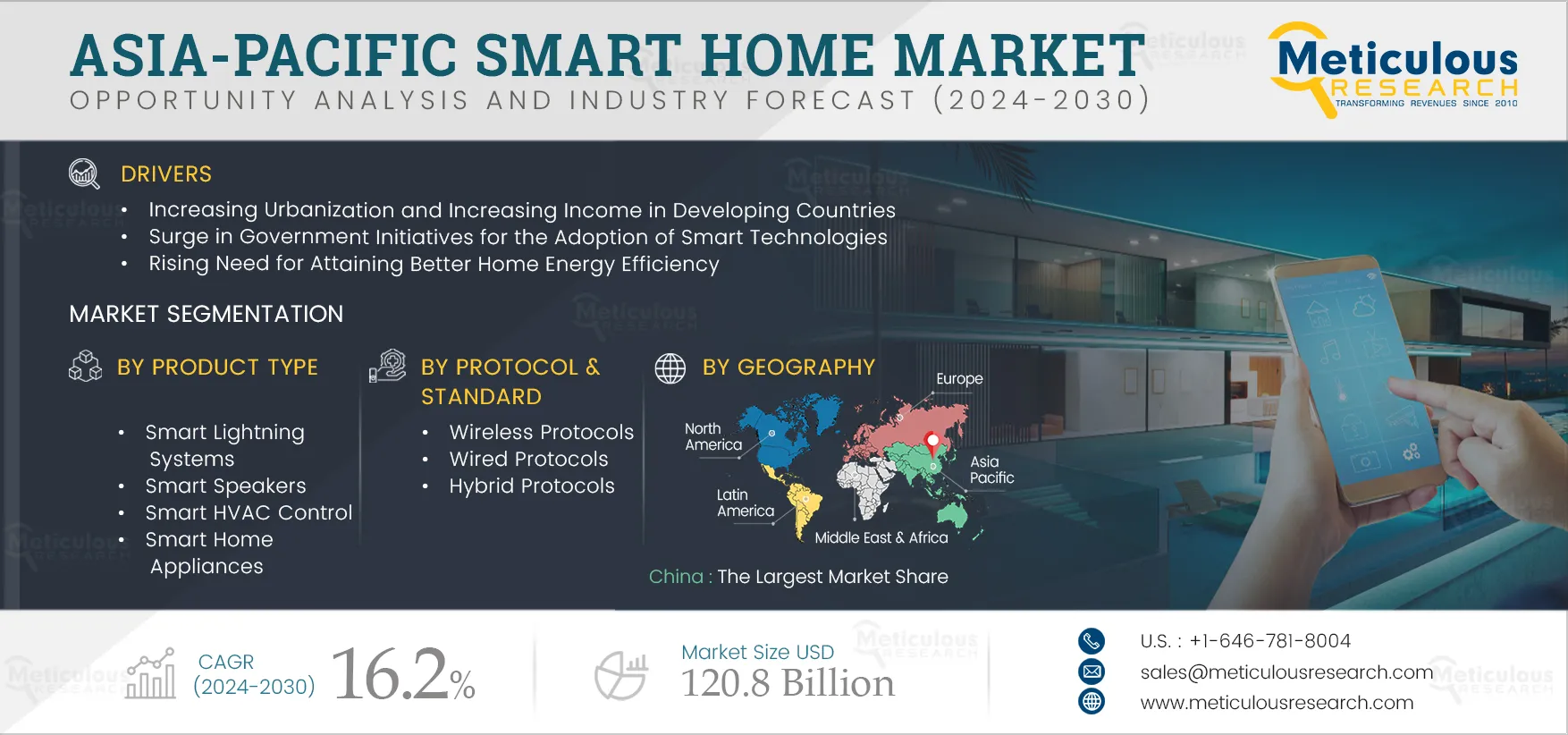
The growth of this market is attributed to the increasing urbanization, the increasing income in developing countries, the surge in government initiatives for the adoption of smart technologies, and the rising need for attaining better home energy efficiency. In addition, the increasing need for flexibility & customization of home appliances & devices for consumers is expected to offer significant opportunities for the growth of this market.

However, the high cost of smart home devices hampers the growth of this market. In addition, compatibility concerns with old infrastructure is a major challenge to the growth of this market.

Increasing Urbanization and the...

Many countries in Asia-Pacific are experiencing rapid urbanization, with a growing urban population. Urban dwellers are more likely to invest in smart home technology to enhance convenience and security in their home. The convergence of these trends has led to changing lifestyles, higher consumer expectations, and the desire for convenience and efficiency. Improvements in internet infrastructure and the widespread availability of affordable high-speed internet have made it easier for residents to connect and control smart devices in their home.

As urban areas become more densely populated, living spaces often become smaller. Smart home technologies offer solutions to optimize space utilization and enhance comfort. For example, in cities like Tokyo and Hong Kong, where space is at a premium, residents are adopting smart furniture and appliances that are equipped with sensors and controls that allow users to adjust the mattress firmness, monitor sleep patterns, and even set alarms that wake you up at the optimal point in your sleep cycle.

Furthermore, smart home technologies offer unparalleled convenience and energy efficiency. Busy urban lifestyles in countries like South Korea and Singapore have demanded seamless home automation. Residents can remotely control lighting, heating, cooling, security systems, and appliances, resulting in optimized energy consumption and cost savings. The influence of technology-centric cultures such as South Korea and Japan has paved the way for the adoption of innovative smart home products and encouraged neighboring countries to follow suit. Overall, the combination of urbanization, rising income, technological advancements, and changing lifestyle preferences in developing countries has created a favorable environment for the adoption of smart home technologies. The smart home market will likely experience further growth and innovation as these trends continue.
Asia-Pacific Smart Home Market

Click here to: Get Free Sample Pages of this Report

Key Findings in the Asia-Pacific...

In 2025, the Smart Security & Monitoring Systems Segment is Expected to Dominate the Asia-Pacific Smart Home Market

Based on product type, the Asia-Pacific smart home market is segmented into smart lighting systems, smart speakers, smart HVAC control, smart security & monitoring systems, smart entertainment systems, smart home appliances, smart kitchen appliances, smart home healthcare systems, and smart furniture. In 2025, the smart security & monitoring systems segment is expected to account for the largest share of the Asia-Pacific smart home market. Smart security cameras, interfaces, and smart locks & access control are gaining momentum due to rising demand for safety & security among the residents. A significant reduction in the cases of home break-ins and burglary owing to smart security & monitoring systems is also encouraging consumers to incorporate such systems, driving the segment's growth. However, the smart speakers segment is projected to register the highest CAGR during the forecast period.

Segment Analysis

Based on protocols & standards, the Asia-Pacific smart home market is segmented into wireless protocols, wired protocols, and hybrid protocols. In 2025, the wireless protocols & standards segment is expected to account for the largest share of the Asia-Pacific smart home market. The large market share of this segment is attributed to its reliability compared to other protocols & standards, offering fast and protected platforms to ensure network connectivity and compatibility with a wide range of devices. Wireless protocols typically comprise ZigBee, WI-FI, Bluetooth, and others. Among these, ZigBee is the most preferred wireless protocol used for modern-day smart home systems owing to its multiple connections simultaneously as it has a large number of nodes. However, the hybrid protocols & standards segment is projected to register the highest CAGR during the forecast period.

In 2025, China is Expected to Do...

Based on country, the Asia-Pacific smart home market is segmented into China, Japan, India, South Korea, Australia & New Zealand, Indonesia, Thailand, Vietnam, Malaysia, Singapore, Philippines, and the Rest of Asia-Pacific. In 2025, China is expected to account for the largest market share owing to the presence of many local players in this market that are increasingly launching consumer-focused and affordable smart home devices for the consumers in the country and strong penetration of technologies including AI, Internet of Things (IoT), and smartphones which is a basic requirement for the proliferation of smart home devices, rising demand for smart home solutions such as smart speakers, and energy efficiency systems. However, India is projected to register the highest CAGR during the forecast period.

Key Companies

The report includes a competitive landscape based on an extensive assessment of the key growth strategies adopted by the leading market participants in the Asia-Pacific smart home market between 2020 and 2025. The key players profiled in the Asia-Pacific smart home market report are Sony Corporation (Japan) Amazon.com, Inc. (U.S.), Samsung Electronics Co., Ltd. (South Korea), Apple, Inc. (U.S.), Siemens AG (German), Axis Communications AB (Sweden), Honeywell International Inc. (U.S.), Johnson Controls International plc (U.S.), Schneider Electric SE (France), LG Electronics Inc. (South Korea), Robert Bosch GmbH (Germany), ABB Ltd. (Switzerland), ASSA ABLOY (Sweden), Emerson Electric Co. (U.S.), and Legrand S.A. (France), among others.

Scope of the Report

Asia-Pacific Smart Home Market, by Product Type

  • Smart Lightning Systems
  • Smart Speakers
  • Smart HVAC Control
    • Smart Thermostats
    • Smart Vents
    • Smart Air Conditioning
  • Smart Security & Monitoring Systems
  • Smart Entertainment Systems
  • Smart Home Appliances
    • Smart Washing Machines
    • Smart Water Heaters
    • Robotic Vacuum Cleaners
  • Smart Kitchen Appliances
    • Smart Refrigerators
    • Smart Coffee Makers
    • Smart Dishwashers
    • Smart Ovens
  • Smart Home Healthcare Systems
  • Smart Furniture
    • Smart Sofas and Recliners
    • Smart Tables & Desks

Asia-Pacific Smart Home Market, by Protocol & Standard

  • Wireless Protocols
    • ZigBee
    • Wi-Fi
    • Bluetooth
    • Z-Wave
    • Thread
    • Enocean
  • Wired Protocols
    • KNX
    • UPB
    • X10
    • BACNET
    • LONWORKS
    • DALI
    • MODBUS
    • ETHERNET
  • Hybrid Protocols
    • Insteon
    • C-Bus

Asia-Pacific Smart Home Market, by Country

  • China
  • Japan
  • India
  • South Korea
  • Australia & New Zealand
  • Indonesia
  • Thailand
  • Vietnam
  • Malaysia
  • Singapore
  • Philippines
  • Rest of Asia-Pacific

Key questions answered in the report:

Frequently Asked Questions

How We Built This Intelligence

Table of Contents

Expand all

Access & Licensing

Choose how you access this intelligence — from a standalone data pack to organization-wide access. Every option is delivered within 24–48 hours and backed by analyst support.

Single User License
Instant access to full PDF report + Excel dataset.
$4,175
1–5 User Access
Full PDF Report + Excel Datasheets
1-Hour Analyst Call included
Free 10% Customization
POPULAR
Multi-User License
Instant access to full PDF report + Excel dataset.
$5,875
1–5 User Access
Full PDF Report + Excel Datasheets
1-Hour Analyst Call included
Free 10% Customization
Enterprise License
Instant access to full PDF report + Excel dataset.
$7,875
1–5 User Access
Full PDF Report + Excel Datasheets
1-Hour Analyst Call included
Free 10% Customization
Flexible Purchase Options
Buy the complete report, individual chapters, or only the data you need. Starting from $1,500.
Analyst-reviewed intelligence
Multi-source validation
Transparent methodology
Citation-ready data
Analyst assistance

Related Statistics & Insights

$120.8B
projected market value by 2032
16.2%
compound annual growth rate
Cite this report
Meticulous Research. (2025). Asia-Pacific Smart Home Market - Opportunity Analysis and Industry Forecast (2025-2032) (Report No. MR-937). Meticulous Market Research Pvt. Ltd. https://meticulousresearch.com/reports/asia-pacific-smart-home-market-5620
Custom Research

Need something more specific?

A custom-scoped study can target a single segment, geography, or competitor set — or answer a board-level question this syndicated report doesn't. Tell an analyst what decision you're making and we'll scope it.

Search Market Intelligence

Search across reports, blogs, press releases, and industries