Advanced Aerospace Coatings Market
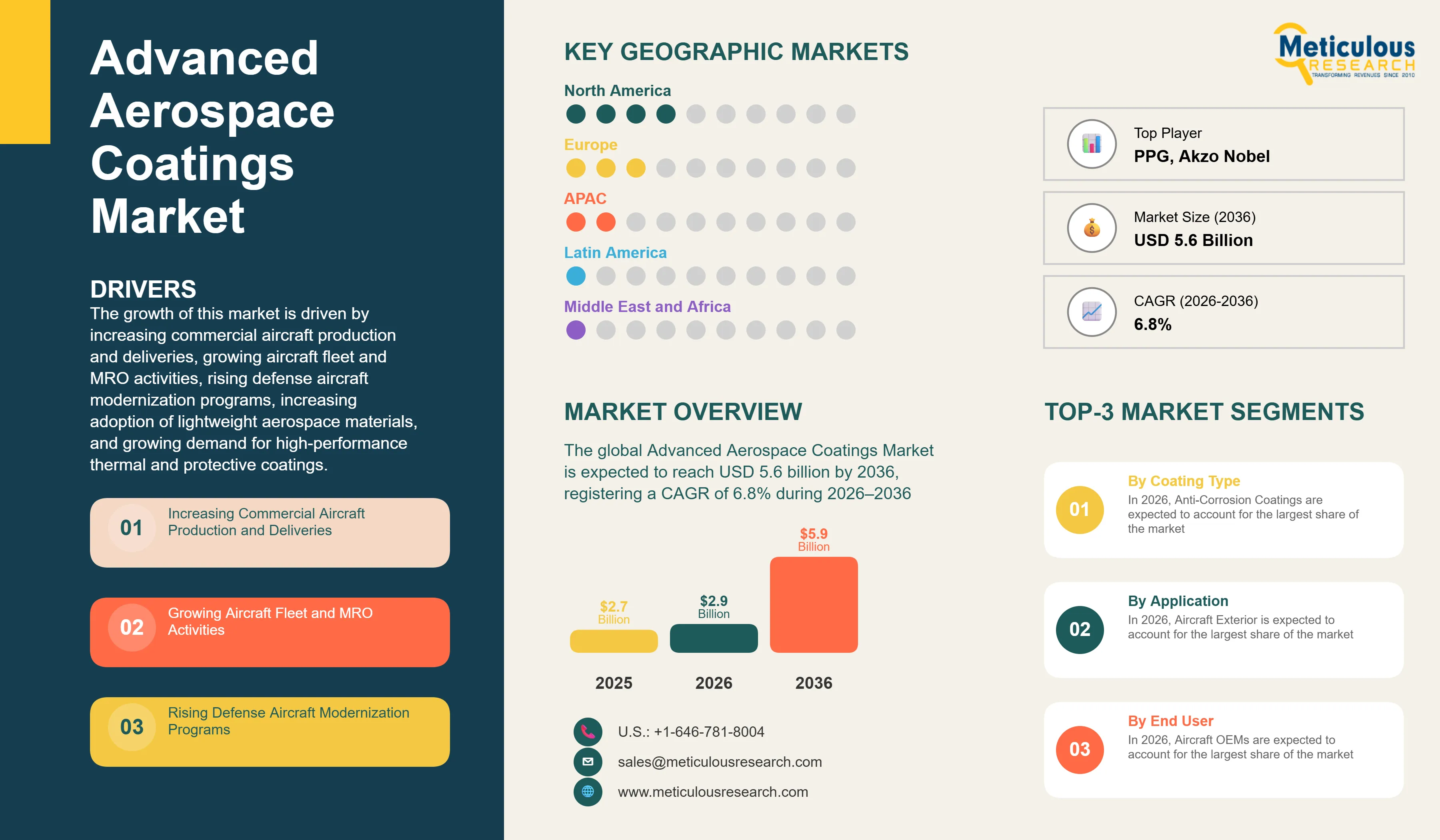
The global Advanced Aerospace Coatings Market was valued at USD 2.7 billion in 2025 and is projected to reach USD 2.9 billion in 2026. The market is expected to reach USD 5.6 billion by 2036, registering a CAGR of 6.8% during the forecast period (2026–2036).
- Published
- Aug 2026
- Pages
- 295
- Format
- PDF + Excel
- Report ID
- MR-2139
- Base year
- 2025
- 2025 · BASELINE
- $2.70B
- 2036
- $5.60B
- CAGR 2026–2036
- 6.8%
2025 baseline · 2026–2036 forecast at 6.8% CAGR · hover a bar for the value
Key highlights
The global Advanced Aerospace Coatings Market is projected to reach USD 5.6 billion by 2036, driven by rising commercial aircraft production and deliveries, expanding MRO activity across an aging global fleet, and increasing defense aircraft modernization programs.
North America is expected to account for the largest market share in 2026, while Asia-Pacific is projected to register the fastest growth during the forecast period.
By coating type, Anti-Corrosion Coatings are expected to account for the largest market share, whereas Functional & Smart Coatings are projected to witness the fastest growth through 2036.
By resin type, Polyurethane is expected to remain the dominant resin technology, owing to its superior UV resistance, gloss retention, and weatherability for exterior aircraft applications.
Aircraft exterior surfaces are typically repainted every 5–7 years, creating a steady, recurring aftermarket demand stream throughout an aircraft's operational life, independent of new aircraft production cycles.
Growing adoption of nanotechnology-enabled and low-VOC, environmentally sustainable coatings is expected to create significant long-term growth opportunities across commercial, military, and space applications.
Report summary
| Particulars | Details |
|---|---|
| Forecast Period | 2026–2036 |
| Base Year | 2025 |
| Estimated Year | 2026 |
| CAGR (Value) | 6.8% |
| Format | PDF, Excel & Cloud Portal · 295 pages |
| Market Size (Value) in 2026 | USD 2.9 Billion |
| Market Size (Value) in 2036 | USD 5.6 Billion |
| Segments Covered | By Coating Type: Anti-Corrosion Coatings, Thermal Barrier Coatings, Erosion-Resistant Coatings, Conductive & EMI Shielding Coatings, Low-Observable & Radar-Absorbing Coatings, Anti-Icing & Ice-Phobic Coatings, Fire-Resistant & Flame-Retardant Coatings, Wear-Resistant & Surface Protection Coatings, Functional & Smart Coatings. · By Resin Type: Epoxy, Polyurethane, Acrylic, Fluoropolymer, Silicone, Polyester, Other Resin Types. · By Technology: Solvent-Based Coatings, Water-Based Coatings, High-Solids Coatings, Powder Coatings, Thermal Spray Coatings, Physical Vapor Deposition (PVD), Chemical Vapor Deposition (CVD), Plasma-Based Coating Technologies, Other Technologies. · By Application: Aircraft Exterior, Aircraft Interior, Aircraft Engines, Landing Gear & Actuation Systems, Aerospace Electronics & Electrical Systems, Spacecraft & Satellites, Launch Vehicles, UAVs & Advanced Air Mobility. · By Aircraft & Aerospace Platform: Commercial Aircraft, Military Aircraft, Helicopters, Unmanned Aerial Vehicles, Business & General Aviation, Spacecraft & Satellites, Launch Vehicles, Advanced Air Mobility & eVTOL Aircraft. · By End User: Aircraft OEMs, Aerospace Tier-I & Tier-II Suppliers, Engine Manufacturers, MRO Providers, Defense Contractors, Spacecraft & Launch Vehicle Manufacturers, Research & Development Organizations. |
| Countries Covered | North America: U.S., Canada. · Europe: Germany, France, U.K., Italy, Spain, Netherlands, Rest of Europe. · Asia-Pacific: China, Japan, India, South Korea, Singapore, Australia, Rest of Asia-Pacific. · Latin America: Brazil, Mexico, Argentina, Rest of Latin America. · Middle East & Africa: UAE, Saudi Arabia, Israel, South Africa, Rest of Middle East & Africa. |
| Key Companies | Akzo Nobel N.V., PPG Industries, Inc., The Sherwin-Williams Company, Axalta Coating Systems Ltd., Henkel AG & Co. KGaA, BASF SE, H.B. Fuller Company, Mankiewicz Gebr. & Co., IHI Ionbond AG, OC Oerlikon Management AG, Zircotec Ltd., AHC Oberflächentechnik GmbH, Praxair Surface Technologies, Inc. (Linde), Saint-Gobain S.A., and Solvay S.A. |
Report overview
Segments covered: coating type, resin type, technology, application, aircraft & aerospace platform, end user.
The Advanced Aerospace Coatings Market comprises specialized protective and functional coating systems applied to aircraft, spacecraft, and launch vehicle surfaces to provide corrosion protection, thermal insulation, erosion resistance, electromagnetic shielding, low-observability, anti-icing, fire resistance, and wear protection. These coatings, formulated using epoxy, polyurethane, acrylic, fluoropolymer, silicone, and polyester resin systems, are applied through solvent-based, water-based, high-solids, powder, thermal spray, and vapor deposition technologies across both original equipment manufacturing (OEM) and maintenance, repair, and overhaul (MRO) channels.
The market is underpinned by two structurally distinct demand drivers: new aircraft production and recurring aftermarket recoating. On the OEM side, Airbus and Boeing ended 2025 with a combined gross commercial aircraft backlog of more than 15,000 aircraft, representing many years of future production and supporting sustained demand for coatings used on new-build aircraft. Airbus reported a backlog of 8,754 commercial aircraft at the end of 2025, while Boeing's commercial backlog exceeded 6,100 aircraft. These substantial order books provide long-term visibility for aerospace coatings suppliers across fuselage, wing, engine, and structural applications.
On the aftermarket side, the expanding global in-service fleet creates a recurring requirement for protective coatings as aircraft undergo scheduled maintenance and exterior refurbishment. According to IATA, global passenger traffic reached a record level in 2025, with total revenue passenger kilometers (RPKs) increasing approximately 5.3% compared with 2024 and exceeding pre-pandemic levels by more than 5%. Higher aircraft utilization increases exposure to UV radiation, moisture, erosion, hydraulic fluids, de-icing chemicals, and other environmental conditions, supporting recurring demand for corrosion-protection, topcoat, primer, and erosion-resistant coating systems.
Aircraft maintenance, repair, and overhaul activity provides a further structural tailwind for the market. IATA estimates that global airline MRO spending reached approximately US$109 billion in 2025, reflecting the expanding installed fleet and increasing maintenance requirements as aircraft utilization remains high. This growing MRO activity supports demand for stripping, surface preparation, primers, topcoats, thermal-protection coatings, and other advanced aerospace coating systems.
Report infographic
Market dynamics
8 factors across 4 forcesIncreasing Commercial Aircraft Production and Deliveries
Sustained order backlogs at Airbus and Boeing are driving continued growth in new aircraft production, directly supporting demand for OEM-applied primers, topcoats, and specialty protective coatings across narrow-body and wide-body aircraft programs. At the end of 2025, Airbus reported a record commercial aircraft backlog of 8,754 aircraft, while Boeing reported more than 6,100 commercial airplanes in its backlog, together representing nearly 15,000 aircraft awaiting delivery. Airbus delivered 793 commercial aircraft in 2025, up 3.5% from 766 in 2024, while Boeing delivered 600 commercial aircraft, its highest annual total since 2018. These production volumes and substantial backlogs provide strong visibility for continued consumption of advanced primers, basecoats, topcoats, corrosion-protection systems, and other specialty coatings used during aircraft manufacturing.
Growing Aircraft Fleet and MRO Activities
As the global commercial aircraft fleet continues to expand and age, recurring maintenance and recoating requirements are rising in parallel. With aircraft typically repainted every 5–7 years and the global aircraft MRO market projected to grow from roughly USD 90.8 billion in 2024 to USD 120.9 billion by 2030, aftermarket coating demand is expected to remain a stable, recurring revenue base for coating manufacturers independent of new aircraft delivery cycles.
Table of contents
14 chapters · 247 sections · 295 pages · click to expandSegmental analysis
| Segment | Largest share (2026) | Fastest growth (2026–2036) |
|---|---|---|
| By Coating Type | Anti-Corrosion Coatings | Functional & Smart Coatings |
| By Resin Type | Polyurethane | Fluoropolymer-based coatings |
| By Technology | Solvent-Based Coatings | Water-Based Coatings |
| By Application | Aircraft Exterior | Spacecraft & Satellites |
| By Aircraft and Aerospace Platform | Commercial Aircraft | Advanced Air Mobility & eVTOL Aircraft |
| By End User | Aircraft OEMs | MRO Providers |
By Coating Type
- Market Analysis by Coating Type (Primary Segmentation)
- Anti-Corrosion Coatings are expected to account for the largest market share, reflecting their essential role in protecting both metallic and composite aircraft structures across OEM and MRO applications.
- However, Functional & Smart Coatings are projected to register the fastest growth during the forecast period, driven by increasing adoption of self-healing, self-cleaning, and sensor-enabled coating systems that support condition-based maintenance strategies.
By Resin Type
- Polyurethane is expected to account for the largest market share, owing to its superior UV resistance, gloss retention, and weatherability, which make it the preferred choice for exterior aircraft topcoats.
- However, Fluoropolymer-based coatings are projected to register the fastest growth, supported by their increasing use in high-performance, long-life exterior finishes and specialty protective applications.
By Technology
- Solvent-Based Coatings are expected to account for the largest market share, reflecting their continued widespread use and proven performance across established aerospace applications.
- However, Water-Based Coatings are projected to register the fastest growth, driven by tightening VOC emissions regulations and growing manufacturer investment in low-emission coating reformulation.
By Application
- Aircraft Exterior is expected to account for the largest market share, supported by both new aircraft production and the recurring 5–7 year exterior repaint cycle across the global in-service fleet.
- However, Spacecraft & Satellites are projected to register the highest CAGR during the forecast period, driven by expanding satellite constellation deployments and growing demand for specialized thermal control and radiation protection coatings.
By Aircraft and Aerospace Platform
- Market Analysis by Aircraft & Aerospace Platform
- Commercial Aircraft are expected to account for the largest market share, underpinned by sustained OEM production backlogs and recurring MRO recoating demand across a large and growing global fleet.
- However, Advanced Air Mobility & eVTOL Aircraft are projected to register the fastest growth, driven by increasing development and early commercialization activity in electric and hybrid-electric aircraft programs.
By End User
- Aircraft OEMs are expected to account for the largest market share, reflecting their role in specifying and applying coatings during initial aircraft manufacturing.
- However, MRO Providers are projected to register the highest CAGR during the forecast period, supported by the global aircraft MRO market's projected growth from approximately USD 90.8 billion in 2024 to USD 120.9 billion by 2030 and the recurring nature of aircraft recoating demand.
Geographic analysis
North America
Largest shareIn 2026, North America is expected to account for the largest share of the global Advanced Aerospace Coatings Market, supported by the region's concentration of leading aircraft, engine, defense, and coatings manufacturers, extensive MRO infrastructure, and substantial defense aircraft modernization spending. Boeing reported a commercial aircraft backlog of approximately US$682 billion at the end of 2025, reflecting the scale of future aircraft production and associated demand for OEM-applied primers, topcoats, corrosion-protection systems, and specialty coatings. The United States also accounted for approximately US$997 billion of global military expenditure in 2025, according to SIPRI, supporting continued investment in military aircraft, aerospace platforms, and associated maintenance and refurbishment activities.
Asia-Pacific
Fastest growthHowever, Asia-Pacific is projected to register the highest CAGR during the forecast period. The region's rapid growth is driven by expanding commercial aviation fleets, growing MRO infrastructure investment, and rising domestic aircraft manufacturing activity in China and India. According to Airbus' 2025 Global Market Forecast, Asia-Pacific is expected to require approximately 20,700 new passenger and freighter aircraft through 2044, representing nearly half of global aircraft deliveries over the period. China alone is projected to require approximately 9,520 new aircraft during the next 20 years, creating substantial long-term demand for OEM coatings, maintenance coatings, corrosion protection, and other advanced aerospace coating technologies. In addition, increasing aircraft utilization and expansion of MRO facilities across India, China, Singapore, and Southeast Asia are expected to strengthen recurring aftermarket demand for aerospace coatings.
Competitive landscape
The global Advanced Aerospace Coatings Market is moderately consolidated, with competition among diversified global coatings manufacturers, specialty aerospace coating formulators, and surface treatment technology providers. Companies compete primarily on coating performance, qualification credentials across aircraft and engine OEM specifications, environmental compliance, application technology capabilities, and global MRO service network coverage.
Leading market participants are investing in low-VOC and water-based coating reformulation, expanding thermal spray and vapor deposition coating capacity for engine components, and developing nanotechnology-enabled and multifunctional coating systems. Strategic partnerships with aircraft OEMs and MRO providers, capacity expansions, and new product qualifications remain key strategies adopted by major vendors to strengthen their position across both OEM and aftermarket coating channels.
The report provides a comprehensive competitive assessment of the leading companies operating in the global Advanced Aerospace Coatings Market. The key players profiled in the report include Akzo Nobel N.V., PPG Industries, Inc., The Sherwin-Williams Company, Axalta Coating Systems Ltd., Henkel AG & Co. KGaA, BASF SE, H.B. Fuller Company, Mankiewicz Gebr. & Co., IHI Ionbond AG, OC Oerlikon Management AG, Zircotec Ltd., AHC Oberflächentechnik GmbH, Praxair Surface Technologies, Inc. (Linde), Saint-Gobain S.A., and Solvay S.A.
- Akzo Nobel N.V.
- PPG Industries, Inc.
- Sherwin-Williams Company
- Axalta Coating Systems Ltd.
- Henkel AG & Co. KGaA
- BASF SE
- H.B. Fuller Company
- Mankiewicz Gebr. & Co.
- IHI Ionbond AG
- OC Oerlikon Management AG
- Zircotec Ltd.
- AHC Oberflächentechnik GmbH
- Praxair Surface Technologies, Inc. · Linde
- Saint-Gobain S.A.
- Solvay S.A
Frequently asked questions
The global Advanced Aerospace Coatings Market is estimated at USD 2.9 billion in 2026.
Cite this report
Meticulous Research. (2026). Advanced Aerospace Coatings Market - Global Opportunity Analysis and Industry Forecast to 2036 (Report No. MR-2139). Meticulous Market Research Pvt. Ltd. https://www.meticulousresearch.com/product/advanced-aerospace-coatings-market-6822