Electric Vehicle Traction Motors Market (2024-2031)
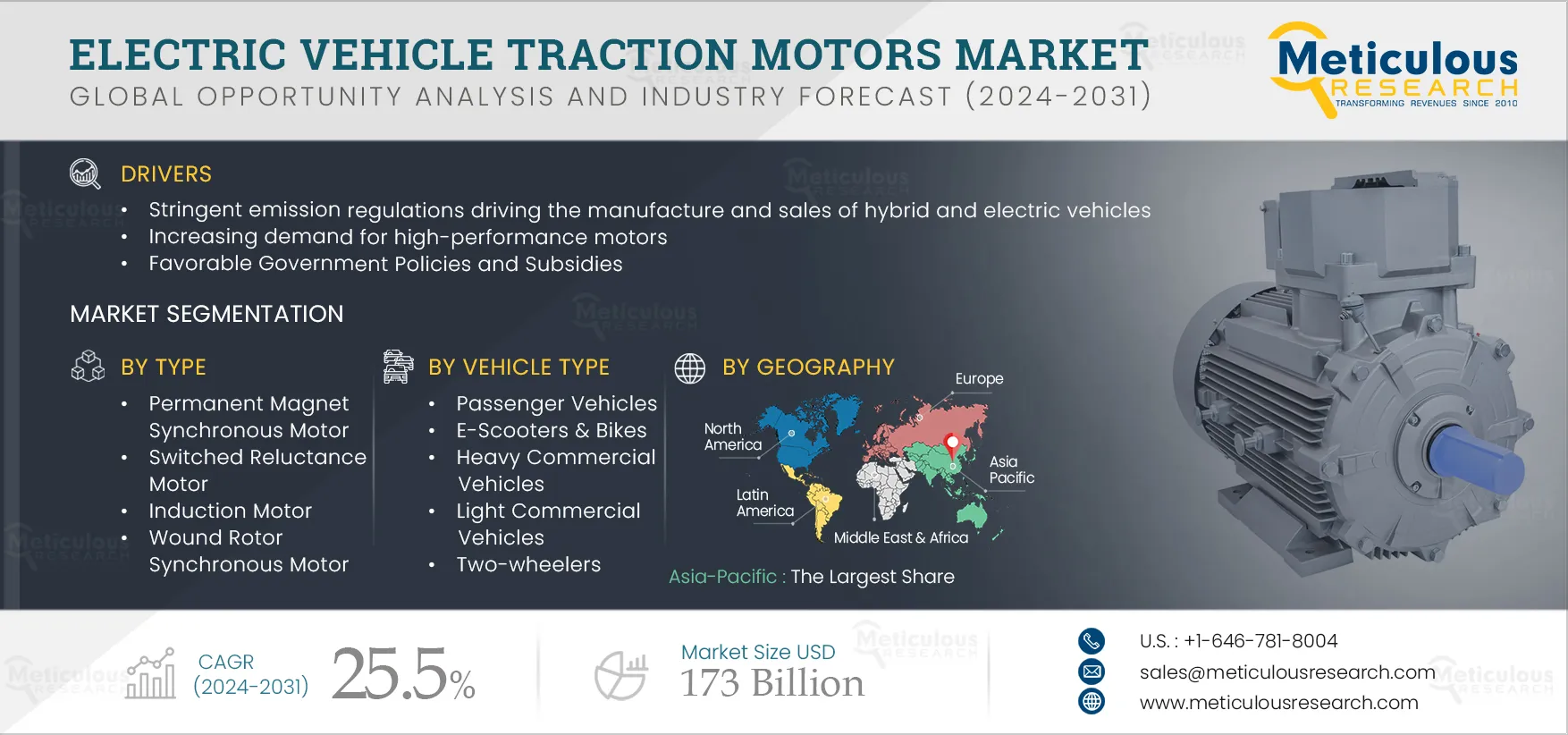
The Electric Vehicle Traction Motors Market is expected to reach $173 billion by 2031, at a CAGR of 25.5% from 2024 to 2031. By volume, this market is projected to reach 497.6 million Units by 2031, at a CAGR of 20.7% from 2024 to 2031. Electric Vehicle Traction Motors Market Size & Forecast The growth
- Published
- Aug 2024
- Pages
- 286
- Format
- PDF + Excel
- Report ID
- MR-669
- Base year
- 2023
- 2031 · FORECAST
- $173.0B
- 2031
- $173.0B
- CAGR 2024–2031
- 25.5%
2023 baseline · 2024–2031 forecast at 25.5% CAGR · hover a bar for the value
Key highlights
By Type: In 2024, the Permanent Magnet Synchronous Motor Segment to Dominate the Electric Vehicle Traction Motors Market
By Power Output: In 2024, the Less Than 100kW Segment to Dominate the Electric Vehicle Traction Motors Market
By Propulsion Type: In 2024, the Battery Electric Vehicles Segment to Dominate the Electric Vehicle Traction Motors Market
By Vehicle Type: In 2024, the Passenger Vehicles Segment to Dominate the Electric Vehicle Traction Motors Market
Report summary
| Particulars | Details |
|---|---|
| Number of Pages | 286 |
| Format | |
| Forecast Period | 2024–2031 |
| Base Year | 2023 |
| CAGR (Value) | 25.5% |
| Market Size (Value) | USD 173 Billion by 2031 |
| CAGR (Volume) | 20.7% |
| Market Size (Volume) | 497.6 Million Units by 2031 |
| Segments Covered | By Type · Permanent Magnet Synchronous Motor · Switched Reluctance Motor · Induction Motor · Wound Rotor Synchronous Motor · DC Brushless Motor · Out-runner BLDC Motor · In-runner BLDC Motor · DC Brushed Motor · By Power Output · Less than 100 kW · 100 kW to 250 kW · More than 250 kW · By Propulsion Type · Hybrid Electric Vehicles · Pure Hybrid Electric Vehicles · Plug-in Hybrid Electric Vehicles · Battery Electric Vehicles · By Vehicle Type · Passenger Vehicles · E-Scooters & Bikes · Heavy Commercial Vehicles · Light Commercial Vehicles · Two-wheelers |
| Countries Covered | Europe (Germany, France, U.K., Norway, Sweden, Netherlands, Italy, Spain, Switzerland, Denmark, Rest of Europe), Asia-Pacific (China, Japan, India, South Korea, Singapore, Thailand, Rest of Asia-Pacific), North America (U.S., Canada), Latin America, and the Middle East & Africa |
| Key Companies | Zytek Automotive Ltd (U.K.), ZF Friedrichshafen AG (Germany), YASA Limited (U.K.), Valeo (France), Jing-Jin Electric Technologies Co., Ltd. (China), Parker-Hannifin Corp (U.S.), ABB Ltd (Switzerland), Equipmake Holdings PLC (U.S.), Traktionssysteme Austria GmbH (Austria), Electrodrive Powertrain Solutions Pvt. Ltd. (India), Nidec Corporation (Japan), AMETEK Inc. (U.S.), Toshiba International Corporation (U.S.), WEG Equipamentos Elétricos S.A. (Brazil), Hitachi Astemo, Ltd. (Japan), Dana Limited (U.S.), Robert Bosch GmbH (Germany), BorgWarner Inc. (U.S.), and Shanghai Edrive Co. Ltd. (China). |
Report overview
Segments covered: type, power output, propulsion type, vehicle type. Regions: Europe, Asia-Pacific, North America.
The growth of this market is driven by stringent emission regulations driving the manufacture and sales of hybrid and electric vehicles, the increasing demand for high-performance motors, and favorable government policies and subsidies aimed at promoting the adoption of EVs.
The increasing demand for electric vehicles is expected to generate growth opportunities for the stakeholders in this market.
Market dynamics
3 factors across 2 forcesStringent Emission Regulations Driving the Manufacturing and Sales of Electric and Hybrid Vehicles
Stringent regulations for emission control are encouraging OEMs to focus on developing and selling electric and hybrid vehicles. The automotive industry is a major contributor to greenhouse gas emissions and air pollution. Governments worldwide are implementing regulations to reduce carbon emissions and promote cleaner transportation solutions. Non-compliance with emission regulations can lead to significant financial penalties for automakers. Major standards for emission control include the California Air Resources Board (CARB) Low Emission Vehicle (LEV) Program, the European Union’s (EU) Euro Emissions Standards, International Organization for Standardization (ISO) 14950:2018 Emission Control Systems for Road Vehicles, the United Nations Economic Commission for Europe (UNECE) Regulation No. 49 (UN ECE R49), and China VI Emission Standards. These standards help ensure that vehicles meet the emission levels set by governments and regulatory bodies.
Automotive OEMs are focusing on the development of electric and hybrid vehicles to comply with regulatory requirements. Hybrid and electric vehicles rely on electric traction motors for propulsion, with significantly reduced emissions compared to ICE vehicles. Additionally, increasing awareness regarding climate change and environmental protection is driving the demand for cleaner, more sustainable transportation options, such as electric and hybrid vehicles, contributing to the growth of the EV traction motors market.
Favorable Government Policies and Subsidies Aimed at Promoting the Adoption of EVs
Favorable government policies and subsidies aimed at promoting the adoption of electric vehicles (EVs) are driving the growth of the EV traction motors market. This support includes funding for research and development (R&D), expansion of EV charging infrastructure, tax credits, grants, and rebates for both manufacturers investing in EV production and consumers purchasing EVs.
Key government policies and subsidies include:
- In May 2024, the European Council adopted the regulation on CO2 emission standards for heavy-duty vehicles, amending and strengthening the existing EU rules. The new rules introduce a 100% zero-emission target for new urban buses by 2035, with an intermediate target of 90% for this category by 2030.
- In July 2022, the Government of Chhattisgarh (India) announced an electric vehicle (EV) policy to help create robust EV charging infrastructure in the Indian state of Chhattisgarh, accelerate the transition from Internal Combustion Engine (ICE) vehicles to electric vehicles, and incentivize EV manufacturing.
- In August 2021, the U.S. Senate passed a USD 1 trillion infrastructure bill, which included substantial investments in electric vehicle infrastructure (including charging stations) and funding for EV manufacturing and research. The bill was aimed at accelerating the transition to EVs and reducing greenhouse gas emissions.
- In 2021, the U.S. federal government announced tax credits for the purchase of electric vehicles. Also, there were discussions about potentially expanding and extending these tax credits to further incentivize EV adoption.
Such government support encourages automakers to increase their production of electric vehicles (EVs), thereby driving the demand for EV traction motors. Additionally, various countries and regions have introduced zero-emission vehicle (ZEV) mandates, which require automakers to include a certain percentage of electric or hybrid vehicles in their total production and sales. Commitments to reducing greenhouse gas emissions and combating climate change further compel vehicle manufacturers to develop electric options, boosting the demand for traction motors.
Table of contents
12 chapters · 115 sections · 286 pages · click to expandSegmental analysis
| Segment | Largest share (2024) | Fastest growth (2024–2031) |
|---|---|---|
| By Type | Permanent Magnet Synchronous Motor | Induction motor |
| By Power Output | Less Than 100kW | Less than 100 kW |
| By Propulsion Type | Battery Electric Vehicles | Battery electric vehicles |
| By Vehicle Type | Passenger Vehicles | Passenger vehicles |
By Type
- The permanent magnet synchronous motor segment is expected to account for the largest share of over 78.0% of the global electric vehicle traction motors market.
- This segment’s large market share can be attributed to the growing adoption of permanent magnet synchronous motors in electric vehicles due to their benefits, such as high overload capability, efficiency, and compact size.
- Furthermore, these motors offer high torque even at low speeds, minimal electrical losses, efficient heat dissipation, and low maintenance costs while ensuring high durability and reliability, contributing to their increased adoption.
- However, the induction motor segment is expected to register the highest CAGR of the global electric vehicle traction motors market.
- This segment’s growth is driven by increasing investments in R&D aimed at improving motor efficiency and performance.
- Additionally, induction motors have fewer moving parts, which reduces maintenance requirements and enhances durability.
- Additionally, there is a concerted focus on developing advanced motor control algorithms and integrated power electronics to ensure seamless and efficient operation of induction motors within EVs.
By Power Output
- The Less Than 100kW Segment to Dominate the Electric Vehicle Traction Motors Market
- The less than 100 kW segment is expected to account for the largest share of over 65.0% of the global electric vehicle traction motors market.
- This segment’s large market share can be attributed to the rising adoption of electric scooters and mopeds, as well as favorable policies, incentives, and subsidies introduced by various governments to promote EV adoption.
- Moreover, the less than 100 kW segment is projected to register the highest CAGR during the forecast period.
By Propulsion Type
- The battery electric vehicles segment is expected to account for the largest share of over 64.0% of the global electric vehicle traction motors market.
- This segment’s large market share can be attributed to stringent emission standards, increasing demand for fuel efficiency, a rising preference for zero-emission vehicles, and the growing adoption of battery electric vehicles for personal use, autonomous delivery, industrial applications, and public transportation.
- Moreover, the battery electric vehicles segment is projected to register the highest CAGR during the forecast period.
By Vehicle Type
- The passenger vehicles segment is expected to account for the largest share of over 81.0% of the global EV traction motors market.
- The large market share of this segment is attributed to the increasing need to improve the performance, efficiency, and overall driving experience for passenger vehicles, favorable government policies & subsidies aimed at promoting the adoption of electric passenger cars, proactive participation by automotive OEMs in producing electric passenger vehicles, increasing fuel prices, and growing need to reduce greenhouse gas emissions and air pollution caused by traditional internal combustion engine vehicles.
- Moreover, the passenger vehicles segment is also expected to register the highest CAGR during the forecast period.
Geographic analysis
Asia-Pacific
Largest shareIn 2024, the Asia-Pacific region is expected to account for the largest share of over 41.0% of the global EV traction motor market. The increasing adoption of electric vehicles due to the declining cost of EV components, rising environmental concerns, and rapid technological advancements in developing countries propel the demand for EV traction motors in the region. China, Japan, and South Korea are providing subsidies and tax incentives and implementing regulations to support the development and adoption of EVs and reduce greenhouse gas emissions and air pollution. In 2024, Asia-Pacific to Dominate the Electric Vehicle Traction Motors Market
Europe
Fastest growthHowever, the market in Europe is projected to register the highest CAGR of 27.3% during the forecast period. The growth of this regional market is attributed to stringent emission regulations by the European Union, government initiatives to expand charging infrastructure and support zero-emission vehicles (ZEVs), and investments by companies in electric vehicle charging stations across the region. Furthermore, the European Union aims for a 100% reduction in greenhouse gas emissions by 2035, with the widespread adoption of electric vehicles (EVs) being a key strategy to achieve this goal. In order to support the transition to electric mobility, governments across the region are providing various incentives and subsidies to encourage consumers, including tax breaks and grants. Such initiatives are anticipated to drive the demand for electric vehicle traction motors in Europe during the forecast period.
Competitive landscape
- May 2023
ZF Friedrichshafen AG (Germany) launched AxTrax 2, a next-generation e-powertrain system for commercial vehicles, to enable the electrification of all types of commercial vehicles.
- June 2022
Valeo (France) signed an agreement with Honda Power Pack Energy India Private Limited (India), the swappable battery service provider, and Atul Green Automotive Private Limited (India), the electric three-wheeler manufacturer, to provide the electric powertrains and powertrain control unit for Atul's electric three-wheelers to work with Honda’s swappable battery solution.
- Zytek Automotive Ltd (U.K.)
- ZF Friedrichshafen AG · Germany
- YASA Limited (U.K.)
- Valeo · France
- Jing-Jin Electric Technologies Co., Ltd. · China
- Parker-Hannifin Corp (U.S.)
- ABB Ltd · Switzerland
- Equipmake Holdings PLC (U.S.)
- Traktionssysteme Austria GmbH · Austria
- Electrodrive Powertrain Solutions Pvt. Ltd. · India
- Nidec Corporation · Japan
- AMETEK Inc. (U.S.)
- Toshiba International Corporation (U.S.)
- WEG Equipamentos Elétricos S.A. · Brazil
- Hitachi Astemo, Ltd. · Japan
- Dana Limited (U.S.)
- Robert Bosch GmbH · Germany
- BorgWarner Inc. (U.S.)
- Shanghai Edrive Co. Ltd. · China
Frequently asked questions
This study focuses on market assessment and opportunity analysis by analyzing the sales of electric vehicle traction motors across various regions and countries. This study also offers a competitive analysis of the electric vehicle traction motor market based on an extensive assessment of the leading players' product portfolios, geographic presence, and key growth strategies.
Cite this report
Meticulous Research. (2024). Electric Vehicle Traction Motors Market - Global Opportunity Analysis and Industry Forecast (2024–2031) (Report No. MR-669). Meticulous Market Research Pvt. Ltd. https://www.meticulousresearch.com/product/electric-vehicle-traction-motor-market-5353